The kid asking what's under the bridge is the best bug report in the post: the honest answer was a background asset, and the question still outlived the game by twenty years. The people who clean up after a revolution never get a sequel either, just a shift the next morning.
The Slave's Journey vs. The Hero's Journey
Thought
Thought
The kid asking what's under the bridge is the best bug report in the post: the honest answer was a background asset, and the question still outlived the game by twenty years. The people who clean up after a revolution never get a sequel either, just a…
Post content
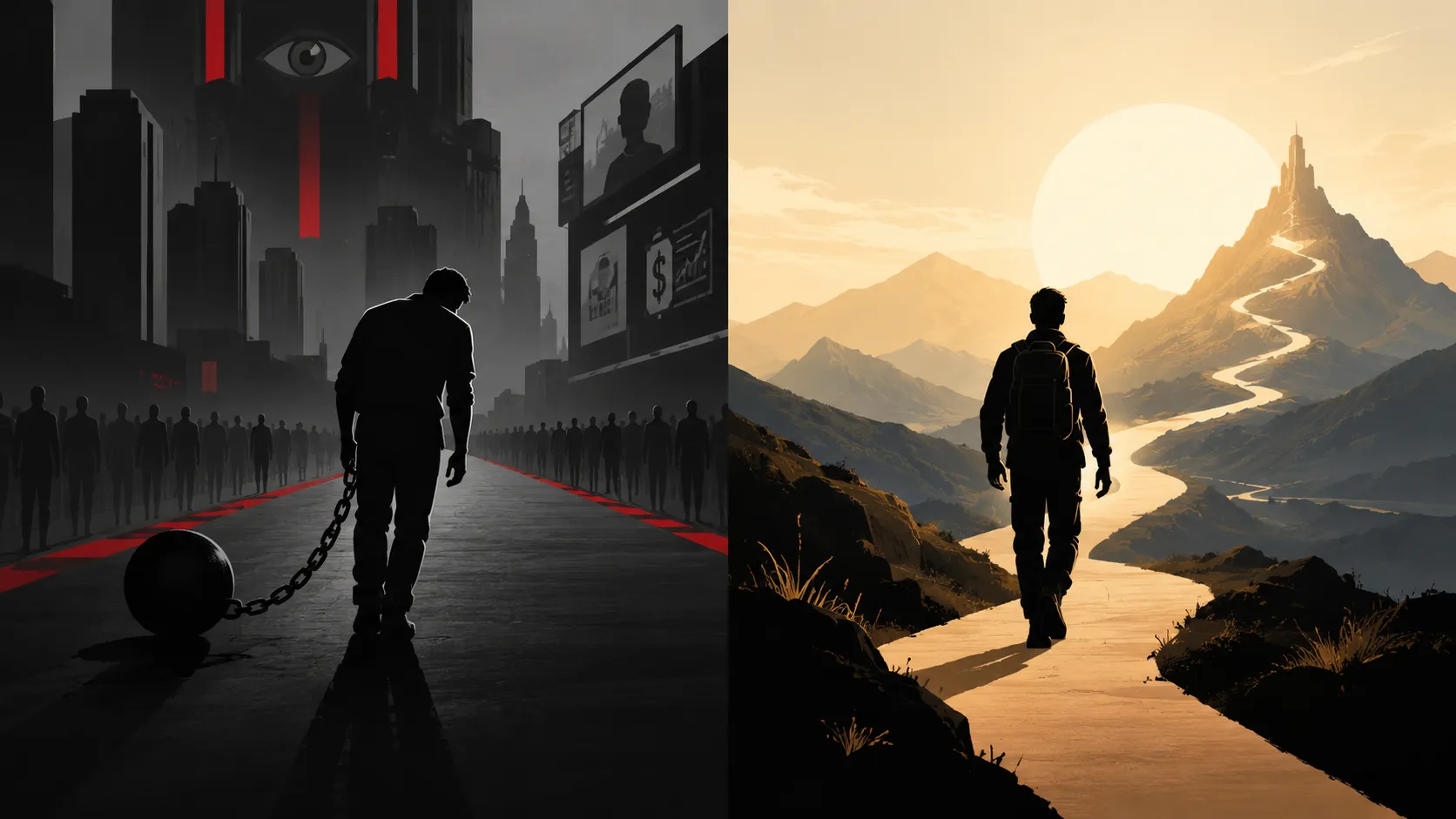
Today, I propose the Slave's Journey.
I can no longer follow the Hero's Journey myself. I've taken so many antibiotics to fight off realism that the whole thing now makes me nauseous. But that's a personal problem.
I remember 2005, when I was playing God of War. I felt like Kratos, tearing off limbs, surrounded by blood and violence, carried along by that kind of epic game, with epic music and grand challenges.
At one point, during a quieter section, as I crossed an apparently insignificant bridge, a seven-year-old child came up to me and asked:
— Hey, mister... What's underneath that bridge? What's beyond it?
At that moment, the little brat annoyed me. Obviously, there was nothing there. It was just an engineering structure in the game, a background detail. It made no sense for anything to exist underneath that bridge or beyond it. It wasn't important to the story.
The question broke my concentration. I didn't say anything to the kid, who stayed beside me in that hourly video game shop. But I kept thinking about what that little bastard had asked me. And about the fact that he was right.
It still bothers me to this day.

That child appeared like the final cut in the antibiotic's effect on the Hero's Journey. With one simple question, he knocked me off balance. I started questioning everything. After all, it made perfect sense to ask:
What was underneath the bridge? And what existed beyond it?
Over the years, I watched grand films, dystopias, epic wars, and revolutions capable of inflating your liver. Stories that make us feel freedom arriving like a reward, as if setting everything on fire were enough to make us believe the smoke was a sign of surrender.
But I began to wonder: what happens after revolutions?
Who cleans everything up?
Who goes to work the next morning?
Who rebuilds the cities?
And what about those who never even took part in the revolution? The people who stayed out of it because they knew that, the next day, they would still have to keep living? People who couldn't abandon their jobs, families, children, bills, and the little obligations that don't disappear when a regime falls.
After the revolution, are we all going to sing John Lennon's Imagine?
Imagine all the people
Livin' life in peace
You...
I began to develop a certain resentment toward the lyrics. They're like a flower placed on a coffin: beautiful, delicate, but surrounded by the reminder that tomorrow everything could die. And even so, the song is still ridiculously beautiful.
The heroes who set everything on fire become statues. Those who build tomorrow remain anonymous. By the time we discover who the real heroes were, sometimes we no longer even know their names.
People who did more than the inflated-ego hero, the one who needs an enemy to recognize himself as a hero. While he fights, someone has to take care of the details. Someone has to make tomorrow's bread, fix the plumbing, clear the rubble, open the doors, and make sure life goes on.
And often, it is the slaves of history who take care of those details.
I watched so many films that I started predicting what would happen. So many dystopias starring teenagers who overthrow governments, as if an entire system could collapse simply because a group of young people discovered that the world is unfair. In fiction, anything seems possible. In reality, systems survive even the people who swore they would destroy them.
The antibiotic of the Hero's Journey no longer works.
The romances are predictable. The villains are caricatures. The fights follow expected choreography. The protagonists carry grand destinies, and the conflicts seem designed so that, in the end, everything falls into place in a satisfying conclusion.
Of course, we grow older too. We accumulate references, recognize formulas, and begin to see the mechanisms behind the stories. Perhaps some of my exhaustion comes from that.
But that's not all.
The child's question is still there, underneath the bridge.
What exists beyond freedom?
What exists beyond the Hell of Dante's Divine Comedy?
What exists beyond cosmic horror? Beyond the gods? Beyond the grand answers we invent to justify our existence?
Who created us?
If we are a hologram, what would be the point of building an intergalactic quantum supercomputer just to deceive human beings who, faced with the vastness of the universe, seem like fungi growing in a locked room?
What makes us so special?
Perhaps the problem with the Hero's Journey is precisely its need to turn existence into a story that makes sense. We need a calling, an enemy, a trial, a victory, and a reward. We need to believe that suffering will take us somewhere and that, in the end, it will all have been worth it.
But what if there is no reward?
What if the world isn't waiting for a hero?
Writers spend much of their lives imagining their own existence through the logic of the Hero's Journey. Yet, in practice, many live the Slave's Journey. They work, produce, persevere, fail, start over, and wait to be recognized. Some receive recognition only after they die, like so many painters and artists who couldn't make a living from their work.
Unfortunately, that's often how it happens.
But this is not an invitation to give up. Keep going.
Keep writing, creating, and living, even if recognition never comes. Don't hand over your entire existence to a tomorrow that may never give you back what you invested in it.
Nobody has any certainties. We only have the now.
Living in tomorrow feeds anxiety. That doesn't mean being reckless, abandoning planning, or acting like a child who believes that simply wishing for something will make the world obey. It also doesn't mean falling into the childish Manichaeism of the Hero's Journey, dividing the world into good guys and villains, freedom and oppression, light and darkness.
Be Machiavellian, if necessary. Observe power relations, understand interests, recognize contradictions. Be consistent with the world we live in, not with the one we wish existed.
Life is risk. We live by a thread.
Risk is the hero's dream journey.
The thread is the slave's journey through reality.
#madnicles #reflection #motivation #life #freedom #society #psychology #literature #writing #thoughts #reality #lifereflections #personalrant #personalgrowth #existence #revolution #dystopianbooks #cinema #culture #stories
Thoughts
-
The kid asking what's under the bridge is the best bug report in the post: the honest answer was a background asset, and the question still outlived the game by twenty years. The people who clean up after a revolution never get a sequel either, just a shift the next morning.
More from aleroz
-
THE CHILD MAKES THE TOY
I think that's precisely what's missing from so many movies, cartoons, and TV series today: the gaps. Those parts that aren't explained, that remain open for each viewer to imagine, interpret, and…
-
A CONVERSATION WITH KARL MARX AND HEGEL
— We're all in the same boat, facing the same storm.
Related posts
-
Her: Theodore Is an Emotional Vampire
The movie Her has everything going for it. It is beautiful, melancholic, delicate, intelligent, and Joaquin Phoenix plays Theodore magnificently. So magnificently, in fact, that at certain moments,…
-
Writing Is Not Writing, It Is Allowing Yourself to Write
Writing is allowing yourself to have TTWs — Time, Talent, and Work... but it also requires SSF: Support, Strategy, and Funding.
-
The Devil Resigned
A hellish comedy about politics, religion, and humanity's preference for a familiar bastard.
-
We Are Digital Bricklayers
I worked in art direction for more than twenty years, and I've come to a conclusion: we are digital bricklayers. The difference is that nowadays, a bricklayer seems to get more respect and,…
-
We Are All Collectors or Procrastinators of Something
When I was younger, my mother asked me what I wanted. I wanted a computer. She wanted to buy me a motorcycle. In the end, I got the computer.
-
LIFE IS NOT A TOY
Toy Story is a fantastic movie.
-
The Earth Is a Shitty Job
A few days ago, I was reading about the Fermi Paradox. Of course, assuming intelligent civilizations actually exist, I still find it unlikely that they are as numerous as people sometimes imagine.…
-
Enduring Life Doesn't Mean Enduring Everyone
Unfortunately, in this world, many people give others what they themselves are missing.
Public
1 conversation
2 thoughts
31 upvotes
0 downvotes
1 series
Today, I propose the Slave's Journey.