I worked in art direction for more than twenty years, and I've come to a conclusion: we are digital bricklayers. The difference is that nowadays, a bricklayer seems to get more respect and, depending on the job, can earn more than an art director. They get meals, formal employment benefits, personal protective equipment, work materials, and usually a more defined schedule. They start at seven or eight in the morning and finish at six in the evening. And best of all: they actually work with materials.
No disrespect to the profession, of course. I'm joking, but only halfway.
An art director has no fixed starting time, let alone a finishing time. They work without proper equipment, reasonable deadlines, and sometimes without even the basic conditions needed to deliver what they're being asked to do. You spend hours creating, developing ideas, studying compositions, colors, and typography. You deliver the work on Thursday, and on Friday, at six in the evening, the account manager shows up with a new list of revisions.
They want the logo bigger. After all, they want to sell, as if increasing the logo's size alone would somehow make customers buy more.
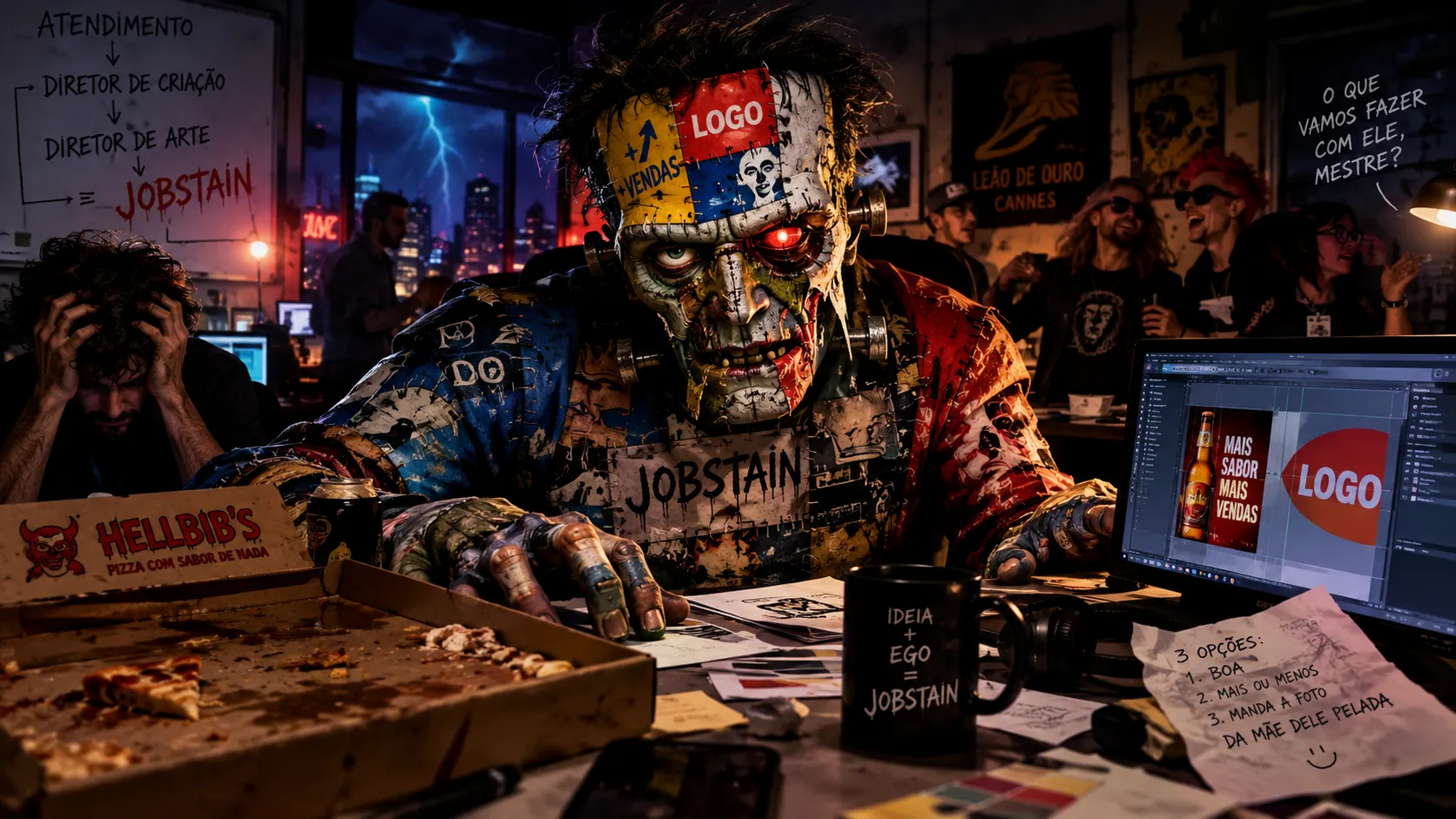
After three rounds of revisions, a hybrid of the two concepts you originally presented emerges. A little bit of one, a little bit of the other, colors from one side, elements from the other. The result? An advertising Frankenstein.
I called it JOBSTAIN: a horrible creature with a demonic voice that appeared on Friday nights, accompanied by a HELLBIB'S pizza. A pizza with so little flavor that you actually had to make an effort to remember it was supposed to be pizza.
And there you were, sitting in front of your computer, trying to bring the creature to life while the entire agency pretended that any of it made sense.
Art direction should be called Ego Direction. Because, quite often, there's more ego than art involved in this business.
You burn through your brain cells for hours, develop some elaborate idea, and present three options. The first is good, the second is so-so, and by the third, you're so exhausted that you consider sending a nude picture of the client's mother just to see if anyone notices that the entire process has lost its meaning.
But you don't. You're a professional.
The creative director asks for three options for peace of mind. Not necessarily because they need three solutions, but because they need to manage their own ego, the account manager's ego, and the client's ego. Everyone wants to feel involved, to have contributed, to have had a brilliant idea. In the end, the art director becomes responsible for turning this gathering of vanity into something visually presentable.
The account manager, meanwhile, promises ridiculous deadlines because the client wants to see the campaign on Saturday morning. You work until the early hours, deliver the material, and then the client doesn't even look at it until the following Wednesday.
Sometimes you leave the office at three in the morning on Saturday.
You no longer feel like an art director. You feel like Frankenstein's assistant.
And the account manager, always ready to carry the master's orders, shows up in that shrill voice:
— What shall we do with him, Master?
It's eleven at night. A lightning bolt strikes outside, the power goes out, and the office is illuminated by emergency lights. The UPS units kick in to keep the computers running. You look at the screen, look at the clock, and calculate how much time you have left before losing everything. Fifteen minutes later, the power comes back.
And you keep working.
Because the client needs to see the campaign on Saturday morning.
Or rather, because someone said they needed to see it.
After so many years, I realized that working in advertising isn't just about working with art. In many agencies, it means managing a chain of egos. The account manager pressures the creative director, the creative director pressures the creative team, the creative team pressures the art director, and the art director is expected to be proactive, creative, agile, resilient, available, and preferably capable of performing miracles without complaining.
That whole idea of being proactive can become a toxic expectation in certain environments. You can't simply do your job well. You have to anticipate problems nobody foresaw, fix failures nobody took responsibility for, and still show enthusiasm while doing it all.
And there are people who behave as if working at an advertising agency meant being part of a rock band on the verge of conquering the world. They want a Cannes Gold Lion, they want to be different, they want to look like misunderstood geniuses. They show up wearing obscure designer brands, sunglasses, black nail polish, and a hairstyle that looks like a dead cat sitting on top of their heads.
Of course, there are talented professionals, serious people, and people who genuinely love advertising. I'm talking about the caricature that emerges when vanity starts to matter more than the work itself.
HR deserves a chapter of its own, too. In some companies, it feels like a corporate gossip hotline: they know everyone's business, keep track of every conflict, and then show up talking about motivation, team spirit, and quality of life.
It's practically a nuclear power plant of emotional problems, with a motivational seminar at the entrance and a mental health poster on the wall.
A sort of corporate Chernobyl, except with terrible coffee and an employee satisfaction survey.
After more than twenty years in this world, I've started thinking that maybe I don't want to pay that price anymore. Not because I've stopped loving art, but because I'm tired of burning through my brain cells trying to satisfy people who confuse control with competence and opinions with solutions.
Today, I'd rather be a waiter.
And I say that with no disrespect to the profession. I'm talking about freelance work, where you show up, serve tables, chat with people, tell a joke, and suddenly someone calls you Doctor, General, my drafted man, or my business partner at Banco Master.
You play along, manage an ego or two, keep smiling, and carry on working. Depending on the establishment, you work six to eight hours per shift, three times a week. There's the 10% service charge, tips, and in some cases, pay that can exceed what an art director earns for an entire month of work.
Meanwhile, the art director has to issue invoices, pay taxes — including the 6% DAS tax, depending on their tax classification in Brazil —, cover their own equipment costs, keep their software up to date, and still listen to someone say the logo needs to be bigger.
It's a comparison worth making.
Creative professionals don't just sell the time they spend sitting in front of a computer. They sell experience, knowledge, creative references, problem-solving skills, and years of accumulated expertise. But when the market treats all of that as if it were simply clicking buttons and dragging elements around a screen, it shouldn't be surprising that some people start looking for other paths.
Perhaps I'd rather burn calories standing up than burn brain cells doing something that has stopped being enjoyable.
Because there's an enormous difference between tiring out your body and exhausting your mind. The body rests. The mind, sometimes, keeps working long after you've shut down the computer.
And I still want to write my books, create my stories, and develop my own ideas. I want to make art without having to convince a committee of egos that a visual decision makes sense.
After twenty years, I've learned a lot about art direction.
The most important lesson was this:
First comes the ego. Then, if there's any time left, comes the art.
We are digital bricklayers. Except that sometimes the bricklayer has better working conditions, more respect for their own schedule, and a more honest relationship with the materials they use.
And honestly, I'm already tired of building castles for people who only want to argue about the size of the door.
I'd rather serve a table, tell a joke, and hear:
— My drafted man! My doctor! My business partner!
At least when someone asks me to make the logo bigger, I can bring them another beer.
#artdirection #advertising #graphicdesign #agencylife #darkhumor #design #creativity #advertisingindustry #freelancer #creativework #ego #humor #freelancelife #advertisingagency #designers #advertisers #marketingdigital #work #rant #wearedigitalbricklayers