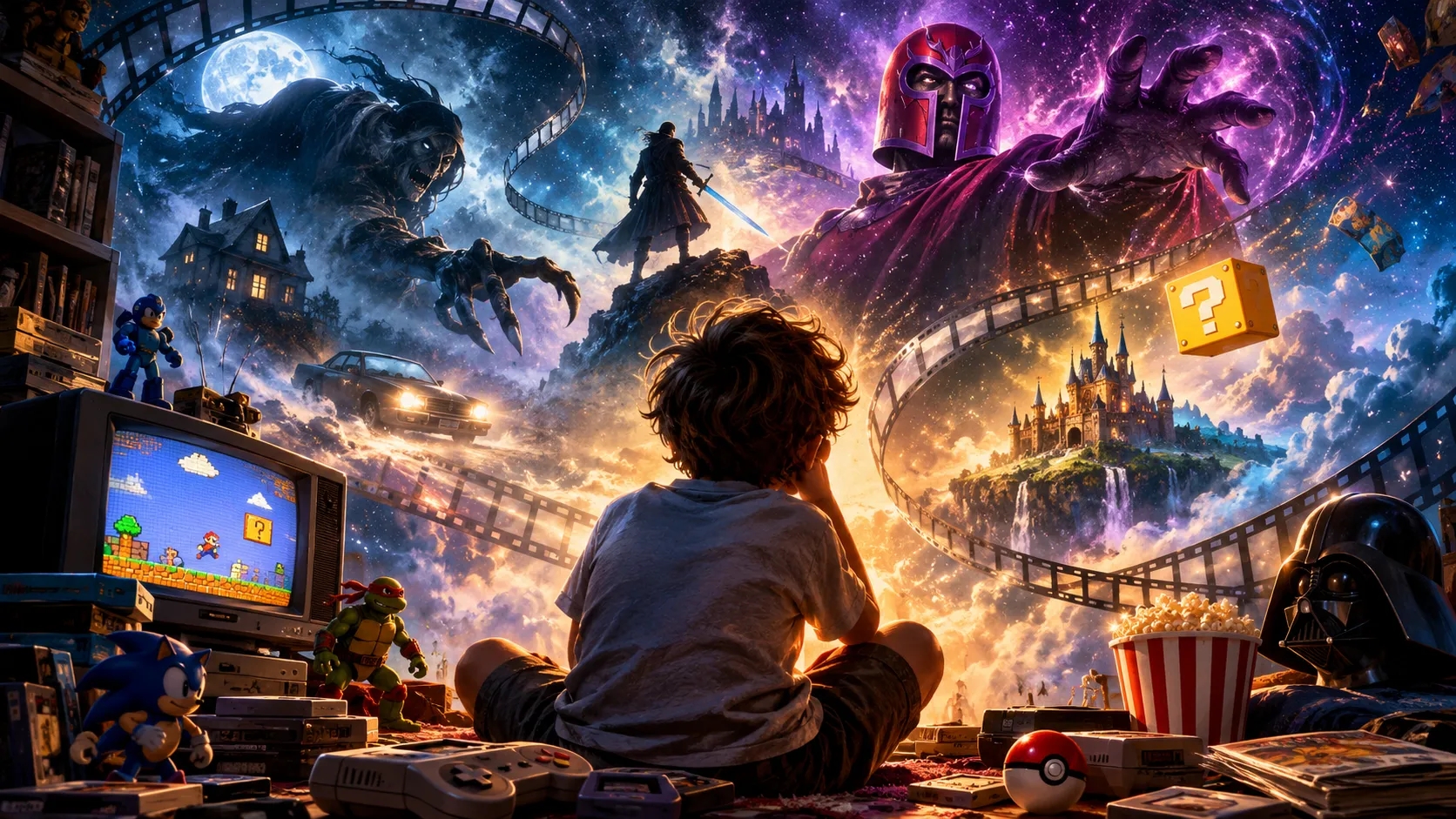
I think that's precisely what's missing from so many movies, cartoons, and TV series today: the gaps. Those parts that aren't explained, that remain open for each viewer to imagine, interpret, and create their own ending. Everyone fills in the blanks in their own way. And in that process, the story stops belonging exclusively to its author and begins to belong to the imagination of those who experience it.
There's a quote attributed to Friedrich Froebel, a nineteenth-century German educator, that captures this idea beautifully: "The child makes the toy."
That's exactly it. A toy doesn't need to come with everything already figured out. The child invents its rules, characters, dangers, and possibilities. Imagination fills in the gaps. And, curiously, the less you explain, the richer, more colorful, and more authentic that universe can become.
Today, many authors seem afraid of leaving any empty space. They domesticate their stories, overexplain, reveal the mechanisms, and provide answers to questions that perhaps never needed to be asked in the first place. They even show us things the audience would have loved to discover on its own. It's like walking into a forest and finding signs pointing out every tree, animal, and pathway. There's nothing left to explore.
The viewer is spoon-fed everything, as though they were incapable of thinking, investigating, or forming their own interpretations. The author seems to feel the need to accompany the audience all the way to the final answer, explaining every behavior, justifying every event, and tying up every loose end. But does every loose end really need to be tied up? Does every question need an answer?
Imagination needs room to play.
Anyone who grew up during the video game era knows exactly what I'm talking about.
Remember Sheng Long, the character who supposedly appeared in Street Fighter II after eight consecutive Perfect victories? What about the secret levels in Super Mario World that no gaming magazine ever revealed? Or the tricks for getting through those seemingly impossible stages in Battletoads in Battlemaniacs?
And what about that legendary X-Men game for the Mega Drive? The one where, to advance, the instruction on the screen simply said: RESET THE COMPUTER. The game was waiting for you to press the reset button on the console itself. Almost nobody knew how to get past that level. And when someone finally figured it out, it felt like discovering a secret that was never supposed to exist. After that, you still had the fight against Magneto.
It wasn't just playing. It was investigating, questioning, talking, exchanging information, testing theories, and making discoveries. Sometimes, a piece of misinformation could fuel months of speculation. A well-told rumor could become just as interesting as the game itself.
The most important thing was that nobody gave everything away. There was mystery, discovery, and room for imagination to do its work. The experience didn't end when we turned off the console. It continued through conversations, theories, attempts, and even dreams. Every player carried a little version of that universe inside them.
Perhaps that's the nostalgia we feel: not necessarily for the graphics, cartoons, or games of that era, but for the feeling that there was an unexplored wilderness waiting in front of us. A place where we could still be curious, investigators, hunters, biologists observing an unknown species. We didn't have all the answers, and that was precisely why we wanted to keep searching.
When Overexplaining Destroys the Magic
Two cinematic examples illustrate this problem particularly well: Jeepers Creepers and Highlander.
The first Jeepers Creepers is phenomenal precisely because we don't know exactly what we're dealing with. The creature seems to belong to a category we don't understand. It's not simply a monster with an origin story, a species, a family tree, and an instruction manual explaining how it works. It's almost an entity. Its presence is threatening because we can't fully comprehend it. We don't know the extent of its abilities, where it came from, or the true scope of its existence.
The unknown works in our favor. Every appearance opens up new possibilities in our imagination. The fear isn't just in what we see, but primarily in what we cannot see.
In the sequels, however, the story begins to domesticate its own mystery. What was once an inexplicable presence starts receiving explanations, mechanisms, and details about how it operates. The creature loses some of that almost supernatural dimension. What was once an enigma begins to look like a subject for scientific study.
Something similar happened with Highlander.
The first film had an atmosphere that was almost impossible to reproduce: it felt like an eighties rock music video transformed into cinema. Music, violence, immortality, melancholy, past, and present blended together into a very particular experience. And there was that monumental line:
There can be only one.
It was simple, direct, and full of possibilities. It didn't need a treatise on the origins of immortals, nor an explanation for every mechanism in that universe. Mystery was part of the work's identity.
The sequels tried to expand, explain, and reorganize something that worked precisely because it didn't need so many explanations. Instead of expanding the magic, they ended up domesticating part of it.
And here's an interesting contradiction: expanding a universe doesn't necessarily mean enriching it. Sometimes, the more information we receive, the smaller it becomes. What once seemed infinite starts fitting inside a set of rules, justifications, and explanations. The universe loses the dimension our imagination had built for it.
Of course, we can reveal the machinery. We can leave clues, suggest rules, and introduce events that raise new questions. But there's an enormous difference between showing how a world works and explaining everything that exists within it.
Don't hand out the instruction manual for a universe the audience is still discovering.
Let the child within us speculate. Let that child imagine how the world works, invent theories, disagree with other people, and even come up with explanations that may never have crossed the author's mind.
It's like learning something new without being handed a ready-made formula. First, we observe, experiment, make mistakes, and create our own connections. Discovery happens inside us. We don't necessarily need someone pointing the way, telling us what to feel, or anticipating what we haven't yet managed to understand.
Think of a story that ends but continues living inside the viewer's mind for days, months, or even years. People discuss theories, disagree about a character's fate, and imagine events that were never shown. Each person creates their own ending. And none of those interpretations necessarily has to be considered wrong.
The author created the territory, but doesn't need to determine every step taken by those who cross it.
Perhaps that's why some gaps make more sense than logic itself. Because logic tries to close off possibilities, while imagination can multiply them. An explanation can end a discussion; a good unanswered question can fuel thousands of them.
We don't need the author to show us every door. Some need to remain closed. Others may never have even been drawn. The viewer also deserves the pleasure of finding a passage nobody pointed out.
Perhaps the real problem with contemporary storytelling isn't a lack of creativity, resources, or complexity, but the fear of leaving the audience alone in front of the unknown. As though a work had to justify its existence every step of the way, rather than trusting the intelligence and curiosity of those experiencing it.
The author doesn't need to own every answer in the universe they've created.
Because the real pleasure isn't just knowing where a story ends, but imagining all the places it could have gone. It's not just about watching, but mentally participating in everything that was never shown.
It's like exploring an untamed, uncharted territory. You don't know what you'll find beyond the next mountain, you don't know every species, and you don't have a complete map. And that's precisely what makes you want to keep walking.
After all, a child doesn't need someone to teach them every possible way to play with a toy. They just need someone to give them the toy.
The author creates the toy. But the audience decides how to play with it.
Not every mystery needs an answer. Some just need to stay alive.
#madnicles #popculture #geekculture #storytelling #narratives #cinemalovers #movies #tvseries #nostalgia #80s #90s #videogames #retrogaming #nerdculture #creativity #imagination #philosophy #art #culture #contentcreators