Why are video games so fascinating?
In them, we become the protagonists of a story, a rebellion, an adventure in which we matter. It's the old Hero's Journey, precisely the one I criticize so much. But I understand why everyone loves it. It's not easy to live out our own ideas within the structures of reality. Sometimes, we need to experience the feeling that our decisions actually change something.
Personally, whenever I see a hero, my stomach turns. I start observing the machinery, the mechanisms that make the story work, the moralism washed clean with blood, fighting, and smoke. I don't trust anyone in that story. And yet, I find myself sympathizing with the villains and feeling enormous admiration for those left beneath the rubble, trying to rebuild their lives, which haven't changed in any way except for the wall that collapsed on top of them.
Of course, I know these characters can also be meaningful in video games. Ever since I was young, I've watched people playing GTA and doing all kinds of crazy things in that world. The worst atrocities were possible. Obviously, it's a representation, and the person would probably never do any of those things in real life. Would they? What would happen if we gave them Superman's powers?
I don't think I'd ever write that story.
Nobody is entirely guilty or entirely innocent. We emerge into this world and choose our paths, often pushed around by nature and the circumstances that brought us here without ever asking our permission. And those same forces will eventually take us away without asking either. Some people carry a hatred of life and of everyone around them, as though somebody had to pay for the simple fact that we exist. Sometimes it's just the need to find someone to blame; other times, it's sheer boredom.
We see this in real life. Just remember that fellow who, in 1938, had his application rejected by an art school and look at what came afterward. The oppressed man's dream can be to become the oppressor.
Of course, I'm exaggerating. But everyone carries a little bit of the Hero's Journey within them. It's like a woman who becomes a mother and suddenly gains a kind of guided-flip-flop XP: she discovers things nobody else can find, locates lost objects, and identifies food that's about to spoil just by smelling it, all while her eyes are burning in the kitchen.
The Hero's Journey within us calls for adventure. It's a desire that comes straight from the liver, while the mind seems to have temporarily shut down. There we are, inside the video game, exploring worlds, fighting enemies, and transforming entire civilizations. We spend hours trying to change a world made of pixels, while the real world remains exactly the same.
After all, we want easy catharsis. Instant noodles with badass storytelling and worldbuilding. Protagonists who have suffered and now want everyone else to suffer too, in the name of revenge, rebellion, or some supposedly righteous cause. We want to put our feet on the necks of our enemies. We just forget that, to them, we might be exactly the same kind of monster.
The game ends, but that world keeps invading our minds. We create fandoms, theories, interpretations, and sometimes hijack the author's own story because we identify more with what we've imagined than with what was actually written.
The author becomes a traitor when they don't think like us. If they refuse to respect our interpretation, they must be sacrificed, canceled, removed from the conversation.
Strange. It sounds as though I'm talking about a man who died on a cross approximately two thousand years ago and asked us to love one another. But a member of his fan club explains:
— But loving your neighbor means they must love the way I love, not any other way. If they don't love according to my understanding of love, then they deserve to be sacrificed.
Well, we're living in modern times. Not that eliminating people has disappeared. Quite the opposite. But I sometimes imagine that fellow returning two thousand years later and discovering that his followers are still arguing over who has the authority to love their neighbor.
I think he'd be crucified all over again. The only difference is that this time everything would be filmed in 4K and broadcast live.
Sounds like Black Mirror.
I don't think he's coming back. People have become such a pain in the ass.
Video games offer us an immersive experience that, paradoxically, can also reveal structures of reality. Perhaps this valley of shadows isn't as dark as we imagine. Perhaps it's precisely the reality we refuse to see. Maybe the valley is only dark at certain hours. After all, the midday sun must shine there too, right?
But being sober all the time gets exhausting. We need something that switches off our sense of reality, lowers our anxiety, and allows us to forget, for a few hours, the machinery that keeps running out there.
After all, I worked hard to buy a video game console, bought a game, and now I'm not allowed to play the damn thing?
Fuck off!
I understand the fascination. When I got my first video game console, I remember actually smelling the box. It was an almost inexplicable experience. I was addicted, played an absurd amount, and eventually started noticing the mechanisms behind it all. I discovered that I enjoyed the story more than the actual gameplay.
It was like realizing that the script for Street Fighter II had been written by a sixth-grader from Class B: the villain killed everyone's father, and now everybody is fighting for revenge.
My last console was the PlayStation 3. I was waiting for God of War III. I liked it, but I was disappointed by the expectations I'd built up after God of War II, which I consider supreme. Shadow of the Colossus was also an extraordinary experience.
Personally, I feel that was where a certain limit between storytelling and gameplay had been reached.
Later, I discovered God of War (2018) and Ragnarök. I thought both were phenomenal. But I realized I enjoyed the story more than the experience of actually playing. I even started watching them on YouTube, specifically searching for "God of War Gameplay No Commentary," because I couldn't stand those commentators making ridiculous jokes just to sound funny.
I cried at the story.
Today, video games are almost like a box of light to me. It's not that they've lost their value, but perhaps my relationship with them has changed. I no longer necessarily need to control the character to become involved in what's being told.
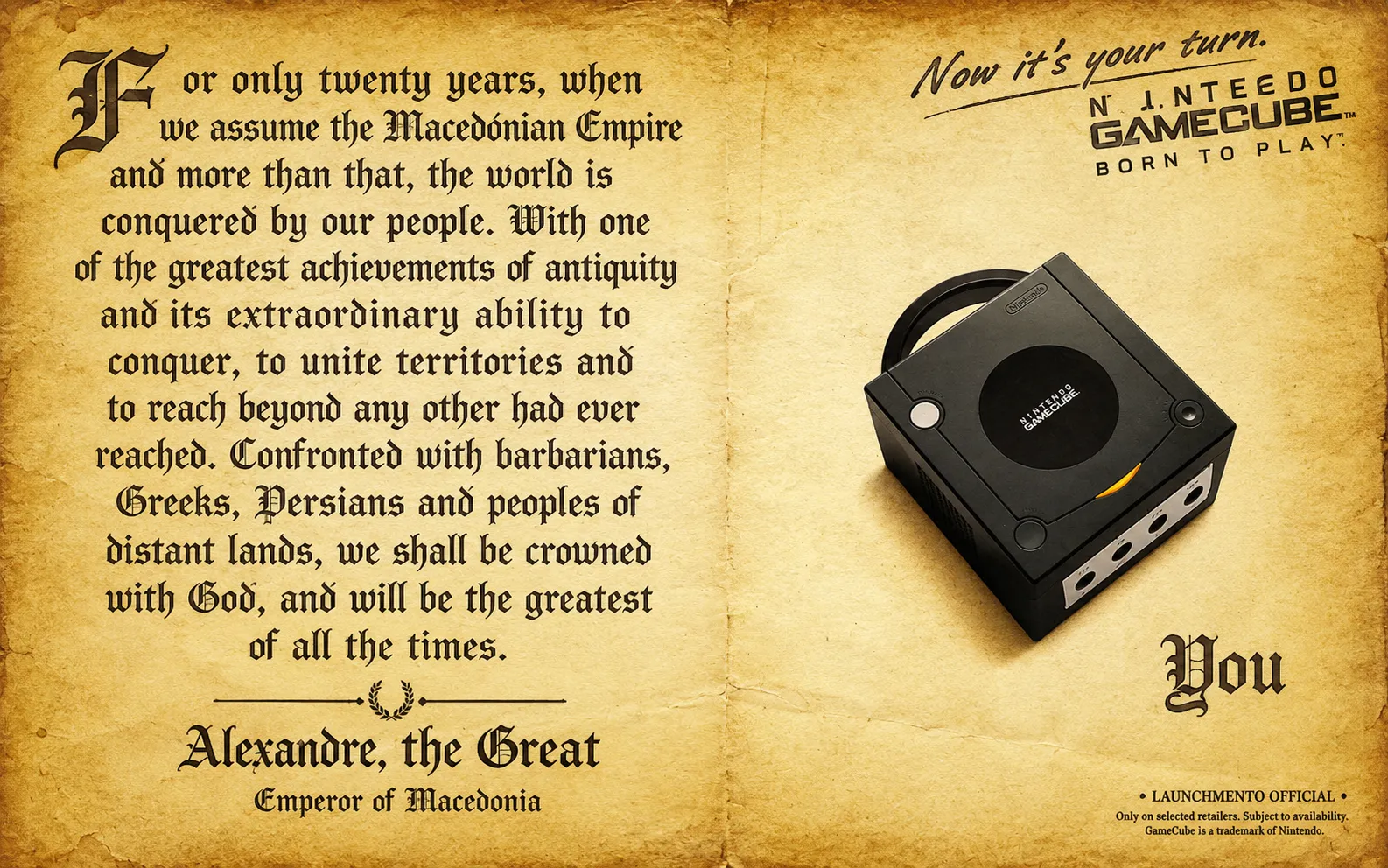
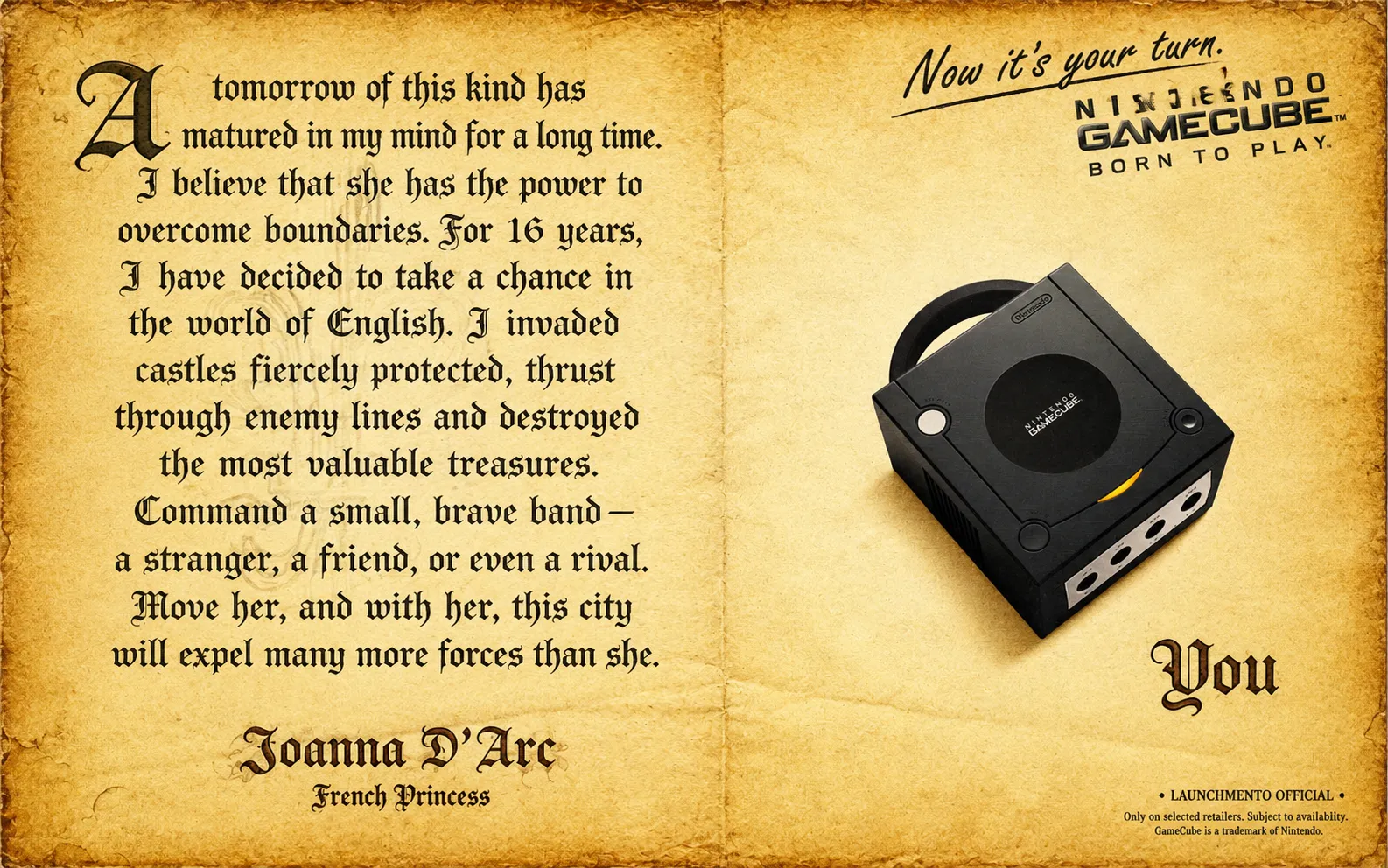
And I remember one of the best video game advertisements I've ever seen.
It wasn't about graphics, incredible characters, or technical demonstrations. It was an all-type advertisement, built entirely around words. It introduced Alexander the Great:
"He was only 20 years old when he assumed control of the Macedonian Empire and later became the world's most celebrated conqueror. With one of the greatest armies of antiquity, and extraordinary skill and courage, he conquered territories and reached places no one else had ever reached. He bravely faced barbarians, Greek legions, Persians, and Egyptian peoples. He was crowned Pharaoh, declared a god, and dreamed of becoming the greatest warrior of all time.
Alexander the Great.
Emperor of Macedonia."Then came the phrase:
Now it's your turn.
Nintendo GameCube.
To me, it was the best video game advertisement I'd ever seen. It said everything about our fascination with games. It wasn't just selling a console. It was selling protagonism.
You could be Alexander the Great. You could conquer territories, face empires, be feared, loved, hated, and recognized. You could destroy oppressive systems in the name of revolution, without necessarily realizing that your own struggle could become oppressive too.
You would be the protagonist. The entire world would revolve around your decisions.
And perhaps that's exactly what we're looking for.
In real life, we find ourselves facing a machine. We aren't necessarily important to it, we don't control its mechanisms, and we can't always change the way it works. So we return to the video game, where everything seems to respond to our desires.
It's a form of anesthesia. A way of temporarily suspending reality and experiencing an existence in which we're capable of doing things that, outside the screen, we might never be able to accomplish.
But there's an irony in all of this: we want to be the heroes of our own stories without realizing that, in someone else's story, we might be the villains.
And what about those left beneath the rubble?
Perhaps the problem was never wanting to be the hero of our own story. The problem is believing that, because of that, everyone else was born to play supporting characters.
In the end, perhaps we don't want to save the world. Perhaps we just want, for a few hours, to feel that it belongs to us.
And then return to reality, put the controller down, and discover that nothing has changed.
But that's okay. There's another level tomorrow.
#videogames #herosjourney #gamingculture #videogamepsychology #philosophy #narratives #protagonism #virtualworld #virtualreality #gta #godofwar #shadowofthecolossus #nintendogamecube #storytelling #popculture #humanbehavior #society #culturalcriticism #blackmirror #madnicles