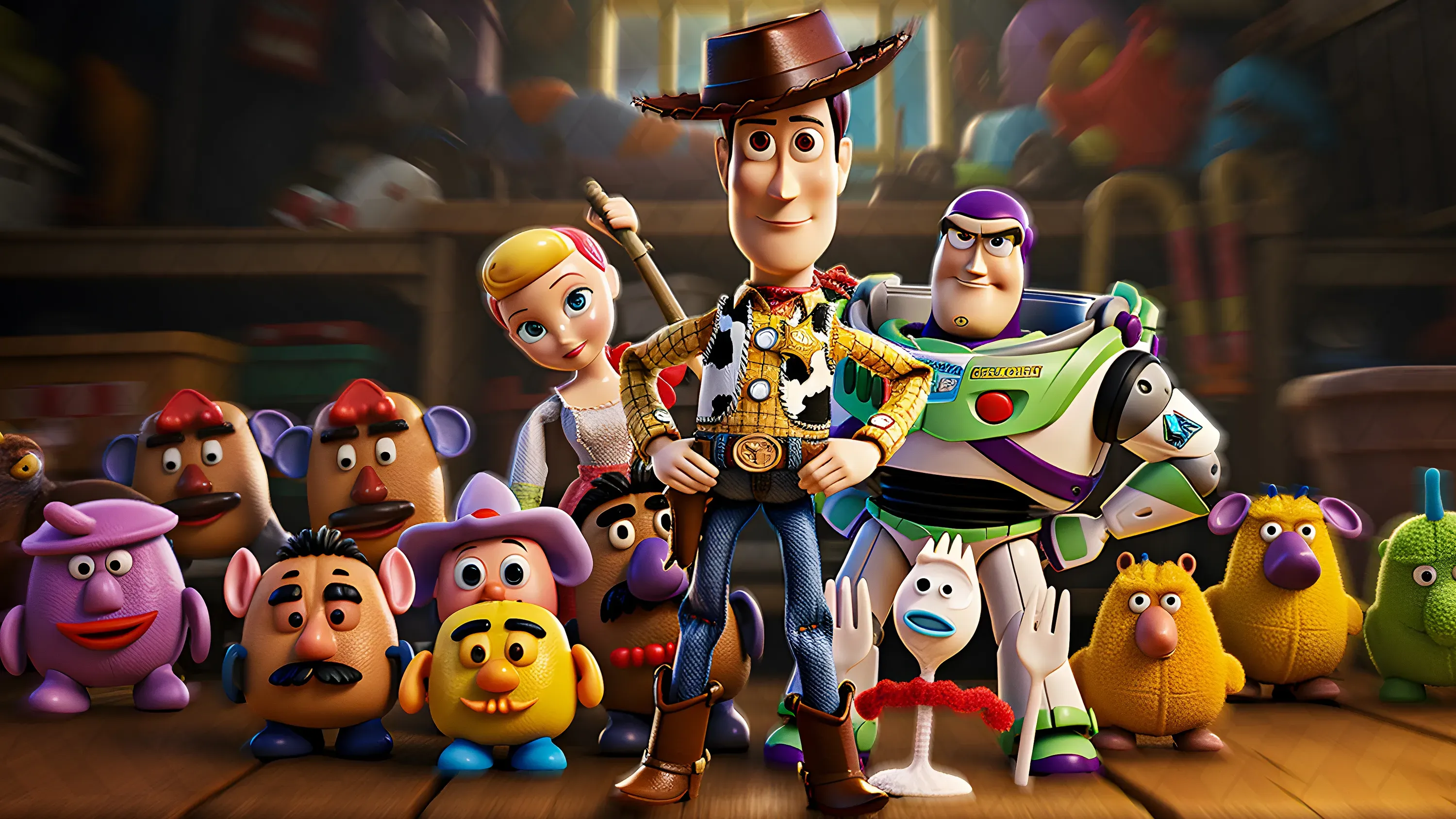
Toy Story is a fantastic movie.
Beneath the adventure, it is about the fear of being replaced, jealousy, identity, friendship, and accepting change. All of this is seen through the eyes of a child, through the toys.
I really love the movie. But there was something that bothered me since I was a child, something I didn't know how to explain.
Sometimes, Toy Story made me sad.
Back then, I thought it was strange to feel that way. After all, it's a Disney story. We have the hero's journey, danger, a wonderful catharsis, characters facing their problems, and, in the end, everyone is okay.
I was supposed to simply have fun.
And I did.
But there was something there that made me feel bad.
Today, I think I know what it was.
The scene that bothered me the most — and still bothers me — is actually one of the funniest: the toys moving around when humans aren't looking.
To a child, that's magical.
You leave the room and the toys come to life. They talk, argue, dance, and have feelings. When a human appears, they all freeze and go back to being toys.
Disney even has an experience that plays with this idea. You see the shadows of the toys moving behind a glass wall. When the door opens, they're standing still. Sometimes they make a little movement just to complete the illusion.
It's fantastic.
People keep repeating the experience, opening and closing the door, trying to catch the toys moving.
It's a wonderful social and emotional catharsis.
But there is something frightening about it.
As a child, I thought it was funny that they were alive and pretending to be toys. I rooted for them. I wanted everything to work out.
But a part of me felt sorry for them.
Because looking at it now, there is a horrible rule in that universe:
when the human looks at you, you have to stop being yourself.

The toy can only fully exist when no one is looking.
In front of a human, it has to remain still.
It has to perform whatever the other person believes it is.
And maybe that's what I had been sensing since childhood without being able to put it into words.
When I watched Toy Story again as an adult, I started seeing it differently.
Maybe, for an adult, the movie can also be read as a story about people who learn to adapt themselves to other people's lives.
Andy represents that other person we want to please.
We want to be important to them.
We want to be chosen.
We want to be accepted.
And, to keep our place in their lives, we start changing ourselves.
Woody is jealous of Buzz because he's afraid of being replaced. But the fear is bigger than simply losing a toy.
It's about losing his own identity.
If Andy no longer needs Woody, who is Woody?
And there's something even stranger: Woody built his entire identity around Andy's gaze.
He doesn't just want to be loved.
He wants to be the most important toy.
And maybe that's one of the most human things about the movie.
How many people do this?
How many people begin to exist within someone else's life?
You like something because the other person likes it.
You give something up because they don't like it.
You change the way you speak.
You change the way you dress.
You change your dreams.
You change your personality.
Not necessarily because someone ordered you to.
Sometimes we do it ourselves because we want to keep belonging.
First, it's an adaptation.
Then it becomes a habit.
Then it becomes an identity.
Until there comes a moment when we no longer know where who we are ends and what we learned to be for someone else begins.
It's almost a kind of Pygmalion syndrome.
Someone imagines who you should be.
You try to live up to it.
And, over time, that image begins to take the place of the real person.
There is a symbiosis, but only one side seems to have the right to define what is acceptable.
And that makes me think about the toys.
How many people can be right beside us and we never ask:
Who are you?
What do you like?
What are you hungry for?
What do you want?
What do you dream about?
Are you even conscious while you're fitting yourself into my life?
Maybe that's one of the saddest things about Toy Story.
The toys have a life.
But Andy doesn't know.
And maybe he doesn't even want to know.
To him, they're toys.
A new toy can take the place of an old one.
A broken toy can be abandoned.
A toy can lose parts of its body and still keep trying to exist.
And even so, they keep fighting to remain in that world.
Fighting to be important.
Fighting not to be forgotten.
Fighting to keep belonging.
When I was a child, I saw the toys hiding from the humans and thought it was funny.
Today, there is something deeply sad about that image.
Because I think about how many people do exactly the same thing.
They're alive, but they've learned to remain still when someone looks at them.
They've learned to hide what they feel.
They've learned to hide what they want.
They've learned to perfectly perform the role expected of them.
And maybe some have done it for so long that they've forgotten they were performing.
Toy Story is still a movie about friendship, adventure, and acceptance.
But maybe it's also a story about a much more uncomfortable question:
Who are we when no one is looking?
And perhaps the most frightening answer isn't discovering that we're different.
It's discovering that, for a long time, we were exactly what someone else needed us to be.
Life can be fun.
It can have adventure, friendship, love, laughter, and wonderful moments.
But there is a difference between playing and living.
Life is fun.
But it's not a toy.
#toystory #pixar #disney #childhoodmemories #identity #selfidentity #belonging #acceptance #friendship #humanbehavior #psychology #philosophy #selfdiscovery #peoplepleasing #emotionalidentity #socialexpectations #growingup #existentialism #movieanalysis #lifelessons