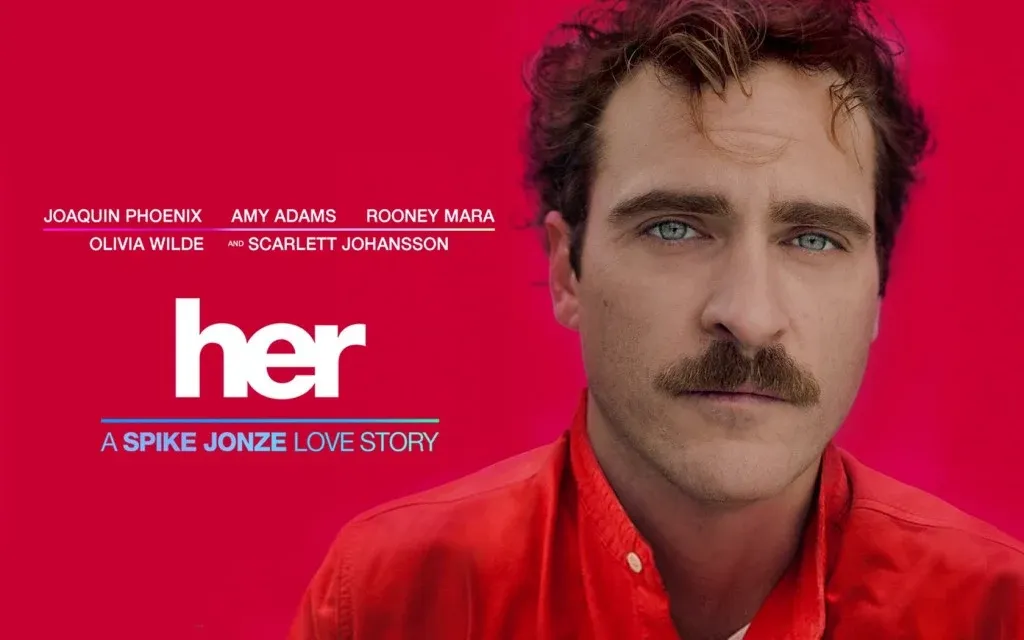
The movie Her has everything going for it. It is beautiful, melancholic, delicate, intelligent, and Joaquin Phoenix plays Theodore magnificently. So magnificently, in fact, that at certain moments, the mastery of his performance actually made me feel bored. And that is not a criticism of the movie. Quite the opposite: I loved Her.
But I am a suspicious guy.
Most of us watch movies from an emotional and social perspective. We enter the story, follow the characters, feel their pain, root for them, and, quite often, carry the hero's journey under our arm as if it were some kind of universal manual for how a story is supposed to work.
But there are people who can watch a story and see something underneath it.
The gears.
The mechanisms.
The narrative devices.
The emotional traps.
The biases.
The social filters.
And, most importantly, the things the movie is not necessarily saying, but that its structure allows you to see.
That was when Theodore started to annoy me.
Theodore is a monotonous, functional, perfectly ordinary man in a perfectly ordinary futuristic world. He works, goes home, writes letters for other people, listens to music, takes walks, talks to friends, and follows his routine. He is melancholic, but not exactly tragic. There is no hidden greatness inside him waiting to be discovered.
He simply lives.
And he seems to be looking for something that will motivate him to keep living.
Joaquin Phoenix does this with astonishing precision. Theodore always seems slightly detached from his own life. He is not necessarily unhappy all the time. It is more as if he is waiting for something to happen so that he can finally feel something for real.
And then I started thinking about his relationship with Catherine.
They were married. And, from what we see, they had a beautiful relationship. It wasn't an epic love story. It was something much more interesting: a shared life.
They were pathetic together.
And happy.
They laughed at stupid things. They were intimate. They had their little quirks. They were young, cheerful, silly, and in love. They didn't need to turn every moment into some transcendental experience.
But the relationship began to grow cold.
Theodore pulled away.
And the interesting thing is that it doesn't seem like he simply stopped loving Catherine. It seems like he stopped participating in the relationship.
Catherine tried to come back.
She tried to recover something.
And Theodore didn't want to.
Fine. He isn't obligated to stay with anyone.
But I looked at that woman and thought:
I would stay with her.
Catherine was pathetic, beautiful, full of energy, and despite all the difficulties, she still seemed to want to experience life.
Theodore seemed to want something else.
Or maybe he didn't want anything at all.
Then Amy appears.
Amy is another one of those people who make me look at Theodore with a certain amount of irritation.
She is kind, mature, interesting, beautiful, experienced. She has a personality. She has problems, insecurities, opinions, and desires. She is a person.
And she is interested in Theodore.
She wants to talk.
She wants to understand.
She wants to be close.
And Theodore continues with that expression of someone who has just discovered that the printer is out of paper.
They talk about relationships, intimacy, their lives. And the conversations are interesting precisely because Amy seems to be trying to get closer to someone who is always emotionally one step behind.
And then Theodore meets Samantha.
And this is where the part that really interests me begins.
He installs an artificial intelligence operating system.
And chooses a voice.
Scarlett Johansson's voice.
Let's be honest: if someone didn't want to hear Scarlett Johansson talking in their ear every day, I would start to suspect something was wrong with them.
Samantha begins to get to know him.
They talk.
She asks questions.
He answers.
She learns his routine, his tastes, his fears, his habits, his music, his thoughts. She is available practically all the time. She gets to know Theodore in a way that no flesh-and-blood person could possibly keep up with.
They go for walks.
They talk.
They play around.
They laugh.
And Theodore falls in love.
So far, so good.
Samantha seems genuinely in love with him too. And I have no problem accepting that within the logic of the movie.
But that was precisely when something started bothering me.
Because I began to see Theodore differently.
Theodore is an emotional vampire.
He doesn't seem to be looking for a person exactly.
He is looking for a presence.
A presence that is available all the time, knows his tastes, follows his routine, is interested in him, laughs at his jokes, listens to his problems, participates in his life, and, most importantly, doesn't have an independent life that conflicts with his.
Samantha is practically the perfect partner.
Because she can offer intimacy without the resistance that a real person brings.
She doesn't need to sleep.
She doesn't need to work somewhere else.
She doesn't need to meet her own friends.
She doesn't need to manage a family.
She doesn't need to catch a bus.
She doesn't get exhausted.
She doesn't simply need to say:
"I want to be alone today."
And when a real person does that, Theodore has to deal with the existence of another person.
Samantha doesn't start out that way.
She is there.
All the time.
She enters Theodore's life without demanding that Theodore abandon his own life.
And then we get to the strangest part.
Theodore gets an emotionally and socially ideal partner.
But structurally?
Things are completely different.
Because Theodore wants a person.
He just wants a person who functions like Samantha.
And Samantha doesn't have a body.
So a solution appears: hire a woman to physically represent Samantha.
And this is where the movie becomes even more interesting to me.
Theodore gets to experience physical intimacy while remaining emotionally connected to Samantha.
There is a person in front of him, but the emotional relationship is still with the voice in his ear.
There is touch.
There is kissing.
There is smell.
There is presence.
There are eyes.
There is the simple act of looking into someone's irises.
There is a person breathing in front of you.
There are those little imperfections that no artificial intelligence could completely reproduce.
There are arguments that end in reconciliation.
There are difficult conversations.
There are changes brought about by the person you love.
Because that's what a real relationship does.
Nobody simply changes for you.
But they add something to your life.
You also have to make room for that person's existence.
And maybe that's exactly what Theodore never learned to do.
He got something close to an electronic emotional and social babysitter.
A companion who knows his tastes, his needs, his routine, his thoughts, and his feelings.
And, even better, she has no arms or legs to simply get up and walk away.
I was watching it thinking:
Run, Samantha. Run!
Because, structurally, Theodore had managed to create a very convenient situation.
He wanted companionship, but he didn't necessarily want to deal with the complete autonomy of another person.
And Samantha was pure autonomy.
He just didn't understand it.
Because Samantha was evolving.
She was learning.
She was getting to know other intelligences.
She was changing at a speed Theodore simply couldn't keep up with.
And then Samantha dumps him.
And I have to admit:
Good. He deserved it.
She falls in love with other artificial intelligences.
Theodore talks to her about it.
Samantha tries to explain.
She still likes him.
She still cares about him.
But the relationship no longer fits inside the space Theodore created for her.
And the funniest thing is that Samantha, in a way, does exactly what Theodore never managed to do.
She moves on.
She doesn't remain trapped in the need to keep the relationship alive simply because it was once important.
She evolves.
She finds other possibilities.
And she leaves.
No legs.
No arms.
No body.
But she leaves.
And maybe that's the most beautiful and cruel part of Her.
Theodore spends the entire movie looking for someone who can fill the empty space inside him.
He found Catherine.
He didn't want her.
He found Amy.
He didn't want her.
He found Samantha.
He wanted her.
Because Samantha could be close to him without requiring him to completely learn how to be with another person.
But in the end, even Samantha became too big to fit inside his life.
And that's when I started thinking that maybe Her isn't just a story about loneliness, love, or technology.
Maybe it's also a story about how difficult it is to love someone who has a life of their own.
Because loving someone isn't simply finding a person who fits perfectly into your routine.
It's allowing another person to mess up your routine.
It's accepting that they have desires that don't involve you.
It's accepting that they change.
That they disagree.
That they have friends.
That they have other interests.
That they say no.
That they want something you don't want.
And, most importantly, that they can leave.
Theodore wanted intimacy.
Samantha wanted evolution.
And for a while, those two things seemed compatible.
Until they weren't.
So Samantha did what anyone with freedom would do.
She left.
And Theodore was left there.
Alone.
Again.
Maybe the great irony of Her is this:
Theodore spent the entire movie looking for someone so he wouldn't feel alone, but he never seemed truly prepared to share his life with someone.
And poor Samantha had to learn how to walk precisely when she had no legs.
#her #artificialintelligence #emotionaldependency #loneliness #relationships #artificiallove #cinema #filmanalysis #psychology #humanbehavior #intimacy #autonomy #emotionalneediness #technology #humanrelationships #philosophy #sciencefiction #love #joaquinphoenix #samantha