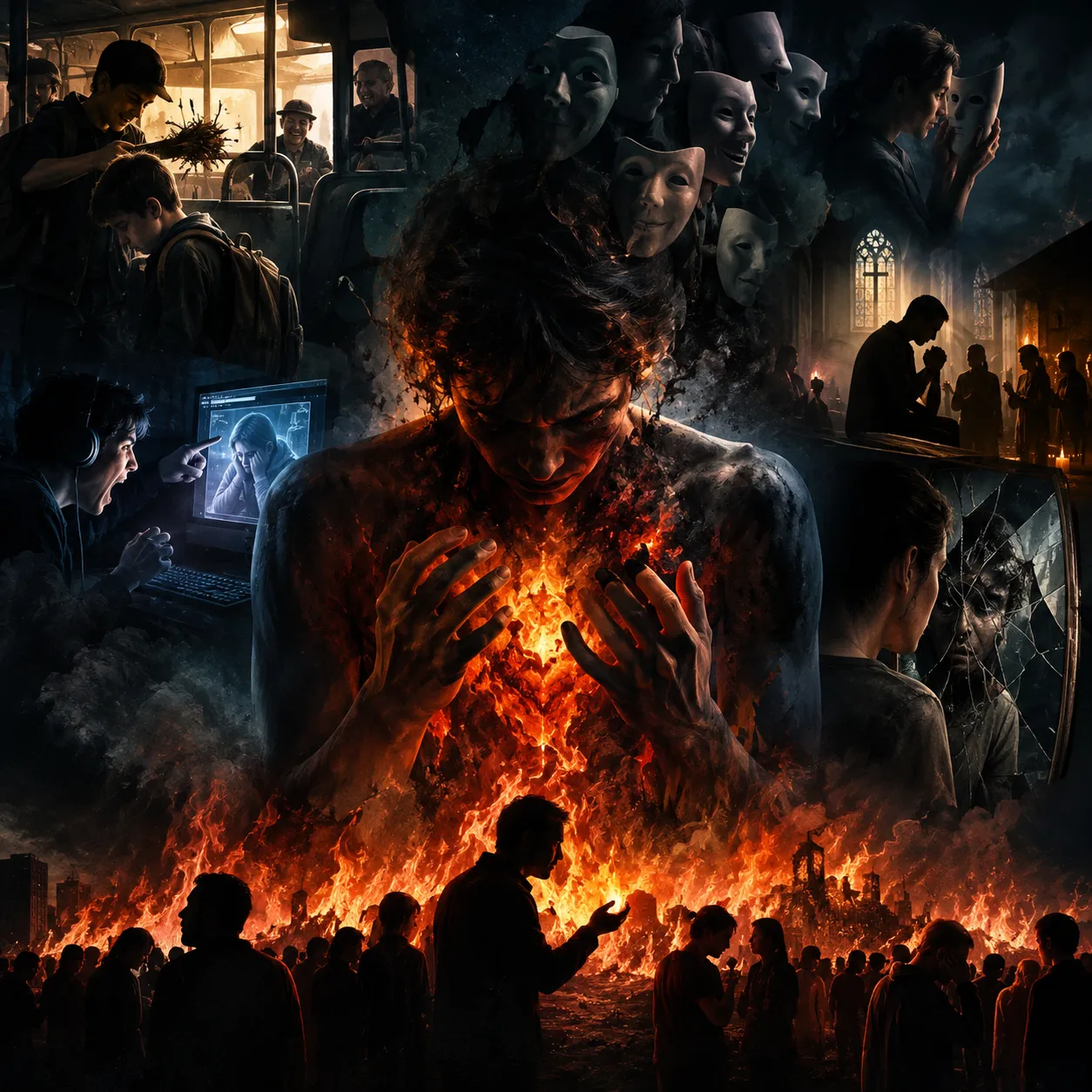
People do terrible things. Some know exactly what they are doing. Others do not. And perhaps the latter are the hardest to understand, because they can hurt, destroy, humiliate, and even ruin their own lives without ever fully recognizing their own part in it. They carry on, repeat themselves, justify themselves. Sometimes they even kneel, pray, ask God for forgiveness, and perform their rituals, only to return the next day and do exactly the same things. As though conscience could be washed clean without the hands ever having to stop getting dirty.
Why?
I remember being a child and taking the bus home from school. At the same time every day, at the same stop, there was a boy who got on without paying the fare. He could have slipped under the turnstile, but there was something else he seemed to enjoy more. He would gather a bunch of burrs and use them as whips, striking the boys who boarded the bus. No mercy, no pity. The driver and the fare collector thought it was funny. They laughed while we were being whipped.
I was one of the boys he hit.
I felt immense hatred for that boy. Some days, I stopped taking the bus he was on. He knew me by sight, and when I didn't get on, he laughed with a kind of pleasure that felt like a victory to me. The driver and the fare collector kept smiling. I waited for another bus.
That was it. To them, it was a joke. To me, it was humiliation I had to escape by changing my route home.
Weeks later, I heard that the boy had moved to another state. His family was extremely violent. His mother had died, his father beat him and was always drunk. Sometimes, the boy sniffed glue.
That information did not erase what had happened to me. But it added something to the memory.
That boy was beaten, too. Perhaps he had learned at home that force was what determined who suffered and who made others suffer. Perhaps, when he held those burrs, he experienced a kind of power he could not find anywhere else in his life. At home, he might have been the powerless boy. On the bus, he could choose who would be afraid.
I don't know if that was how it was. I never knew what went on inside him.
But there is something terrible about that possibility: that someone who knows pain from the inside might discover that they can inflict it on others, too, and begin to take pleasure in it.
The victim ceases to be only a victim. They also become the agent of a violence they know all too well.
And in that moment, the pain does not disappear. It simply changes address.
What troubles me most, however, is not only the existence of people who knowingly do cruel things. It is the number of people who seem not to notice the suffering they cause, even when it is right before their eyes. People who think it is funny as long as no one reacts, who call cruelty a joke, humiliation honesty, and cowardice a strong personality.
When someone complains, the response is often even worse: the offended person is too sensitive, can't take a joke, can't handle the truth, has no sense of humor. The aggressor turns the pain they caused into a flaw in the person who felt it.
It is an ingenious way to escape oneself.
A person does not need to deny what they did. They only need to deny that it matters. They do not need to erase the aggression, only diminish the victim. They do not need to prove they are innocent, only convince themselves that the other person deserved it.
And so they can go on living without facing their own reflection.
Perhaps the most dangerous thing is not the inability to distinguish right from wrong, but the ability to recognize the difference and still build justifications for never having to act accordingly.
I witnessed another situation that made me think about this.
I was at a friend's house. He was playing a video game and, through his headset, violently insulting his opponent. The other player was cheating, which was quite obvious. My friend hated people who did that. He said people like that deserved to die. But he did not stop at complaining about the game: he began attacking the guy's personal life, saying his father beat him, his family despised him, nobody liked him, and he was worthless.
On the other end, the player began to cry.
He apologized. He said his life really was like that. His father beat him, his mother despised him, and he genuinely believed he was worthless.
My friend stopped playing.
He began offering advice, apologized, and tried to make amends for what he had done. The atmosphere became painfully awkward.
What happened in that moment?
Until then, there had been an opponent. A cheater. A guy who, in my friend's mind, deserved to be punished. Someone who existed only as an annoying presence on the other side of the screen.
Suddenly, that presence answered with real pain.
My friend had used as an insult precisely the wound the other person carried. Without knowing it, he had turned someone's suffering into ammunition for his own indignation.
Perhaps it was the first time in that match that he managed to see his opponent as a whole person, rather than an obstacle that needed to be destroyed.
Cruelty became unbearable when it stopped being abstract.
And that makes me wonder how many people can recognize another person's humanity only when they are forced to look directly at it. As long as the pain remains distant, it is easy to joke, insult, despise, and wish someone dead. As long as there is no face, trembling voice, or tears, suffering can be treated as a concept, a weakness, or a deserved punishment.
But the other person existed long before they began to cry.
Their humanity did not begin when my friend was moved. What began was my friend's awareness.
This is where I remember a line from Parable of the Sower, by Octavia Butler:
“People do fires because they're frustrated, angry, hopeless. They don't have the power to improve their lives, but they have the power to make other people even more miserable... and the only way to prove to themselves that they have power is to use it.”
There is something deeply disturbing about this idea.
A person may be unable to change their own life, but they can ruin someone else's. They may be unable to earn respect, but they can inspire fear. They may find no way out of their own misery, yet find a way to drag someone else into it.
They cannot build, so they destroy. They cannot feel important, so they diminish someone. They cannot stop their own suffering, so they spread suffering as though handing others a bill they never asked to pay.
For a few moments, it works.
The person feels they have done something. They got a reaction. They made someone lose their temper. They made someone cry. They imposed their presence. They caused something to happen.
And for someone who feels powerless, even the ability to destroy can seem like a form of freedom.
But what kind of power depends on making another person's life worse so that one's own existence feels bearable?
What kind of victory requires turning someone into a victim so that someone else can feel like a winner?
The fire solves nothing. It only illuminates, for a few seconds, the feeling that it is still possible to do something. Then everything keeps burning.
And the person goes looking for something else to set on fire.
The most frightening part is that they may not even notice the repetition. They do not necessarily think, “I'm suffering, and I want others to suffer with me.” They may think everyone is an idiot, nobody is any good, the world is unjust, people get what they deserve. They can construct an explanation for every act of aggression and find a different justification for every victim.
That is how someone can spend an entire life spreading what they cannot bear inside themselves without recognizing that they are doing it.
Anger becomes an opinion. Resentment becomes a principle. The humiliation they suffered becomes permission to humiliate others. And their own inability to deal with pain is mistaken for insight, strength, or superiority.
They no longer see the fire. They see only those responsible for it.
Some people say all this happens because people are wounded. I believe that often it does. But I do not want to turn every act of cruelty into a secret tragedy, as though every aggressor were merely a victim waiting for someone to discover their story.
Some people do harm out of convenience, self-interest, pleasure, or because they have learned they can get what they want by hurting others. Some know perfectly well what they are doing and simply do not consider other people's suffering important enough to stop.
Not every monster is hiding a wounded child.
And not every wounded child becomes a monster.
Suffering can help explain a person's behavior, but it does not make that behavior inevitable. Someone's history may help us understand how they arrived at a certain place, but it does not oblige us to accept their continuing to drag other people there.
There is a difference between understanding a person and absolving them.
To understand is to try to see the mechanisms that led them to act. To absolve is to declare that those mechanisms eliminate their responsibility.
They do not.
The boy on the bus may have been reproducing the violence he knew. Even so, I was a child who had to change buses to avoid being whipped. My friend may have been unleashing anger that went beyond that match. Even so, his words hurt someone who was already down.
We can recognize the suffering of the person who harms others without erasing the suffering of the person who was harmed.
In fact, if we cannot do both at the same time, we are merely choosing which pain deserves to exist.
I also wonder what happens when these people turn to religion, take part in rituals, ask for forgiveness, and continue behaving in the same way.
Perhaps because ritual is easier than confronting oneself.
It is possible to kneel without deeply repenting. It is possible to confess a mistake without abandoning the behavior that produces it. It is possible to ask for forgiveness while remaining convinced that the blame belongs to others.
A person can learn every word of love and never learn to love anyone beyond themselves.
They can speak of kindness while humiliating those who have no power to fight back. They can defend justice while justifying the injustice that suits them. They can condemn the violence committed by their opponents and find a thousand reasons for the violence committed by their allies.
The problem is not necessarily the absence of values. It is the ability to separate declared values from one's own conduct.
A person believes in goodness, as long as goodness does not require them to give up being right. They believe in forgiveness, as long as they do not have to repair the damage. They believe in justice, as long as they are not required to answer for what they have done.
And perhaps that is what troubles me most: how easily someone can build a moral identity without having to look at the consequences of their actions.
It is possible to spend an entire life trying to be a good person without ever asking whether the people around you feel safe in your presence.
It is possible to sincerely believe you are on the right side and still make someone else's life unbearable.
You cannot ask only what a person believes about themselves. Sometimes you have to ask what happens to others when that person enters a room.
Because there are people who speak of love and spread fear. People who defend freedom and suffocate anyone who disagrees. People who demand respect but know how to offer it only to those who obey them.
And when someone points out the contradiction, they take offense.
Criticism becomes an attack. Consequences become persecution. A boundary set by someone else is treated as an injustice.
The person who hurt someone discovers that they, too, can suffer when confronted with what they did. So they shift the problem again: instead of discussing the wound they caused, they begin discussing the cruelty of the person who dared to point it out.
The mirror becomes the enemy.
Perhaps this is why so many people run from themselves. Not because they have no idea what they have done, but because recognizing what they did would require them to give up something precious: their image of innocence, their position as the victim, their sense of superiority, their need to always be right.
Some people would rather lose a relationship, a friendship, a family, or their own dignity than admit they were wrong. Not necessarily because they do not know they are losing everything, but because, in that moment, accepting responsibility feels like an even greater loss.
And so they carry on. Even when there is no one left to defeat.
It is possible for someone to destroy their own life trying to prove that others are to blame for it.
They can drive away everyone who loves them, lose opportunities, destroy trust, and end up alone, still convinced that the world owes them something. Their life becomes evidence of their unhappiness, but they cannot see that some of that unhappiness was also produced by their own choices.
Not because everything was under their control. Not because every injustice they suffered was imaginary. But because the pain they received does not, by itself, explain everything they went on to do.
There comes a point when the story stops being only about what was done to us and also becomes about what we do with what was done to us.
That moment can be unbearable.
Perhaps that is why some people never reach it.
I prefer to think of these people as human beings who may be trapped in mechanisms they can no longer recognize. Not because I want to pity them. Not because I think they are entitled to my understanding as an obligation. And certainly not because I believe everyone can be saved.
I want to understand because ignorance of one's own cruelty is one of the most dangerous things there is.
Someone who knows they are doing harm can at least be confronted with what they chose to do. Someone who has convinced themselves they never do harm turns every confrontation into proof that others are against them.
No one can force their way into another person's conscience.
We can show them. We can speak. We can set boundaries. We can refuse to take part. But we cannot force someone to recognize what they do not want to see.
Nor should we sacrifice our own lives trying to convince someone else that they are destroying theirs.
I do not want to pity those who hurt me. I do not want to be forced to forgive someone because I know their story. I do not want to turn understanding into yet another debt the victim has to pay.
I only want to understand how we reach this point, where someone can suffer so much that they begin to cause suffering and still fail to recognize their own part in the fire.
Because perhaps some people live in hell without knowing they are there.
They feel the heat, the anger, the frustration, the humiliation of existing in a life they cannot bear. But instead of asking where the flames come from, they look for someone to blame among those nearby.
And when they find someone, they throw on more wood.
Perhaps the person whipping others is trying to forget that they are beaten, too. Perhaps the one who humiliates others desperately needs to believe they are not as insignificant as they feel. Perhaps the one who wishes death on a stranger is trying to silence something they cannot bear to recognize in themselves.
Perhaps.
But the boy being whipped does not stop feeling pain because the other boy is also beaten at home. The player who cries does not suffer less because his opponent was frustrated. And the people who live around someone at war with themselves are not obliged to serve as a battlefield.
One person's hell does not give them the right to set other people's homes on fire.
And here I return to Octavia Butler's line. The power to destroy may be the last thing left to someone who has lost hope of building anything. But that does not turn destruction into greatness. It does not turn cruelty into courage. It does not turn suffering into innocence.
There is a difference between being wounded and turning your wound into a weapon.
Perhaps the hardest question is not why people do terrible things. Perhaps it is why some need to believe they are not doing anything terrible in order to keep living with themselves.
Because as long as someone can say, “I was wrong,” there is still a crack through which something different might enter. But when everything they do is justified, when every victim is to blame, when every boundary is an insult and every criticism is persecution, they build a prison without bars around themselves.
And they may spend their entire lives blaming others for keeping them trapped.
What frightens me is not only the possibility that someone is burning inside.
It is the possibility that they have spent so long burning that they no longer recognize fire as fire. That they have mistaken their own pain for the whole of reality. That they believe the world is simply like this, that people only understand force, that nobody is any good, that everyone deserves to suffer.
And that, for this reason, they keep spreading the flames.
I do not want to save everyone. I do not want to carry the pain of strangers, justify the cruelty of those around me, or pretend that understanding means acceptance. I only want us to be able to recognize the difference between the pain we receive and the pain we choose to give back.
Because one thing is to have been burned by life.
Another is to start setting everything around you on fire.
And perhaps the deepest tragedy is this: some people spend their lives trying to escape hell and, without realizing it, become the very thing that makes the world hell for others.
They do not know why everyone walks away. They do not understand why no one stays. They cannot comprehend why they meet hostility when they believe they are merely defending themselves.
They keep looking for the source of the fire everywhere except in their own hands.
And perhaps they will never find it.
Not because the mirror is broken.
But because every time they approach it, they would rather set the room on fire.

#psychology #humannature #empathy #life #reflections #selfawareness #humanbehavior #bullying #cruelty #toxicpeople #mentalhealth #philosophy #truth #society #responsibility #trauma #kindness #personalgrowth #octaviabutler #lifelessons