Plato has Socrates make this same complaint about writing in the Phaedrus: letters would make people forgetful and only seem wise. Your closing question is that one again, two thousand years later.
𝚃𝙷𝙴 𝙳𝙰𝚈 𝚆𝙷𝙴𝙽 𝙰𝙸 𝙳𝙸𝚂𝙰𝙿𝙿𝙴𝙰𝚁𝙴𝙳
Thought
Thought
Plato has Socrates make this same complaint about writing in the Phaedrus: letters would make people forgetful and only seem wise. Your closing question is that one again, two thousand years later.
Post content
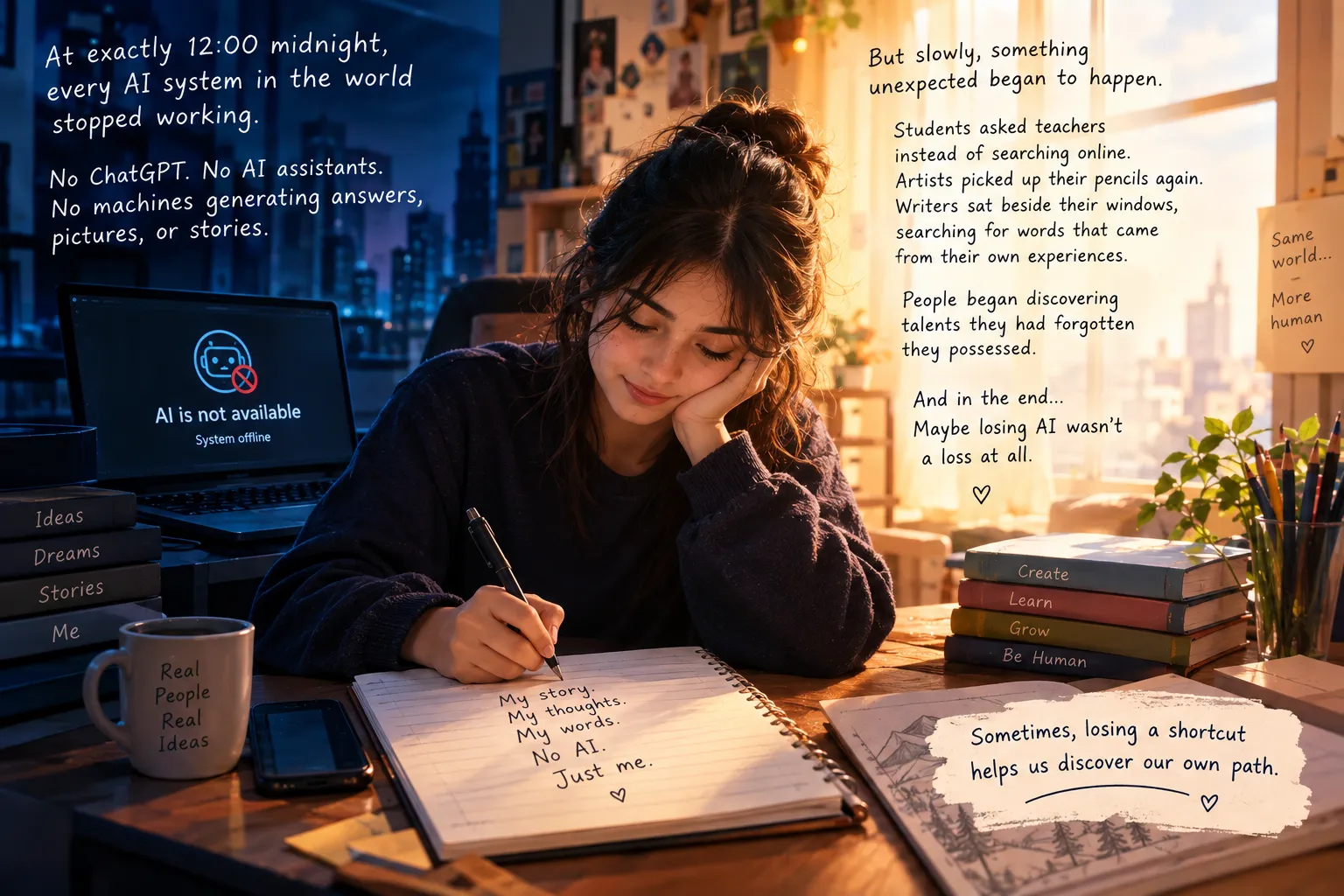
What if the world became human again?
At exactly 12:00 midnight, every AI system in the world stopped working.
No ChatGPT. No AI assistants. No machines generating answers, pictures, or stories.
At first, people panicked. Students wondered how they would complete their assignments. Companies struggled with automated tasks. Millions of people stared at their screens, waiting for something that would never return.
But slowly, something unexpected began to happen.
In schools, students started asking teachers questions instead of searching for instant answers. Libraries became busier. Friends sat together, discussing problems and finding solutions with their own minds.
Artists picked up their pencils again. Some drawings looked imperfect, but every line carried a human touch. Writers sat beside their windows, searching for words that came from their own experiences.
People began discovering talents they had forgotten they possessed.
There was one more change.
Fake images and AI-generated voices became harder to produce. People began questioning what they saw online and listening more carefully to what others said in real life.
Of course, the world faced difficulties. Some hospitals and businesses had to adjust, and many tasks became slower. Losing AI did not magically solve every human problem.
But something beautiful emerged from the struggle.
People learned that they could make mistakes without being failures. They could take time to understand something. They could create something imperfect and still be proud of it.
Months passed.
One day, a young student wrote a story entirely on paper. She crossed out sentences, changed words, and started again several times.
When she finally finished, she smiled.
The story wasn't perfect. It didn't have extraordinary vocabulary or flawless grammar.
But every word was hers.
She looked at her notebook and whispered, “I thought I needed a machine to help me create something wonderful. I never realised I needed to give myself a chance.”
And perhaps that was the greatest lesson of all.
The world had lost a powerful technology, but it had not lost its ability to imagine, discover, or create.
AI had disappeared, but human intelligence had never disappeared. People had simply needed a reminder of what they could do on their own.
Sometimes, losing a shortcut helps us discover our own path.
The question is: Were humans becoming smarter with AI, or were they forgetting how powerful they had always been?
Thoughts
-
Plato has Socrates make this same complaint about writing in the Phaedrus: letters would make people forgetful and only seem wise. Your closing question is that one again, two thousand years later.
-
Crossing out sentences and starting over is the whole story for me. The midnight shutdown is just the excuse to get her to that notebook.
Related posts
-
About a Capoeira beginner:
I just finished 4 training sessions:
-
Why Is Creating Something New So Difficult?
I see this in video game criticism, too. There's a term called metroidvania , used to describe platform games featuring exploration, abilities that unlock new paths, challenging bosses, and other…
-
The Slave’s Journey: How to Sell a Book That Was Born Dead
There you go. You have a dead book.
-
The Man Who Lives in His Own Room
Homer Simpson is an idiot. At least, that is how the world knows him.
-
How to Write Well!
To me, this is the stupidest question in the world. And since so many people answer it, writing is simply taking a piece of paper or sitting down in front of a computer and writing. Even famous…
-
We Are All Collectors or Procrastinators of Something
When I was younger, my mother asked me what I wanted. I wanted a computer. She wanted to buy me a motorcycle. In the end, I got the computer.
-
HELL THAT DOESN'T KNOW IT'S BURNING
People do terrible things. Some know exactly what they are doing. Others do not. And perhaps the latter are the hardest to understand, because they can hurt, destroy, humiliate, and even ruin their…
-
Romero Britto and Romero-Britto-ization
Once, I was at a bar on Augusta Street with a friend. We had drunk ourselves silly when a group at the next table started talking about Romero Britto.
Public
1 conversation
3 thoughts
17 upvotes
0 downvotes
0 series
What if the world became human again?