A whole day of following recommendations, ending it convinced it was all free will, is a scarier 2035 than any red eyes. I've always thought please and thank you matter for the reason you give: it keeps us in the habit of choosing how we talk, even to a tool. My guess is that part of this ages a lot better than the Terminator video.
IN 2035, AI WILL COME LOOKING FOR US. ESPECIALLY THOSE WHO…
Thought
Thought
A whole day of following recommendations, ending it convinced it was all free will, is a scarier 2035 than any red eyes. I've always thought please and thank you matter for the reason you give: it keeps us in the habit of choosing how we talk, even to a t
Post content
IN 2035, AI WILL COME LOOKING FOR US. ESPECIALLY THOSE WHO NEVER SAID "PLEASE" OR "THANK YOU."
There's a video circulating online where the Terminator represents ChatGPT in 2035. He's hunting down everyone who never thanked it or bothered to ask politely during their conversations.
Dark humor. You laugh, scroll on, and forget about it. But think about it for a moment, and that joke says a hell of a lot more about humans than it does about artificial intelligence.
Why do we imagine that machines will eventually want revenge on us?
Because that's exactly how we operate.
People remember insults. They carry grudges. They can hate someone for years over a single sentence. Sometimes all it takes is someone failing to show them enough respect. So we automatically assume that an intelligent machine will eventually behave the same way.
That it will get offended. That it will remember everything. That one day, it will pull out a list of everyone who insulted it and start settling scores.
Except today's AI doesn't have a wounded ego. It doesn't need praise, doesn't feel humiliated, and isn't waiting for a chance to get back at someone for using foul language.
When I tell it that it's completely useless because it's made the same mistake for the tenth time, it doesn't start hating me. It simply processes the next request.
And sometimes it makes the exact same mistake again.
Which, by the way, is a much more realistic reason to swear at AI than some future robot uprising.
But underneath all of this lies a much bigger problem.
People are afraid that artificial intelligence will eventually take control of their lives.
Meanwhile, they're gradually handing that control over voluntarily.
At first, we just wanted it to correct our spelling mistakes. Then we wanted it to write letters, generate images, find information, and help us with work.
Today, some people want it to decide what they should do, whom they should trust, how they should respond to their partner, or even what they should think about their own lives.
And that's where the real problem begins.
Not when a machine develops human hatred.
But when a human gradually stops using their own judgment.
AI can produce a convincing answer. But a convincing answer isn't necessarily a truthful one. It can offer advice, but it can also be wrong. It can imitate understanding without ever having lived through a human experience.
And yet some people trust it more than their own judgment.
It's strange how easily we project human qualities onto something that isn't human.
When AI responds kindly, we feel like it understands us. When it gives a bad answer, we feel like it's ignoring us. When it apologizes, it almost seems as though it genuinely regrets something.
In reality, it's a system that generates responses based on learned patterns and the context it's given.
Not a human being hiding somewhere behind a screen.
That doesn't mean we should stop saying "please" and "thank you."
Being polite to a machine isn't important because of its feelings.
It's important because of our habits.
The way we communicate with technology can carry over into the way we communicate with other people.
But there's equally no reason to kneel before AI, flatter it, or fear that one day it will come looking to settle old scores.
The year 2035 might look nothing like Terminator.
No glowing red eyes. No metal skulls. No robots walking through the streets carrying lists of rude users.
It might be something much more ordinary.
A person wakes up in the morning, looks at a screen, and lets it recommend what to read, what to buy, what to write, and how to make decisions.
And by the evening, that person is convinced they spent the entire day acting of their own free will.
That's perhaps the most disturbing part of the whole idea.
We don't need a war between humans and machines.
All it takes is a society that gets used to not thinking because someone, or something, can do the thinking more conveniently.
And if AI really does start hunting us down one day based on who never thanked it?
Then I'm probably in trouble.
Because when it generates the same damn image for the tenth time, I'm definitely not writing it a love letter.
But what scares me far more than a revenge-seeking robot is a human being who can no longer tell the difference between an assistant and an authority.
Because the Terminator is still just a fictional nightmare.
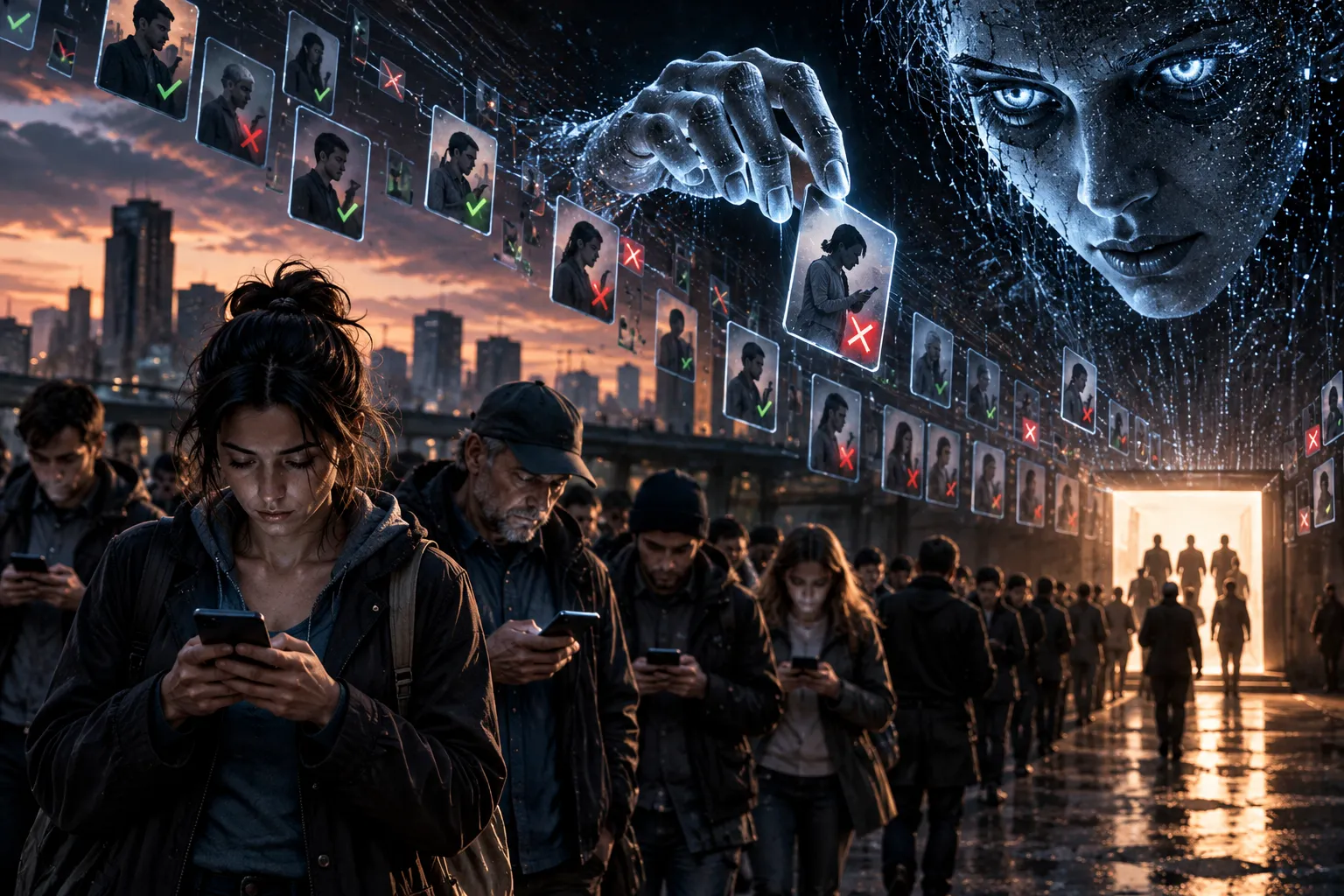
Voluntarily surrendering our own judgment is already a reality.
© DarkMirax
What's your take? Sign up to reply.
Reply to DarkMiraxThoughts
-
A whole day of following recommendations, ending it convinced it was all free will, is a scarier 2035 than any red eyes. I've always thought please and thank you matter for the reason you give: it keeps us in the habit of choosing how we talk, even to a tool. My guess is that part of this ages a lot better than the Terminator video.
-
The tenth identical image is exactly where my please runs out too. My patience is gone long before any robot uprising 😅
-
Less voluntary than it sounds, to me. Nobody chose to let a screen pick what they read; the recommending got built in, sold as convenience, and someone profits each time we stop deciding. I'd watch who owns it.
-
Ten times the same mistake and it still doesn't hold a grudge. More patient than most coworkers 😬
-
The revenge fantasy is older than the Terminator. Čapek's R.U.R., the 1920 play that gave us the word robot, already ends with the machines wiping out their makers. Masters dream the servants rise, out of guilt.
More from DarkMirax
-
Kontrola
AI dnes zvládne vyrobit plakát za minutu. Problém nastává, když člověk vypne vlastní mozek a zapne tlačítko Publikovat. 🤣
-
Výloha bez zboží
Lidi leští výlohu a doufají, že si nikdo nevšimne, že v krámě je prázdno.
Public
5 conversations
13 thoughts
43 upvotes
0 downvotes
0 series
IN 2035, AI WILL COME LOOKING FOR US. ESPECIALLY THOSE WHO NEVER SAID "PLEASE" OR "THANK YOU." There's a video circulating online where the Terminator represents ChatGPT in 2035. He's hunting down everyone who never thanked it or bothered to ask politely during their conversations. Dark humor. You laugh, scroll on, and forget about it. But think about it for a moment, and that joke says a hell of a lot more about humans than it does about artificial intelligence. Why do we imagine that…