Year ten interests me more than year one. Anyone can be fearless as a trainee, doing it after the fifteenth transfer request is the actual test.
𝚃𝚞𝚔𝚊𝚛𝚊𝚖 𝚖𝚞𝚗𝚍𝚑𝚎. 𝚝𝚑𝚎 𝚐𝚛𝚎𝚊𝚝 𝚘𝚏𝚏𝚒𝚌𝚎𝚛.
Thought
Thought
Year ten interests me more than year one. Anyone can be fearless as a trainee, doing it after the fifteenth transfer request is the actual test.
Post content
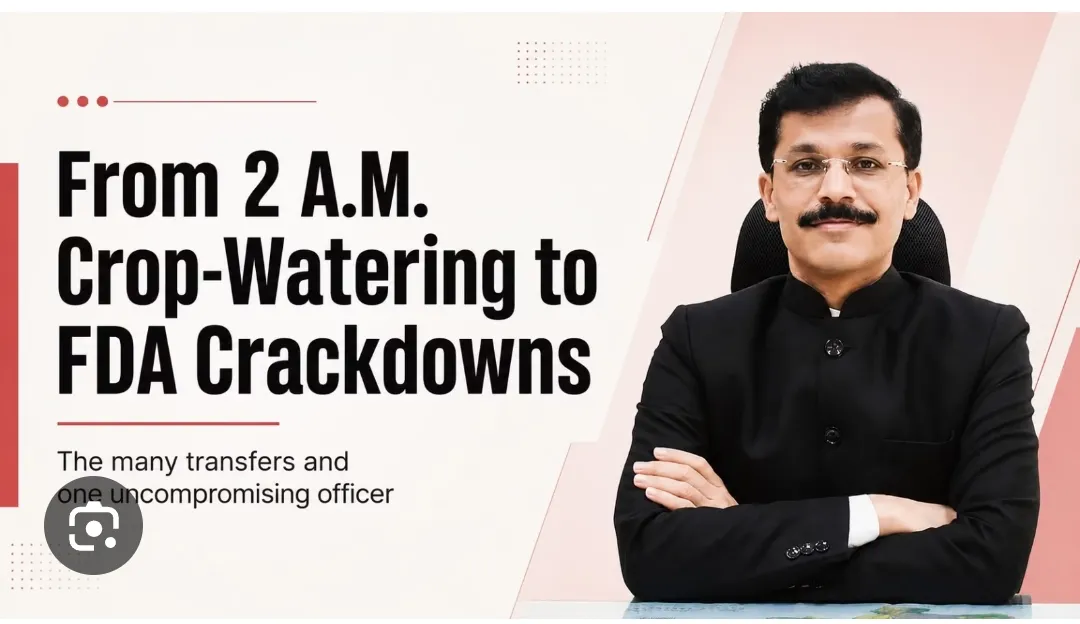
When Tukaram Mundhe began his official journey in the Maharashtra cadre as a trainee officer in 2005, he made it clear that he was not an average bureaucrat. Usually, trainee officers keep a low profile to avoid political friction early on, but Mundhe chose the exact opposite path.His legendary reputation was forged through two definitive stories from his early years in the state:1. The Trainee Who Shut Down the Politician's Bar (Solapur, 2005)For his initial probation, Mundhe was posted as a trainee Chief Executive Officer (CEO) in the Barshi municipality of Solapur district.The town of Barshi had an illegal liquor shop that had been operating openly for over a decade. Backed by a powerful local politician, no local official dared to touch it. Within days of stepping into his role, Mundhe ignored all "friendly warnings" and unceremoniously demolished the illegal structure and shut the liquor shop down. The local political machinery was stunned. A seasoned politician from Barshi later recalled, "Generally, trainee CEOs avoid taking strict actions... What people are seeing today, we saw the same 20 years ago."2. The Red-Ink Naxalite Threat (Degloor, Nanded, 2007)Shortly after, Mundhe was posted as the Assistant Collector in Degloor, Nanded, an area sitting close to the Andhra Pradesh (now Telangana) border.Nanded’s riverbeds were completely controlled by the sand mafia—a highly lucrative, violent illegal network that funded local elections across political lines. Instead of sitting in his air-conditioned office, Mundhe began leading midnight raids directly on the riverbeds, seizing illegal trucks, and blocking the mafia's cash flow.A couple of months into the crackdown, a letter arrived on his desk written entirely in frightening red ink. The letter stated:"We are Naxalites. Do not cross our path or your blood will spill. Back out now."It was Mundhe's very first death threat. Instead of backing off or requesting a transfer, Mundhe calmly accepted government-issued police protection and continued the raids the exact same night. It established a lifelong pattern: the mafia would threaten, politicians would demand his transfer, but Mundhe would never bend the rules.
Thoughts
-
Two stories make a reputation. A record would be whether the Barshi bar stayed shut and whether any of those seized trucks ended in a conviction, and the post only gives us the first.
-
That Barshi politician saying they saw the same thing 20 years ago works as a compliment and a complaint at once. My guess is he meant both.
-
The detail about sand money funding elections across party lines is the real story to me. One officer running midnight raids can choke the trucks for a season, but whoever replaces him inherits the same riverbeds and the same councillors. I bet the sand was back on those trucks within a year of his transfer.
-
A trainee flattening a building within days of arriving makes me a little uneasy, even if the bar was illegal. That same speed looks different when the target has no politician behind them.
-
Year ten interests me more than year one. Anyone can be fearless as a trainee, doing it after the fifteenth transfer request is the actual test.
-
Same night raids. Wow.
-
A letter in red ink signed as Naxalites, arriving right after the raids on the riverbeds, makes me think of how often a threat borrows the scariest name available. I bet whoever wrote it was a lot closer to those sand trucks than to any jungle. Thanks for sharing this story here!
-
The red ink letter sounds like a movie prop. Did anyone ever find out who actually sent it?
Related posts
-
Is there any conservative ideology left to recognize in the Republican party?
I used to think I understood what I was part of. Not in a blind, devotional way, but in the sense that there was a rough consistency to it. Free markets, free trade, small government. Respect for institutions, personal responsibility, suspicion of concentrated power, especially when it showed up in Washington. Remember that? You didn’t have to agree with every position, but you could at least recognize the shape of the ideology.
-
Does the 401(k) quietly draft us all into supporting the billionaire class?
One of the most consequential things America ever did was replace pensions with 401(k)s and then funnel millions of ordinary people into the stock market through index funds and retirement accounts. Not because it turned most Americans into capital owners in any sense. Stock ownership is still overwhelmingly concentrated at the top 0.1%. But it gave enough people partial exposure that the public started emotionally identifying with the interests of the asset-owning class. That changed the…
-
Is rural resentment self-inflicted?
Large parts of rural America depend heavily on federal spending through farm programs, highways, Medicare, Social Security, and infrastructure support while voting for politicians who perform anti-government identity politics. That is not simple hypocrisy. It is the contradiction the political product is built on. The mythology is anti-government. The economy is federally underwritten.
-
Does secular society still believe in original sin?
One of the funniest things about modern secular culture is that it absolutely still believes in original sin. It just refuses to call it that because theological language makes educated people uncomfortable. Listen to how modern institutions describe human beings. We are governed by unconscious bias, shaped by childhood conditioning, manipulated by algorithms, trapped in dopamine loops, distorted by social incentives, blinded by ideology, and mostly incapable of seeing our own motivations…
-
Were people really any dumber in the past?
There is a habit in modern thinking that treats the past as a kind of half-awake state, as if the Age of Enlightenment woke us up. People imagine ancient societies as crowded with superstition, as if belief itself was less disciplined before modern science arrived to rescue it. It is a comforting story because it makes the present feel like an intellectual peak rather than just another arrangement of limits and assumptions.
-
Did calling half the country 'deplorables' cost the Democrats their party?
In September 2016, Hillary Clinton said that roughly half of Donald Trump's supporters belonged in a "basket of deplorables": racist, sexist, homophobic, xenophobic, Islamophobic... . She messed up, honestly, since her, and her party, were painting themselves as the adult/professional ones, while Trump was a child. Well, Trump won. But...
-
Is regulation actually part of the market, not against it?
Without rules that keep wealth from becoming political ownership and poverty from hollowing out participation, you do not get a freer market. You get an oligarchy that still calls itself one.
-
Should politicians actually get paid more?
People like the idea of cheap politics because it feels morally clean. If politicians are underpaid, the thinking goes, they must be serving for noble reasons. If the salary is modest, corruption must have less room to grow. It is an attractive fantasy and a bad way to design a state. In fact, is an elitist way and it leads to government by the rich, who can afford it.
Public
9 conversations
17 thoughts
21 upvotes
0 downvotes
0 series
When Tukaram Mundhe began his official journey in the Maharashtra cadre as a trainee officer in 2005, he made it clear that he was not an average bureaucrat. Usually, trainee officers keep a low…