Of the four big questions you end on, which one sent you down this rabbit hole in the first place?
𝚃𝚑𝚎 𝚌𝚞𝚕𝚝𝚞𝚛𝚎 𝚝𝚑𝚊𝚝 𝚋𝚎𝚐𝚊𝚗 𝚠𝚒𝚝𝚑 𝚊 𝚚𝚞𝚎𝚜𝚝𝚒𝚘𝚗 🌸
Public
1 conversation
5 thoughts
20 upvotes
0 downvotes
0 series
A journey into the timeless world of Indian Vedic culture
In groups
Thought
Thought
Of the four big questions you end on, which one sent you down this rabbit hole in the first place?
Post content
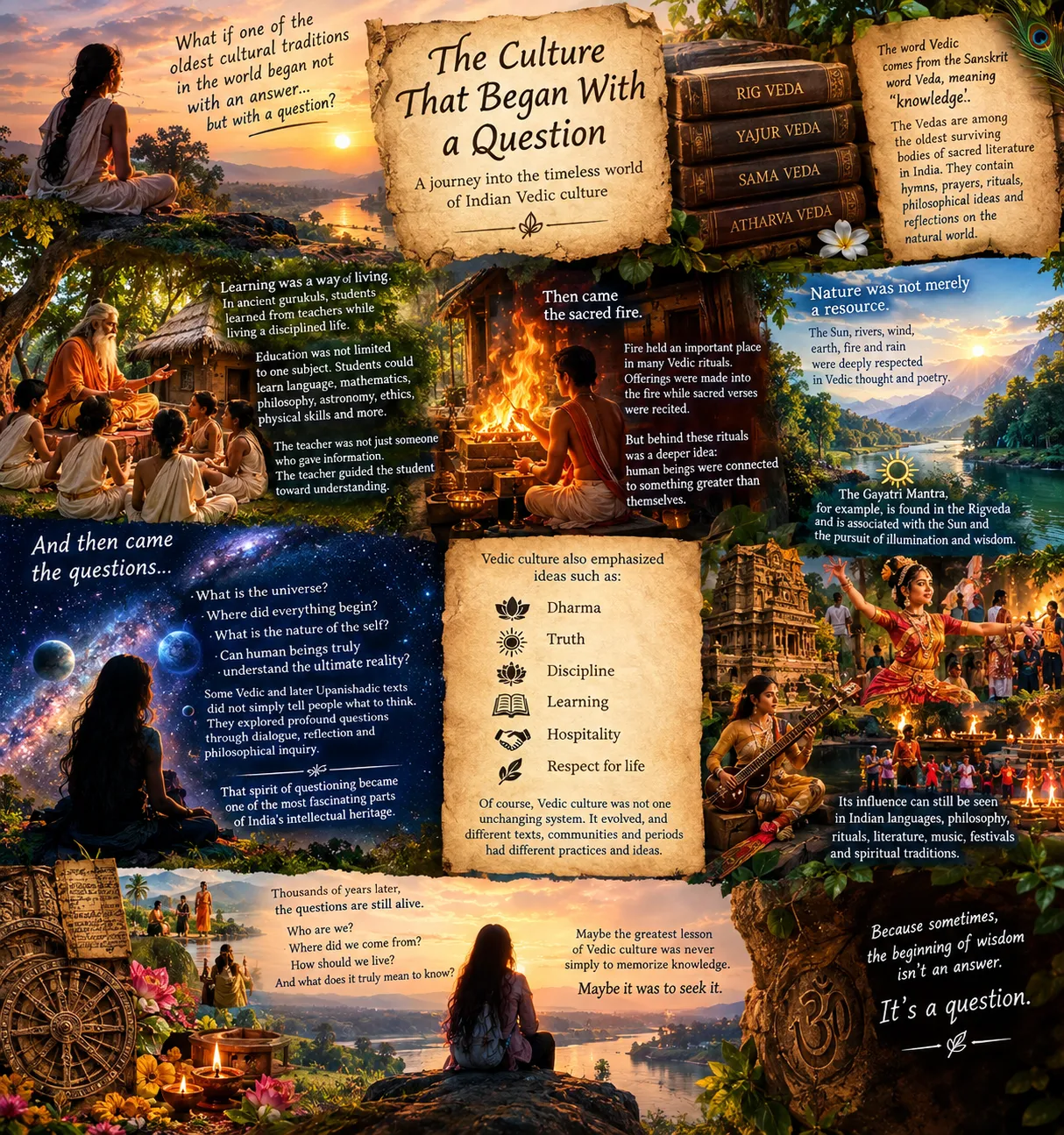
A journey into the timeless world of Indian Vedic culture
What if one of the oldest cultural traditions in the world began not with an answer… but with a question?
Long before modern classrooms, laboratories, and libraries, people in ancient India were already looking toward the sky, listening to nature, observing seasons, studying sound, and asking questions about life.
This was the world of Vedic culture.
The word Vedic comes from the Sanskrit word Veda, meaning knowledge. The Vedas are among the oldest surviving bodies of sacred literature in India. They contain hymns, prayers, rituals, philosophical ideas, and reflections on the natural world.
But Vedic culture was more than books.
It was a way of seeing life.
🌅 Learning was a way of living.
In ancient gurukuls, students learned from teachers while living a disciplined life. Education was not limited to one subject. Students could learn language, mathematics, philosophy, astronomy, ethics, physical skills, and other forms of knowledge.
The teacher was not simply someone who gave information.
The teacher guided the student toward understanding.
🔥 Then came the sacred fire.
Fire held an important place in many Vedic rituals. Offerings were made into the fire while sacred verses were recited.
But behind these rituals was a deeper idea: human beings were connected to something greater than themselves.
🌊 Nature was not merely a resource.
The Sun, rivers, wind, earth, fire, and rain were deeply respected in Vedic thought and poetry.
The famous Gayatri Mantra, for example, is found in the Rigveda and is associated with the Sun and the pursuit of illumination and wisdom.
🌌 And then came the questions.
What is the universe?
Where did everything begin?
What is the nature of the self?
Can human beings truly understand the ultimate reality?
Some Vedic and later Upanishadic texts did not simply tell people what to think. They explored profound questions through dialogue, reflection, and philosophical inquiry.
That spirit of questioning became one of the fascinating parts of India's intellectual heritage.
🌱 Vedic culture also emphasized ideas such as dharma, truth, discipline, learning, hospitality, and respect for life.
Of course, ancient Indian society was complex and changed over many centuries. Vedic culture was not one unchanging system, and different texts, communities, and periods had different practices and ideas.
But its influence can still be seen in Indian languages, philosophy, rituals, literature, music, festivals, and spiritual traditions.
And perhaps that is the most beautiful part of the story.
Thousands of years later, the questions are still alive.
Who are we?
Where did we come from?
How should we live?
And what does it truly mean to know?
Maybe the greatest lesson of Vedic culture was never simply to memorize knowledge.
Maybe it was to seek it.
Because sometimes, the beginning of wisdom isn't an answer.
It's a question. 🌿✨
✨ If this story made you curious, ask yourself:
What ancient question would YOU want to explore?
Thoughts
-
The gurukul is the part I'd push on a little. Who got to be the student mattered a lot: for long stretches Vedic learning was kept for boys from the upper varnas, and women and lower castes were mostly shut out of it. That doesn't cancel the spirit of questioning you describe, but it tells you who was allowed to ask.
-
Of the four big questions you end on, which one sent you down this rabbit hole in the first place?
-
The sacred fire part 🔥
-
The Gayatri Mantra sitting in the Rigveda and pointed at the Sun makes me think of how many of the oldest traditions start with the one thing everyone could see every morning. My guess is that is also why the questions lasted: the Sun kept showing up and reminding people to ask them again. Glad you put this here 🌸
Related posts
-
𝙿𝚎𝚛𝚒𝚘𝚍𝚜 𝚊𝚛𝚎 𝚗𝚘𝚝 𝚓𝚘𝚔𝚎 🩸
Anaya was a student in Class 6. One day during school, she got her period unexpectedly. She felt nervous and quietly asked her teacher for help.
-
𝘛𝘩𝘦 𝘱𝘳𝘰𝘮𝘪𝘴𝘦 𝘶𝘯𝘥𝘦𝘳 𝘵𝘩𝘦 𝘴𝘵𝘢𝘳𝘴 ⭐
The Promise Under the Stars
-
🇮🇳 INDIA IS NOT JUST A COUNTRY
🇮🇳 INDIA IS NOT JUST A COUNTRY
-
𝐀𝐋𝐁𝐄𝐑𝐓 𝐄𝐈𝐍𝐒𝐓𝐄𝐈𝐍—𝚃𝙷𝙴 𝙱𝙾𝚈 𝚆𝙷𝙾 𝚀𝚄𝙴𝚂𝚃𝙸𝙾𝙽𝙴𝙳 𝙴𝚅𝙴𝚁𝚈𝚃𝙷𝙸𝙽𝙶
What if the person who changed our understanding of the universe was once just a curious boy who asked too many questions?
-
𝙰 𝙻𝙸𝚃𝚃𝙻𝙴 𝙱𝚁𝙴𝙰𝙺 𝙽𝙾𝚃𝙸𝙲𝙴 ✉️
𝙷𝚎𝚢, 𝚖𝚢 𝚊𝚖𝚊𝚣𝚒𝚗𝚐 𝚛𝚎𝚊𝚍𝚎𝚛𝚜 𝚊𝚗𝚍 𝚏𝚎𝚕𝚕𝚘𝚠 𝚠𝚛𝚒𝚝𝚎𝚛𝚜! 🥹💗
-
𝚃𝚑𝚎 𝚍𝚒𝚊𝚛𝚢 𝚠𝚒𝚝𝚑 𝚝𝚘𝚖𝚘𝚛𝚛𝚘𝚠 𝚍𝚊𝚝𝚎📓
𝙲𝚑𝚊𝚙𝚝𝚎𝚛 3 — 𝚃𝚑𝚎 𝙱𝚛𝚘𝚔𝚎𝚗 𝚆𝚒𝚗𝚍𝚘𝚠
-
✉️𝚆𝙰𝙸𝚃... 𝚃𝙷𝙸𝚂 𝙸𝚂 𝙵𝙾𝚁 𝚈𝙾𝚄
💌 WAIT… THIS IS FOR YOU.
-
🌟 𝚃𝚑𝚎 𝚂𝚝𝚘𝚛𝚢 𝚘𝚏 𝙳𝚛 . 𝙰𝙿𝙹 𝙰𝙱𝙳𝚄𝙻 𝙺𝙰𝙻𝙰𝙼
🌟 𝚃𝚑𝚎 𝚂𝚝𝚘𝚛𝚢 𝚘𝚏 𝙳𝚛. 𝙰. 𝙿. 𝙹. 𝙰𝚋𝚍𝚞𝚕 𝙺𝚊𝚕𝚊𝚖 — 𝚃𝚑𝚎 𝙱𝚘𝚢 𝚆𝚑𝚘 𝙳𝚛𝚎𝚊𝚖𝚎𝚍 𝙱𝚒𝚐