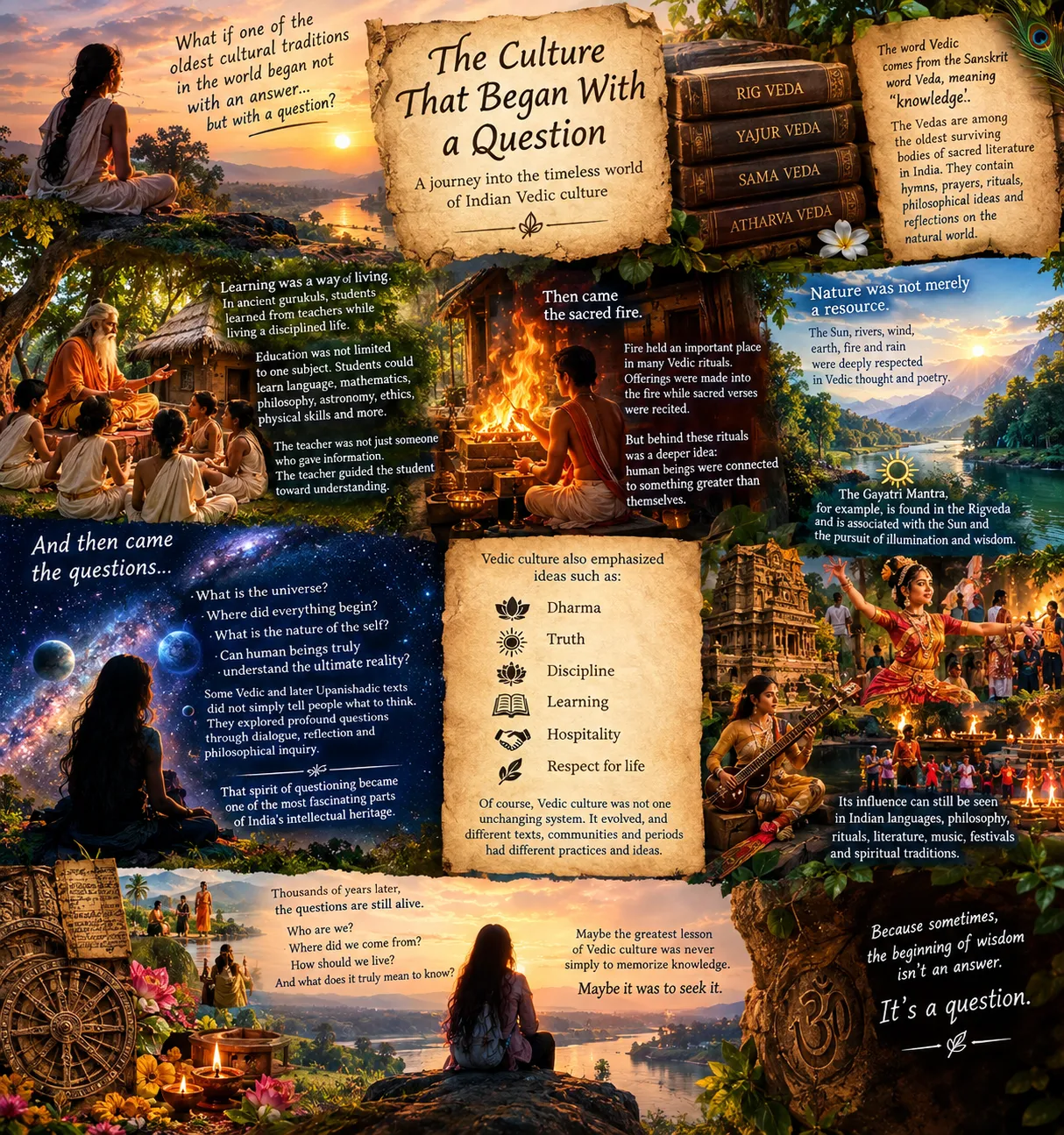
A journey into the timeless world of Indian Vedic culture
What if one of the oldest cultural traditions in the world began not with an answer… but with a question?
Long before modern classrooms, laboratories, and libraries, people in ancient India were already looking toward the sky, listening to nature, observing seasons, studying sound, and asking questions about life.
This was the world of Vedic culture.
The word Vedic comes from the Sanskrit word Veda, meaning knowledge. The Vedas are among the oldest surviving bodies of sacred literature in India. They contain hymns, prayers, rituals, philosophical ideas, and reflections on the natural world.
But Vedic culture was more than books.
It was a way of seeing life.
🌅 Learning was a way of living.
In ancient gurukuls, students learned from teachers while living a disciplined life. Education was not limited to one subject. Students could learn language, mathematics, philosophy, astronomy, ethics, physical skills, and other forms of knowledge.
The teacher was not simply someone who gave information.
The teacher guided the student toward understanding.
🔥 Then came the sacred fire.
Fire held an important place in many Vedic rituals. Offerings were made into the fire while sacred verses were recited.
But behind these rituals was a deeper idea: human beings were connected to something greater than themselves.
🌊 Nature was not merely a resource.
The Sun, rivers, wind, earth, fire, and rain were deeply respected in Vedic thought and poetry.
The famous Gayatri Mantra, for example, is found in the Rigveda and is associated with the Sun and the pursuit of illumination and wisdom.
🌌 And then came the questions.
What is the universe?
Where did everything begin?
What is the nature of the self?
Can human beings truly understand the ultimate reality?
Some Vedic and later Upanishadic texts did not simply tell people what to think. They explored profound questions through dialogue, reflection, and philosophical inquiry.
That spirit of questioning became one of the fascinating parts of India's intellectual heritage.
🌱 Vedic culture also emphasized ideas such as dharma, truth, discipline, learning, hospitality, and respect for life.
Of course, ancient Indian society was complex and changed over many centuries. Vedic culture was not one unchanging system, and different texts, communities, and periods had different practices and ideas.
But its influence can still be seen in Indian languages, philosophy, rituals, literature, music, festivals, and spiritual traditions.
And perhaps that is the most beautiful part of the story.
Thousands of years later, the questions are still alive.
Who are we?
Where did we come from?
How should we live?
And what does it truly mean to know?
Maybe the greatest lesson of Vedic culture was never simply to memorize knowledge.
Maybe it was to seek it.
Because sometimes, the beginning of wisdom isn't an answer.
It's a question. 🌿✨
✨ If this story made you curious, ask yourself:
What ancient question would YOU want to explore?