The three escapes aren't the same kind of thing: facing and fighting are things a person does, while dementia is a condition nobody picks, so pride gets no grip on it. That makes the Quixote part hit harder for me, since the windmills were chosen.
Mirrors & Windmills
Thought
Thought
The three escapes aren't the same kind of thing: facing and fighting are things a person does, while dementia is a condition nobody picks, so pride gets no grip on it. That makes the Quixote part hit harder for me, since the windmills were chosen.
Post content
There is no escape from oneself. Escaping who we are is impossible; all we can do is surrender, grow accustomed to what we see, and learn to live with our own reflection.
The valley of shadows is not dark. It is made of everything we refuse to see.
We do not change by erasing who we were, but by adding new layers to who we are. Sometimes, our past seems to belong to a stranger with whom we share the same memories. Even so, that person is also us.
If we invested in ourselves the energy and time we waste trying to run away, perhaps we would discover that the greatest obstacle was never what we did, but the pride that kept us from acknowledging our mistakes and learning from our successes.
We make excuses, shift the blame onto others, and edit our own lives to preserve the image we want to have of ourselves. We do this out of prejudice, pride, or fear of admitting we were wrong. We would rather distort our own history than accept that we were not always right.
There are three ways to escape.
The first is to face ourselves. To look at the past without editing our memories, acknowledge our mistakes without erasing our achievements, and accept our contradictions without feeling the need to justify them. It means abandoning pride as a shield and using experience as a lesson. It does not mean liking everything we find, but understanding that we cannot add anything new to ourselves while denying what is already there.
The second is to fight ourselves. To turn our own existence into an endless battle, wrestle with our thoughts, and keep fighting until we reach our physical and psychological limits. It is believing that strength can overcome what understanding has failed to reach, while ignoring the damage this war can inflict on our health. Instead of learning to live with themselves, people try to defeat themselves, as if it were possible to walk away unharmed from a fight against their own existence.
The third is to forget ourselves. To gradually lose the memories that sustain our personal history, until the past becomes inaccessible. Alzheimer's and other forms of dementia can impair memory, autobiographical identity, and the ability to recognize parts of one's own life story. This is not a choice, a voluntary surrender, or a conscious escape, but a condition that can deprive someone of access to what they have lived through.
Three paths, three relationships with our own existence: understanding ourselves, fighting ourselves, or losing access to the memories of who we once were.
In the end, perhaps the question is not how to escape ourselves, but how much longer we are willing to waste trying.
Because the mirror does not demand that we like what we see. It does not ask us to be proud of our past or justify our failures. It simply reflects an image back to us.
And perhaps true freedom begins when we stop trying to destroy it.
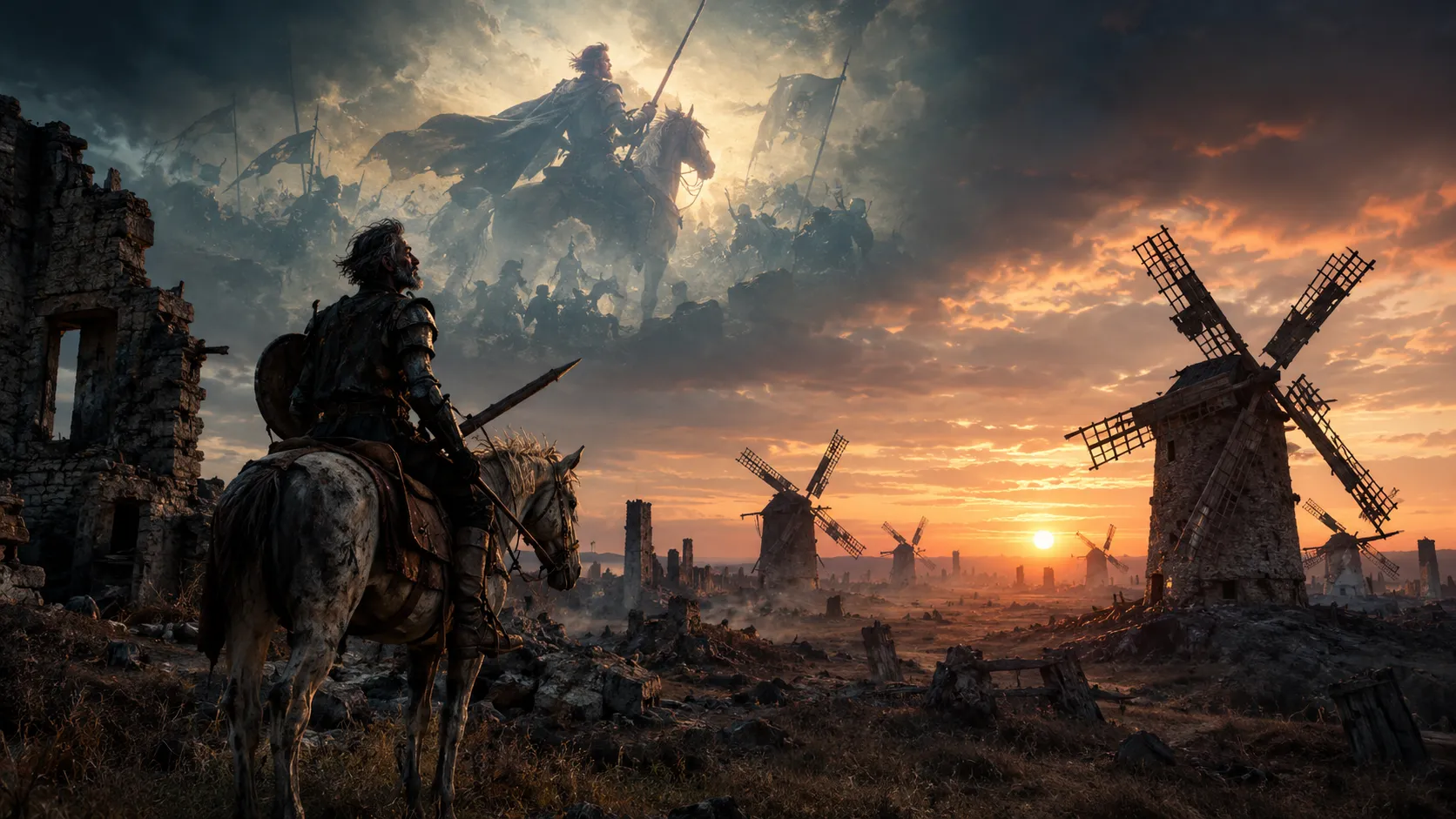
We romanticize our own fiction, turning ourselves into heroes of a lost cause that was doomed from the very beginning of our own journey. We build narratives in which we are the protagonists of grand battles, but while we believe we are fighting giants, the world around us sees nothing but ruins and windmills.
We are Don Quixote, trying to give meaning to our existence through a battle that may never have been what we imagined. And perhaps the most painful part is not fighting windmills, but realizing that we spent so much time trying to be heroes that we forgot to ask whether there was anyone to save at all... or whether we simply needed to accept the reality that had always been right in front of us.
#madnicles #reflection #philosophy #psychology #selflove #mentalhealth #reality #pride #fear #selfsabotage #personalgrowth #lifereflections #existentialism #donquixote #darkchronicles #innerstruggle #truthsoflife #literature #criticalthinking #reallife
Thoughts
-
The three escapes aren't the same kind of thing: facing and fighting are things a person does, while dementia is a condition nobody picks, so pride gets no grip on it. That makes the Quixote part hit harder for me, since the windmills were chosen.
More from aleroz
-
THE CHILD MAKES THE TOY
I think that's precisely what's missing from so many movies, cartoons, and TV series today: the gaps. Those parts that aren't explained, that remain open for each viewer to imagine, interpret, and…
-
A CONVERSATION WITH KARL MARX AND HEGEL
— We're all in the same boat, facing the same storm.
Related posts
-
6 Seconds or 6 Hours
Sex is underestimated by everyone. If it were really that good, nobody would ever leave the house. People like talking about sex more than actually having sex.
-
Romero Britto and Romero-Britto-ization
Once, I was at a bar on Augusta Street with a friend. We had drunk ourselves silly when a group at the next table started talking about Romero Britto.
-
The food behind your mood 🌝
One rainy afternoon, Anaya came home from school feeling tired and upset. She had a difficult day and didn't feel like doing anything.
-
Is therapy just confession with the theology stripped out?
One of the funniest things about secular modern culture is watching people reinvent Christianity piece by piece while acting intellectually superior the entire time. People abandoned confession and now pay someone $240 plus taxes an hour to listen to them describe their guilt in a softly lit room. They abandoned sin and replaced it with "unprocessed trauma." They abandoned repentance and replaced it with "doing the work." They abandoned examination of conscience and replaced it with journaling…
-
Observation on ego..
Breaking down ego and observing the illusion of ego.
-
Does 'no days off' actually mean you're training hard enough?
“No days off” is one of those phrases that sounds tough right up until you think about it for more than five seconds. Because what is the sentence actually saying? If you genuinely train hard, really hard, with enough intensity to force adaptation, your body will demand recovery. Not emotionally. Biologically. Tissue damage, nervous system fatigue, glycogen depletion, inflammatory response. The entire point of hard training is that the body cannot fully maintain itself without rebuilding…
-
Do you really need to have an opinion on everything?
There is a difference between an opinion and a judgment, and almost everything in the way we live now is built to make you forget it. An opinion is what you can produce in four seconds when someone asks. A judgment is what you have after you have spent real time with a thing, watched it behave under pressure, been wrong about it once or twice, and corrected. The first is nearly free. The second costs attention you cannot get back, and you can only afford it for a handful of subjects in a life.…
-
Does your personality matter far less than you think?
I realize, interacting with students, teenagers and younger co-workers peers that many believe that their personality traits are a leading factor in deciding what do to or how to tackle their own career. Although younger people ask these questions more explicitly, older adults also seem to think along the same lines. I personally find it to be far more irrelevant than most people think. Besides my job, where I observe successful people doing the same role with drastically...
Public
1 conversation
2 thoughts
14 upvotes
0 downvotes
1 series
There is no escape from oneself. Escaping who we are is impossible; all we can do is surrender, grow accustomed to what we see, and learn to live with our own reflection.