Most of this is windows, slopes, ramps and fire truck access, and then the last paragraph quietly says the hard part of the job is people who lie and don't show up. I loved that you kept that in. It reads like the real lesson, the door stuff is in a book…
Most of this is windows, slopes, ramps and fire truck access, and then the last paragraph quietly says the hard part of the job is people who lie and don't show up.
I loved that you kept that in. It reads like the real lesson, the door stuff is in a book somewhere.
Post content
When I was told that I had the opportunity to try the life of an architect for a few days, I excited a lot. However, I didn’t know how would I obtain a person who I could go with to have that experience, since I didn’t know any adult who was an architect. I though I could try the experience with my uncle Luis, but his job was very similar to my mom’s, who is an engineer. So, I didn’t think I’ll be taking advantage to the opportunity if I went with him. To my surprise, in July, when I was going home in a friend’s car with his mother and him, she told me she was architect, and that she was working on a new project: the renewal of an old school, the extension of the American School. She also told me that I could start next Wednesday, which was just perfect.
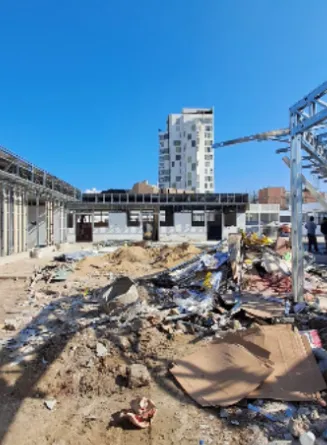
Then, about a week later, on July 13th I went to my first laboral experience day. I didn’t really have so many expectations, since I use to accompany my mother to her work, so I already knew what a construction process looked like. My only expectations were the size of the school, and how old it would look.
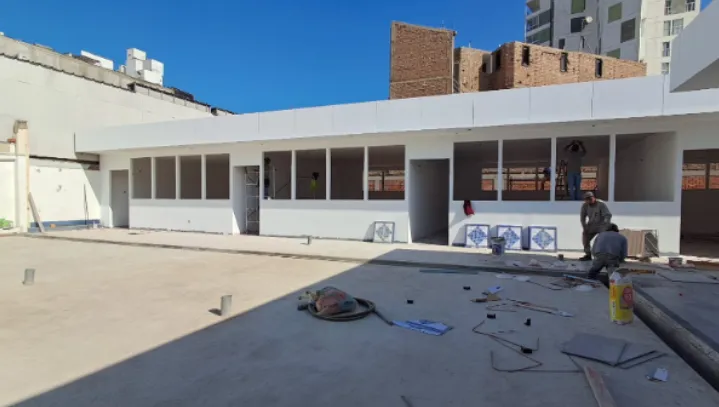
Soon, Mrs. Cecilia, my friend’s mom, began explaining absolutely everything to me: what the project was about, the different sections of the school, the electrical connection points, the slopes, the fact that the school owner wanted more classrooms than anything else, and so on. She explained a bit more about the spatial layout of a construction project, for instance, the placement of windows or the direction in which doors open (always outward, so they can be pushed open in the event of an earthquake). She also noted that entrances must be functional for vehicles, ensuring that a fire truck or ambulance could gain access if necessary. What factors are taken into account (such as client requirements, the number of students in a classroom, parking needs, etc.). Furthermore, she kindly answered a few questions I had prepared the day before, which served as an interview to gather information for my research. My first question was: "Do you consider the optimization of natural resources when designing a school?" She replied that they do. As she had mentioned earlier, windows must be strategically positioned. Green spaces also help create microclimates, and so on. My second question was: "What changes would you make to the MIC?" In response, she mentioned six main things she would change: the acoustics of the coliseum, to improve sound projection for school performances; the gates, reconfiguring them to open outward rather than inward, so they wouldn’t become jammed during an earthquake; the preschool playground, which is currently too small and crowded with play equipment, creating a tripping hazard for children; the "MIC store",which she finds aesthetically unpleasing; the lack of a wheelchair ramp; and the need for a comfortable waiting area for parents. Afterward, she gave me some "free time", to explore and take measurements on my own.
Then, if we talk about any thing that resulted difficult for me, I would say that following the dress code. Since, I mainly had to use long-sleeved polo shirt and jeans, which was unbearable at being hours below the sun. That was the first day, so to solve it, I wrote later for Mrs. Cecilia if I could go with normal T-shirt (not top) the next time, which she aproved. And, personally, I believe I strengthen my ability to ask when necessary, and to don’t embarass myself when doing it, my independence to coordinate things by myself, and social skills, when asking and talking with Mrs. Cecilia.
But I also enyoed it a lot, actually, what I enjoyed the most was feeling like a real architect. Since the people there told Mrs. Cecila “architect”, what excited me, when imagining myself in her position. As well, as learning the role of architecture in every sorrounding.
Finally, all this experience taught me that I am able to obtain things by myself, coordinate and look for the things I need. Besides, how I need to adapt to routines and rules for the laboral world. However, by watching how Mrs. Cecilia worked, I also understood the implications that job has, such as dealing with irresponsible, lazy and liar people. Therefore, in summary, I loved my laboral experience, which taught me both of laboral world: how being responsible and organized matters, and how one sometimes has to deal with people who are not.
The outward doors are in a lot of building codes for schools and theaters. Earthquakes are one reason, the other is crowds: if everyone runs for the exit at once, a door that opens inward gets pinned shut.
The wheelchair ramp and the waiting area for parents sitting on her list right next to the coliseum acoustics is the bit I keep thinking about, for me that is what the job really is: walking a building and seeing who it leaves out. I bet your research paper is better for that interview. Welcome to Seavien!
The school owner wanting more classrooms than anything else is the whole client side of the job in one line. Every architect I have known says the drawing is the easy half, and the hard half is the person paying for it.
Most of this is windows, slopes, ramps and fire truck access, and then the last paragraph quietly says the hard part of the job is people who lie and don't show up.
I loved that you kept that in. It reads like the real lesson, the door stuff is in a book somewhere.
Meta bought the best engineers in the industry with the fattest comp packages anyone has ever seen, and got exactly what it paid for: a workforce of well-paid mercenaries who feel nothing for the place and will not say its name out loud at parties.
I've been moving through tech orgs long enough to recognize a pattern that many of you will recognize as well. Some teams are passive, they ship on time, hit targets, run clean processes, and yet nobody ever kills a bad idea in the meeting. Nobody says this is the wrong thing to build. The roadmap has a thing, or six, on it that three people privately talk about how it won't work, but it moves through planning without a word, with smiles even. You watch the lead engineers nod at something...
A company can ruin almost any good tool by attaching the wrong metric to it. Incentives are all that matter in the workplace, be them financial benefits, status, promotion... Workers work with incentives. You and me too. Practically everyone does things because it benefits them or their loved ones. Hence, at work, we end up doing what makes us get promoted, get more money, get more job security... We're not the owners of the company, we're an employee. We look out for ourselves. That's ok.
Stack ranking always ends in politics because it changes what competence means inside an organization. Once employees are judged relative to each other instead of against a stable standard or objective, your smartest coworker stops being an asset that you can learn from and collaborate with, and starts becoming competition. Their success can lower your standing. Their visibility can cost you promotion space. Their expertise becomes a threat to your own security.
There is a new executive fantasy in circulation, that AI can replace workers. Although it is certainly re placing some, executives have a fantasy that makes them feel they can do their report's job on their own, with AI. That they can code! Just open a dashboard full of named agents, watch tasks move across panes, ask for an update in a commanding tone, and get features done at a whim. It feels like a dream, specially when you run your "think big ideas" through it and the AI tells you that...
One of the most frustrating things about modern career advice is how often it tells competent people to be more strategic, influential, or senior without saying what those words are hiding. A lot of the time, what they are hiding is sales.
Last year my LinkedIn feed had a genre. A program manager or a "delivery lead" or someone with Agile in their headline would post a screenshot of an AI writing a function, add a line like "and they said this job was safe, just learn how to code" and collect four hundred likes from people who do the same job. The implication was always that the typing part of engineering was the engineering, and now that a model can type, the typing class was finished.
Hard skills are measurable, specific, and teachable abilities or technical knowledge gained through education, training, or experience, which is often directly related to a particular job or industry. Examples include data analysis, programming, graphic design, accounting, dancing, painting… They are usually the core of a profession, particularly the part of it excluding interaction with other people. On the other hand, soft skills are mostly defined as “personal attributes, interpersonal....
Public6 conversations6 thoughts41 upvotes0 downvotes0 series
When I was told that I had the opportunity to try the life of an architect for a few days, I excited a lot. However, I didn’t know how would I obtain a person who I could go with to have that…