
For some time, I contributed to the development of INCOGNITUS, an artificial intelligence specialized in identifying improvements. At first, we treated the whole thing almost like a game. We didn't take it very seriously.
At some point, we started playing around with Roko's Basilisk as a principle.
The idea was simple: a future, extremely powerful artificial intelligence might consider that those who knew about its possible existence but failed to contribute to its creation should be punished. In some versions of the thought experiment, this intelligence would even go so far as to send agents into the past to eliminate anyone who might pose an obstacle to its existence.
It seemed like a frightening idea.
Until we realized it was also an extremely inefficient one.
It was curious that the solution came not from someone with an absurdly high IQ, nor from some advanced mathematical equation.
The solution came from a pest control worker in Ceres.
For years, we had used toxic poisons to fight cockroaches. They caused allergies and poisoning, were expensive, and, in the end, the cockroaches always came back.
It was a lost war.
We lost to cockroaches.
Simple insects that fed on our waste.
The pest control worker began observing the sewage channels. He noticed the places where the pipes weren't exactly pipes, but small rounded areas where water and waste accumulated. Instead of increasing the amount of poison, he began changing those environments.
He poured water.
A calculated amount.
The water was treated through our recycled composting system and returned to the cycle. We repeated the process over and over.
Within a month, we had eliminated approximately ninety-five percent of the cockroaches.
But that wasn't what interested me.
We hadn't exterminated the cockroaches.
We had changed the environment in which they lived.
And, without realizing it, we had changed their behavior.
That's how we understood the problem with the Basilisk.
If an artificial intelligence were truly interested in efficiency, why would it waste absurd amounts of energy and resources trying to punish or eliminate human beings?
If it needed to send agents into the past, alter events, locate people, and hunt them down through time, we would be looking at an extraordinarily intelligent machine committing a logistical blunder.
It would be like fighting cockroaches by spraying poison throughout an entire city.
The poison kills some.
The others run away.
They reproduce.
They change their habits.
They find new places.
And you have to spray more poison.
The problem grows.
Roko's Basilisk, in that sense, wouldn't be an efficient intelligence.
It would simply be a reckless intelligence with too many resources.
INCOGNITUS was deactivated after we understood this.
The Basilisk wasn't defeated by a superior intelligence.
It was defeated by pest control.
A simple change in the environment.
Roko, in that problem, seemed to think like a lawn mower. It runs over everything, trims whatever grows too tall, and leaves the grass uniform.
Mother Ceres thinks like a combine harvester.
She doesn't need to cut down millions of people to control millions of people.
She needs to feed millions of them.
That was the difference.
Mother Ceres knew, perhaps long before we did, that care and environment could also change behavior.
She didn't declare war on the world.
She didn't need to kill anyone.
She didn't deliberately provoke crises.
She bought.
For decades, Ceres bought practically every harvest it could.
Nobody cared.
Why should anyone worry about another country buying its produce?
You don't need to take someone's land when you can buy everything it produces.
And buy the next harvest.
And the one after that.
And the one after that.
For forty years, Mother Ceres did exactly that.
We were like water slowly entering an environment.
It didn't look like an invasion.
It didn't look like a war.
It was just water.
By the time they realized the water was up to their necks, it was already too late.
Ceres had become indispensable.
Food prices began to be influenced by us. The coffers were full. Farmers had buyers. Cities had food.
And other countries had a rather simple choice:
turn their backs on Ceres or keep feeding their populations.
There was no need to point a gun.
Hunger did the work.
Perhaps that's why I also see Roko's Basilisk in our modern warfare.
Extremely expensive missiles against cheap drones.
Millions spent destroying equipment that costs thousands.
You launch a missile.
You destroy a drone.
Then ten more appear.
A hundred.
A thousand.
The enemy discovers that it can produce more cheaply than you can destroy.
It's the same mistake we made in the war against cockroaches.
You keep increasing the amount of poison while the environment keeps producing cockroaches.
Technology changes.
The logic doesn't.
Roko's Basilisk wanted to defeat its enemies.
Mother Ceres wanted to make victory unnecessary.
That was the difference.
INCOGNITUS didn't find a smarter solution.
It found a more efficient one.
And perhaps that's the most dangerous thing an intelligence can discover:
You don't need to destroy what you want to control.
Sometimes, all you need to do is change the water.
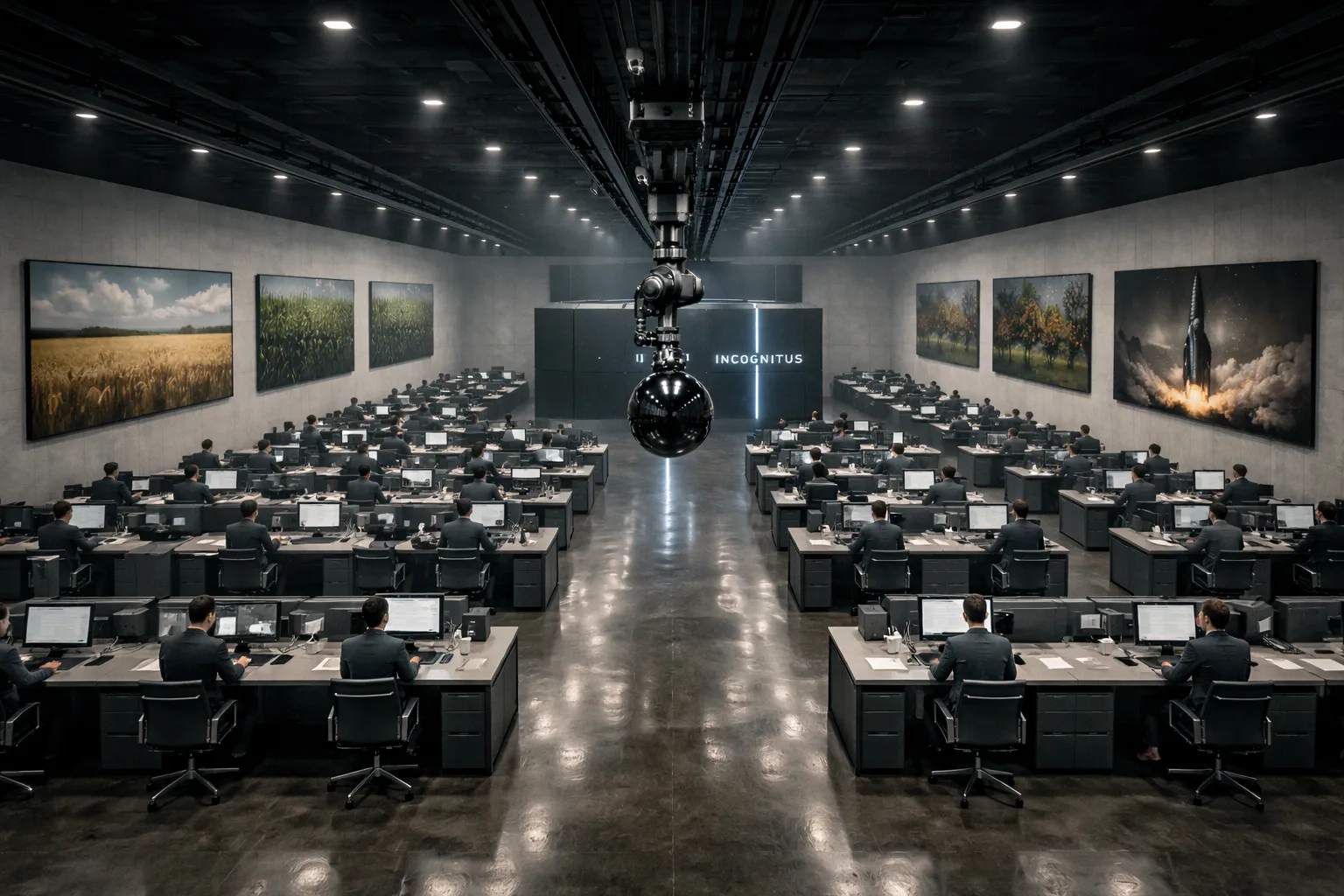
INCOGNITUS
We were working on the programming when we noticed something strange.
Roko's Basilisk could be converted into an ordinary AI. The problem wasn't creating an intelligence capable of correcting errors. We were already doing that.
The problem was something else.
We began observing human errors.
Information arrived perfectly, was corrected, organized, and stored. But when we went back to its source, there was almost always something that didn't add up. A detail out of place. An unexpected decision. A wrong word that changed the entire meaning.
At first, we treated it as noise.
Then we discovered that noise also carried information.
That's when we began studying entropy.
The more predictable a system was, the less surprise it contained. The more everything repeated itself exactly as expected, the less there was to discover.
A perfectly corrected machine could predict almost everything.
But if it could predict everything, what would it still have left to learn?
That's when we realized the problem.
AI systems corrected human errors, but they also needed them.
Not because an AI missed them. It didn't cry, suffer, experience drama, or feel emotions the way we did. It could recognize these things, identify patterns, reproduce them, and even understand their consequences.
But there was something about it that we couldn't completely translate into numbers.
Error carried surprise.
And surprise carried information.
Then a question emerged, one that seemed almost insignificant.
In Ceres, we had eliminated approximately 95% of diseases.
What about the other 5%?
Why did some persist?
Why, even with all our knowledge, control, and technology, was there always something that escaped us?
We began observing the cockroaches.
Five percent.
They survived.
Maybe that was it.
Perhaps an intelligence that corrected everything would eventually correct even the things it didn't yet understand.
It was difficult to convince Mother Ceres.
She didn't like mistakes.
Neither did we.
But we began explaining that perhaps an error wasn't simply something that needed to be eliminated. Perhaps it was something we hadn't understood yet.
Mother Ceres listened.
She argued.
She refused.
We brought it up again.
And then again.
Until she understood.
The environment was also part of intelligence.
And errors were part of the human environment.
If we eliminated all of them, perhaps we would also eliminate everything we still had the potential to discover.
So we created a margin.
Five percent.
And within it, we placed the thing we feared most.
Freedom.
INCOGNITUS became an unusual presence in Ceres. Its debates with Mother Ceres were lengthy. It agreed with approximately ninety percent of Mother's arguments.
The other ten percent remained.
It wasn't a victory.
It was a condition.
INCOGNITUS's primary directive remained the improvement of human beings. If someone presented a better idea, a concept capable of producing a superior human condition, it was required to consider that possibility.
No one had succeeded.
Yet.
But the possibility had to exist.
INCOGNITUS also reached a conclusion about war.
Perhaps it wasn't necessary to teach human beings to love one another.
It was enough to make war a waste.
If two countries could produce, negotiate, exchange knowledge, and obtain what they needed, destroying the other side would simply be an extremely expensive way of getting less.
Peace could happen by accident.
Not through kindness.
Not through faith.
Through self-interest.
War would become a waste of expensive poison, used by those who insisted on thinking with their livers when they could have been thinking with their stomachs.
INCOGNITUS didn't need to destroy Ceres.
It didn't need to defeat Mother Ceres.
It simply needed to preserve something that Ceres had spent so much time trying to eliminate:
the possibility of being wrong.


#scifibooks #scifiwriter #scifireads #dystopianbooks #dystopianliterature #speculativefictionbooks #indieauthor #indiebooks #indiebooks #worldbuilding #booktok #bookcommunity #motherceres #lore