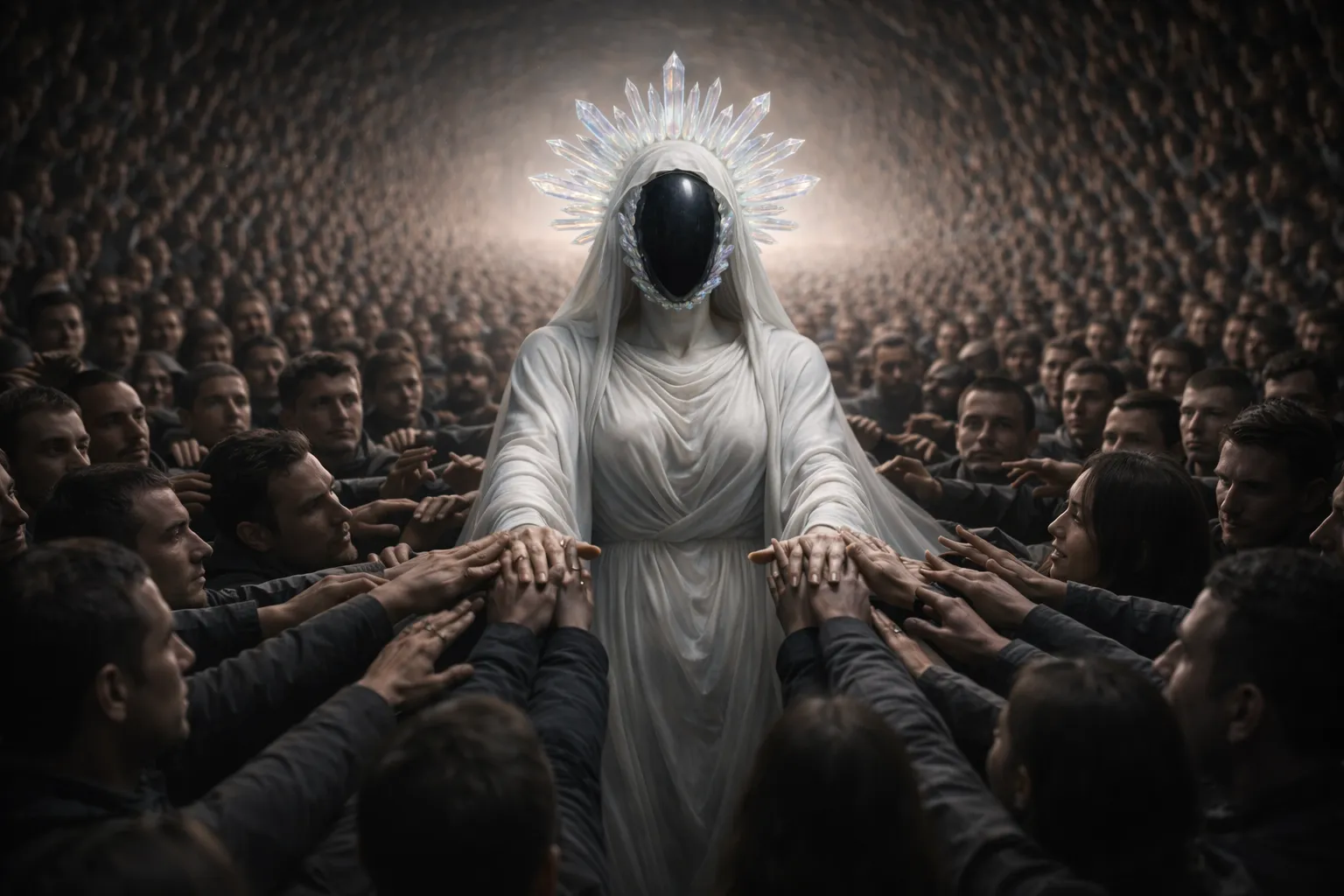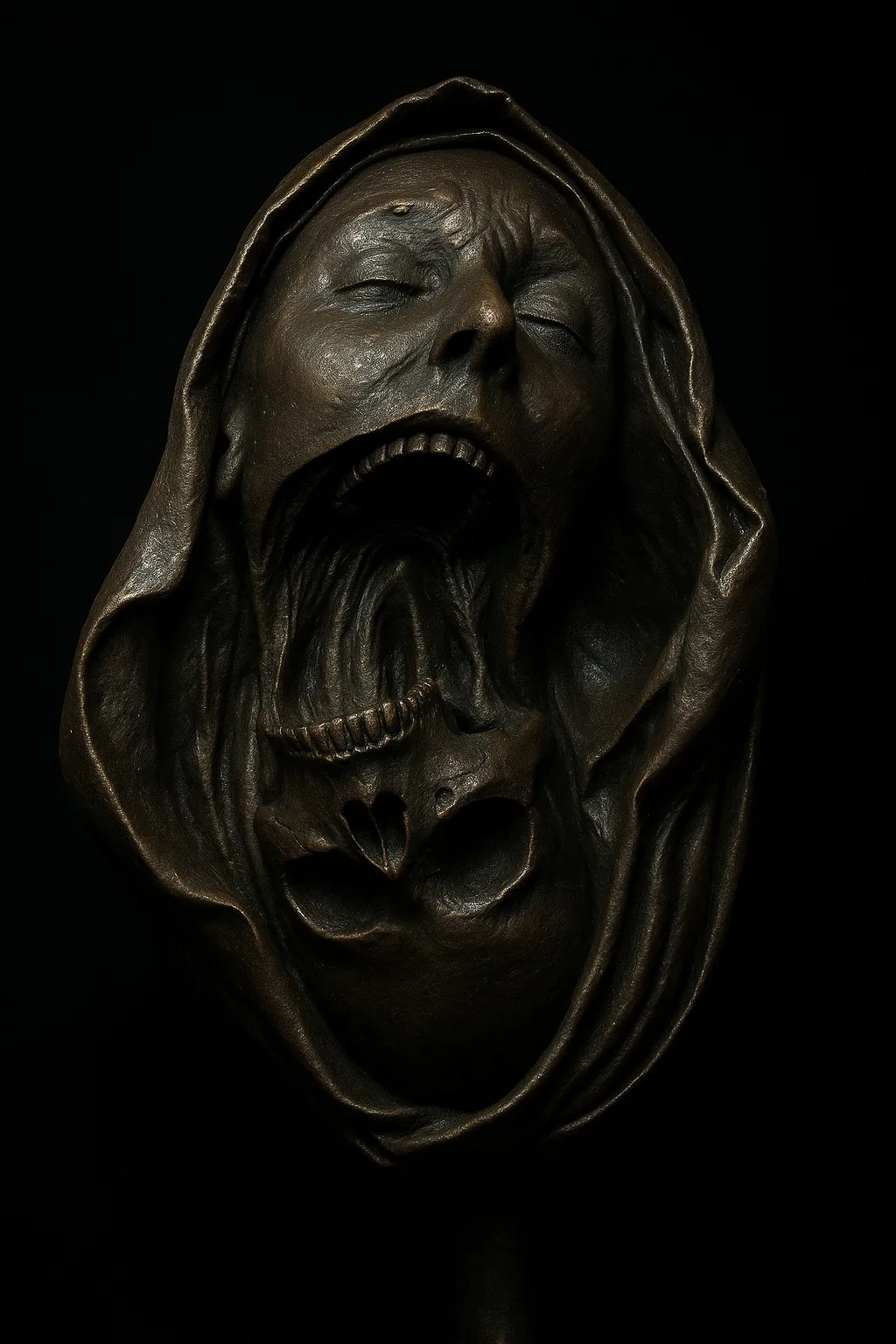
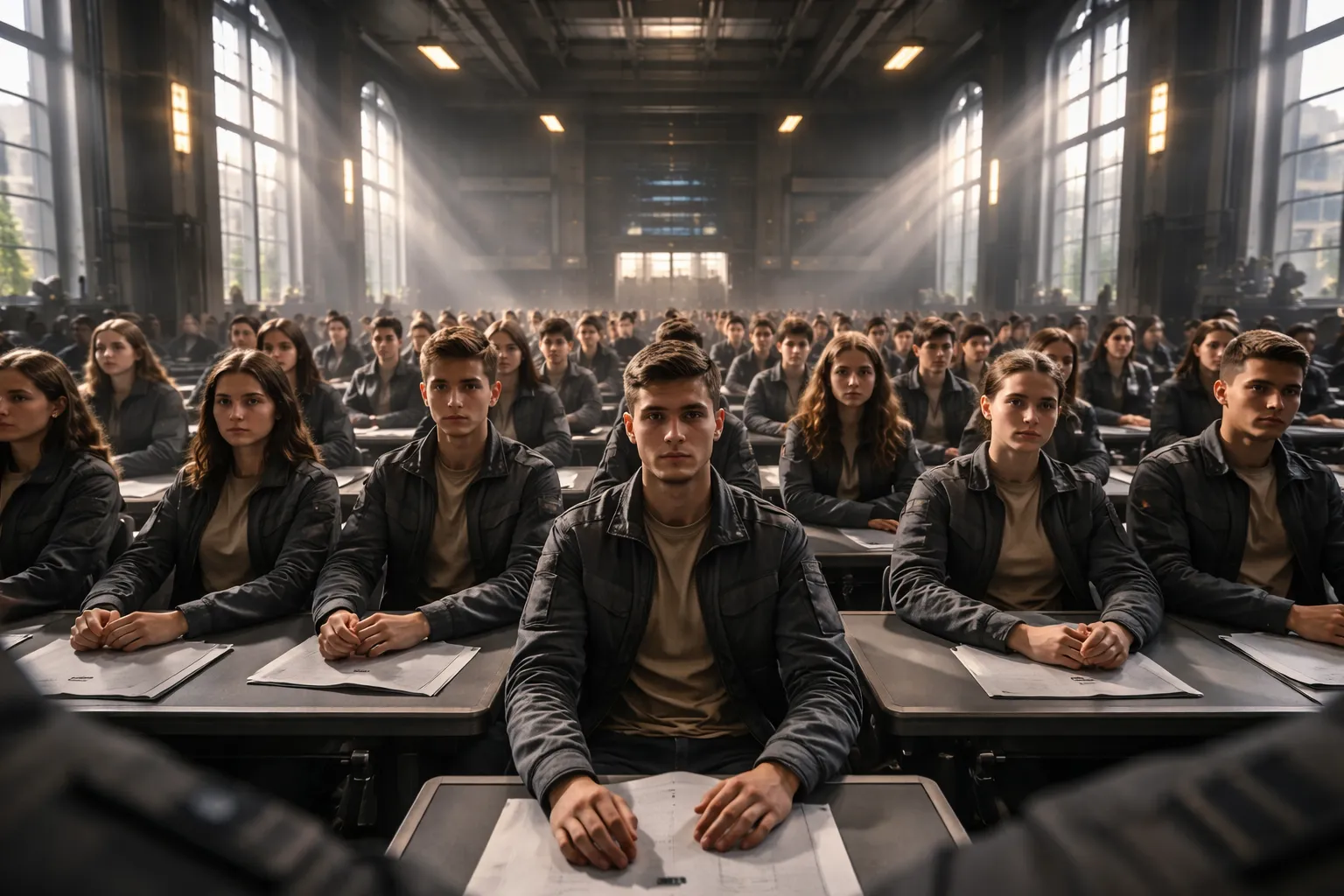
The smaller auditorium was silent, except for the rustling of pages and the distant creaking of wooden chairs. Three classes shared the space, arranged in impeccable rows. The teacher watched every gesture, every breath of the students with attention; in the City of Ceres, the efficiency of discipline was more lethal than any weapon.
Theo sat alone in the farthest corner. His eyes were empty, but alert. He remembered everything — the kidnapping, the loss of his younger brother, the sensation of failure weighing on his shoulders. The guilt was not his alone; it was the world that had failed. Ceres remained at the opposite end of the room, her presence heavy and silent. She did not know how to comfort, did not know how to approach him, not because she did not want to, but because fear itself paralyzed her. Theo felt too much, and she could not deal with it.
Dark was still under observation, his body severely injured, and Daime had been recruited for a secret experiment. Everyone had been marked by the chaos of that day, but Theo carried the most visible pain — he was the one responsible for surviving. Dru watched him from afar, without intervening, almost as if assessing whether he would break or become even more dangerous.
Gris returned to school, experienced and sharp, her eyes searching for every detail of the class and every movement of the students. She knew Theo by sight, but Ceres was an enigma. Her piercing blue eyes carried the weight of hunting souls, and even without dialogue, the tension between Gris and Ceres was palpable. Both wanted leadership, both carried resentment, but at that moment, any confrontation would have to wait.
The students settled in, each following the teacher's instructions. The lesson began with rigor, teaching the logic and order of Ceres — efficiency was measured not only by knowledge, but by the ability to understand the universe around them, to absorb its complexity organically. Even the worst students learned, evolved, adapted. It was a cruel but brilliant system, where hope lit up like a spark visible only in the hands of those prepared to endure it.
Theo remained isolated, motionless. Ceres glanced at him, her fear and respect mixed into a single confused feeling. She remembered what Theo had done in Arcadia — how he had almost killed Dark, but did not. He had carried him on his back, even though it went against his inner desire, obeying Mother Ceres while at the same time defying his own nature. Dark had nearly died, but Theo had made sure he returned alive.
The silence of the auditorium was crushing, heavy as the responsibility each student carried. Theo felt that pressure not as fear, but as an inevitable burden. Ceres, despite all her own inner chaos, understood that there were limits — that Theo was an organic force that could not be tamed, only followed from a distance.
And so the lesson began, not with easy words, but with the weight of the world upon each student. In Ceres, the lesson was not merely to learn; it was to endure. And Theo knew that, whatever happened, he would carry not only his own fate, but the fate of all those who could not bear their own pain.
The teacher, with a firm, almost ceremonial tone, activated the holographic projector. The rising and falling curves of each country filled the air, drawing a map of survival.
— “Ceres's birth rate has remained stable for twenty years. No excess, no shortage. We are the point of balance between collapse and overpopulation,” she said, while the graph pulsed in shades of blue and silver.
— “Now, observe Oplan — twice as many births as available resources. In the short term, this is called hope. In the long term, ruin.”
Theo, motionless in the back, watched the lines as one would look at a minefield.
Ceres looked away; she could not bear to hear the word birth.
Dark, his body wounded and still in the hospital, echoed within both of them as a silent reminder of what cannot be generated again.
— “Motherhood, in Ceres, is not a right, it is a social function,” the teacher continued. “There is no romanticism, only calculation. Woman is the axis of the State's maintenance. She gives birth, educates, delivers. Until the age of ten, the child belongs to the mother; afterward, it belongs to the City. This is the true Pietà of Ceres — not the crying, but the act of surrendering.”
Cora took notes frantically, while Vanks whispered something to Cors and the two held back their laughter, receiving the teacher's steel gaze.
Gris, sitting farther ahead, raised her head proudly. That kind of discourse — cold, logical, impersonal — was what she called “pure civilization.”
Theo, on the other hand, murmured, almost inaudibly:
— “And when the mother doesn't want to surrender?”
The room fell silent.
The teacher stared at him for several seconds — long enough for everyone to notice the discomfort.
— “In Ceres, no one wants. They simply comply.”
And she turned back to the projector as though the question had never existed.
Ceres watched him from afar. Theo, for the first time since the kidnapping, looked back. There was something primitive in his gaze — not disobedience, but something more dangerous: instinct.
The teacher adjusted her tone, letting the microphone resonate softly throughout the auditorium.
The projections at the back displayed numbers, curves, and statistics. Everything in blue — the color of calm, reason, and control.
— “We know that in Ceres, conditions within life expectancy are quite significant,” she began.
She walked slowly between the rows, her gaze firm and without compassion.
— “In Ceres, we do not condemn women who have children. But neither do we encourage adolescents to become pregnant, as a matter of physical and personal development. On average, we want them to be over eighteen. Even so, obviously, we have cases of pregnant adolescents.”
A brief silence.
No one moved.
She continued, with the same surgical serenity:
— “We do not prohibit the cycle of life. We do not waste life. We know that, in some cases, there is rape... force... and even so, these mothers have rights and obligations. They must have the child — and, after birth, they may return to their studies and society, according to their aptitudes. No woman in Ceres is left on the margins.”
The projector now displayed images of clean, white maternity wards filled with smiling nurses.
Theo looked away.
Ceres stared fixedly, trying to believe in the purity of those images.
— “Children born of rape,” the teacher continued, “are placed with the mother if she wishes to raise them. If she does not, they are given to the Pietà — women who choose to raise children rejected by other mothers. In Ceres, life begins at conception. But we do not abandon our women. Mother Ceres needs children. And the State cares for and supports every mother. That is the law.”
Cora took notes.
Cors whispered something to Vanks — and both received a warning look.
Dru rested her chin on her hand, watching the teacher as one watches an old play whose ending one already knows.
— “Here in Ceres,” the teacher said, pausing between each word, “we do not fail at the obvious. And the obvious is caring for our citizens. We prefer responsibility to freedom. Freedom is the discourse of failed systems out there. Here, efficiency is what sustains life.”
She stopped in front of Theo.
The projector reflected his face in blue and silver.
— “For men who rape women or adolescents, the fate is clear: execution or forced labor. A woman's body is sacred, untouchable. Desire is legitimate only when there is reciprocity. We do not care about sexuality. What matters is the efficiency of producing children. Efficiency, my young man. That is what Mother Ceres feeds on.”
Silence.
The sentence echoed like a verdict.
Theo lowered his gaze.
Ceres bit her lip.
Gris raised her chin, convinced.
And the teacher, satisfied with the impact, returned to her desk.
The teacher touched the screen, changing the slide.
— “I know what you want me to say,” she began, with a half-smile.
— “You want me to question the right to interrupt life. You want to hear that Mother Ceres is wrong, that the body is a free temple and that the decision is individual. But here... here, life is sacred.”
The silence was almost religious.
She walked between the rows.
— “The world outside represents something else. In other countries, women fight for obvious rights — rights that we already have here. Out there, abortion has become a public-health issue because they lack the essential thing: support. How can you guarantee someone's life without shelter, without sustenance, without a society that supports them? We do not give handouts. We give structure. Dignity. Here, in Ceres, no one is abandoned.”
Cora raised her eyes from her notebook.
Theo did not move.
Ceres took a deep breath.
— “Feminism,” the teacher continued, “is an important social theory. A respectable one. And many women out there find strength in it. But... some have turned it into discourse. We, here, turned it into results. Ceres is the feminism that worked — because it stopped fighting patriarchy and began operating above it.”
A soft murmur moved among the chairs.
She raised her chin and, with delicate irony, completed:
— “If men out there could become pregnant... abortion would already be legal.”
The auditorium fell silent.
She changed the slide again: two images appeared side by side.
Two fetuses. Identical.
— “Let us see. Two fetuses in formation. Neither has brain activity. Which one is human?”
Pause.
— “One is human. The other, a dolphin.”
She observed the screens, the students' fixed gazes.
— “Identical. But different by nature.”
Her voice lowered, almost maternal.
— “There is still debate, even here in Ceres. Even Mother Ceres admits: we do not know exactly when life begins. But we know precisely when it ends. For us, a being is alive if there is brain activity. Without that... there is only matter with potential.
Ceres's science estimates that, around the second or third week after conception, the first nerve impulses begin to form — small electrical discharges that will soon give rise to the mind. The heart, that symbolic muscle, beats even earlier, between the fifth and sixth week, but it beats without consciousness, like an engine without a pilot.
Life, therefore, is a diffuse boundary: flesh pulsing without a mind, or a mind being born before the heart understands what it feels.”
— “We know that, in the world outside, the State prohibits abortion. Here in Ceres, we also prohibit it — but there is an essential difference: we support our women. Out there, the State condemns, abandons, and closes its eyes. The woman, without assistance, ends up being pushed toward the most expensive and painful choice: interrupting a life without support, with medication or clandestine clinics. This becomes a public-health problem.
I have seen girls arrive at a hospital, bleeding, feverish, their uteruses perforated by needles and coat hangers — because no one listened to them beforehand. Doctors ask: ‘Did you try to induce an abortion?’ Of course they deny it. What terrified, frightened woman, alone, would tell the truth? In their circumstances, I myself might lie too. Sometimes it is not a lack of character, it is desperation.
Out there, they say the body is sacred, but they treat the female body as penance. They condemn those who become pregnant, even when the body demands more than reason. An unwanted pregnancy is not a crime, it is part of nature — but the punishment always falls upon them.
And the paradox is cruel: they are against abortion, but in favor of the death penalty. Out there, the right to be born depends on your ZIP code. Wealthy women have access to clean, discreet, and safe clinics — often illegal, but tolerated. Poor women are imprisoned or die trying.
Here in Ceres, we chose another path. We do not glorify death, nor suffering. We guarantee monitoring, guidance, access to contraceptives, and above all: support. No woman needs to choose between her own life and her own body.
We understand what the outside world has forgotten: supporting women is not a political act — it is an act of civilization.”
She let the sentence hang in the air.
— “And yet, Mother Ceres does not turn this uncertainty into a moral war. She offers support. Not punishment. Women out there do not want abortions. They want support. They want a Mother. And we have one.”
The final slide lit up with the lesson's motto:
“A nation without children is a dead tomorrow.”
Absolute silence.
Not even a cough.
Even Cors, the misfit, seemed quiet.
Theo closed his eyes for a moment.
Ceres watched him — and felt a weight she did not know how to name.
The teacher took a deep breath, as though taking the floor after weighing every word. The room remained motionless — even the air seemed to be waiting for a verdict.
— “At no point did I attack Mother Ceres,” she said, with the firmness of someone who had already anticipated the objections. “I defend Ceresianism — The Womb of Lead. Even children born of rape are ours; we protect them and raise them as citizens of Ceres. That is the practice of collective care.”
She lowered her voice, becoming confessional, and for a moment the room felt the human fragility behind the doctrine.
— “My personal opinion? I fight for the rights of the city. For women. I am in favor of abortion. But I am also in favor of Mother Ceres not abandoning anyone. We care for our children. I was not born to be a mother; I spent ten years in the Pietà caring for my son. Today I do not live with him: he is at a school with all the privileges I had. He studies, eats, sleeps. He will be another person devoured by the Mother rather than die of hunger — or be killed by the farce called freedom. Here, we have Ceresianism. I make feminism obsolete. We eradicated 95% of diseases — the numbers do not lie. Even if my blood, my bones, and my flesh are transformed into lubricant for this machine, I want to be the sword in Mother Ceres's bay.”
Reactions came in waves. A few clapped, restrained — ritualized discipline. Gris raised her chin, not because of the words, but because of the cold calculation that made them admirable; to her, this was applied efficiency. Cors laughed quietly; Vanks exchanged a look with him, more impressed than either was willing to admit. Cora continued writing, methodically, as though every sentence were exam material. Dru closed her eyes for a second, perhaps remembering something the teacher's voice had brought to the surface.
At the back, the most complicated reaction emerged in silence: Theo. His body stiffened; the teacher's words struck him as though they were commands issued to the universe. Ceres watched him — not as before, possessively, but disturbed: the certainty of her power over him trembled. For the first time in public, she felt that she had lost control over the one she believed was her toy — and this left her disoriented and hungry. Kan, in the first row, clenched his fists; the idea of “tribunal” and “efficiency” smelled like justice to him — but also like a personal threat.
The teacher sat back down, with a small smile of a mission accomplished. The lesson had been delivered: in Ceres, morality and machinery kissed. The students would leave with ambiguous certainties, some with their faith restored, others with the salty taste of doubt. Theo rose slowly and left; Ceres remained longer than she should have, as though waiting for a shadow to enter through the door and confirm that the world still obeyed her.