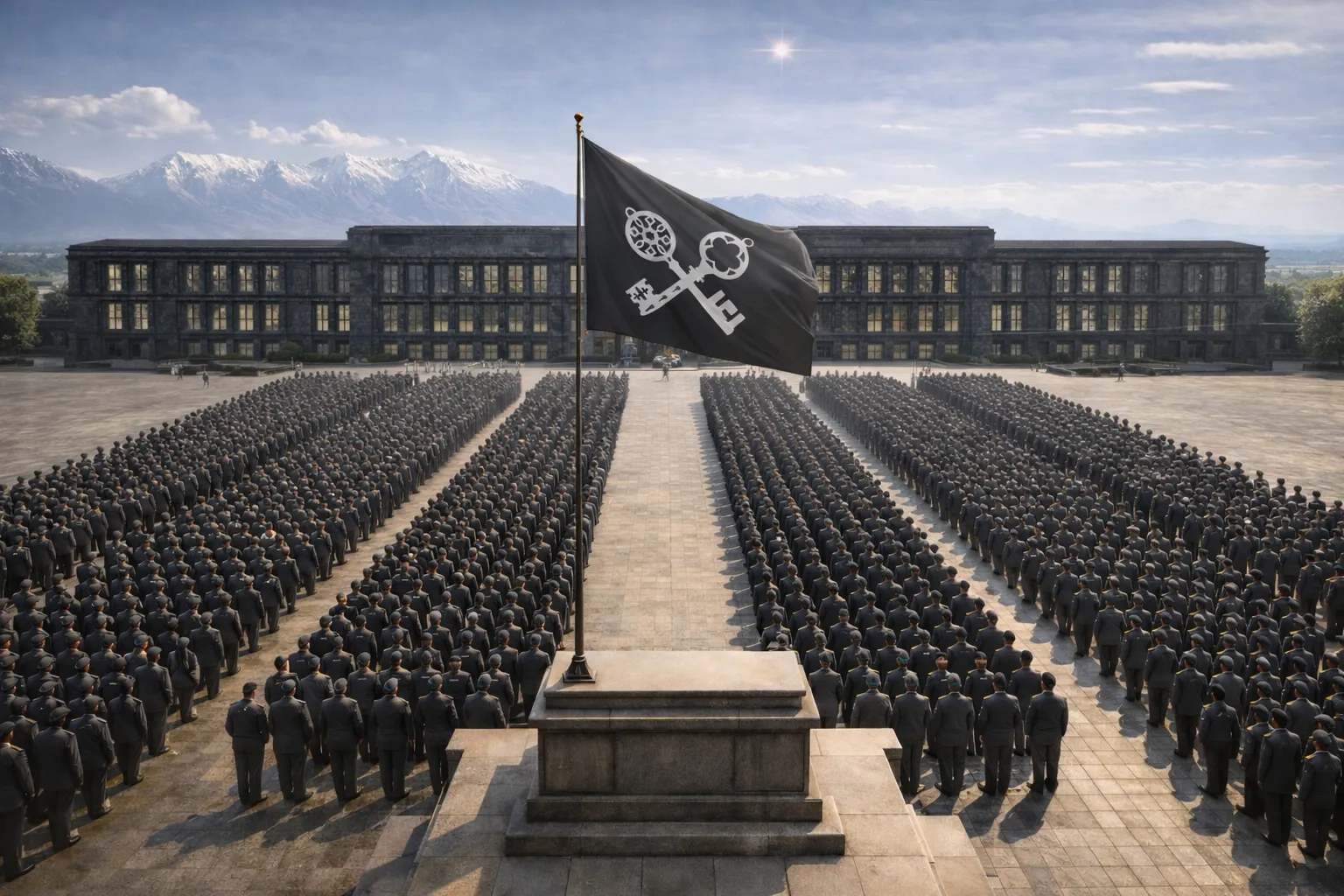
Under the dull afternoon of the following day, Mother Ceres’s military funeral was held.
She was not present. She was too close to the border between Silencium and Arcadia — for diplomatic reasons and, above all, to preserve her own life and keep the heart of the continent intact.
In the highest tower, isolated beneath her opaque black glass mask, Mother Ceres cried.
Fifteen of her children had been killed at the Ceres College, only three kilometers from the tripoint border.
We know how the world names its losses: a child without parents is an orphan. A man or woman without a spouse is a widower or widow.
But when a child is lost... there is no name.
It is so unnatural that language refuses to name it.
Never, in the entire history of the City of Ceres, had anyone heard Mother Ceres cry. Never — until now.
Men from Arcadia, in silence and shadows, invaded the school with a platoon of eighty heavily armed soldiers. They entered like ghosts driven by hatred and killed fifteen children. Fifteen young people who had not yet become men or women. Fifteen seeds of tomorrow.
But they resisted.
The children themselves, trained for generations for a possible attack, fought back. Fifteen fell — but took twenty-five with them. They died fighting.
They died as daughters of the Mother.
"The world is constantly at war; peace has always been an accident."
My children died. My children. My children who were not even adults.
My children who were still inside my womb.
In the courtyard of the College, at the easternmost edge of the center of Ceres, perfect rows were formed.
Almost five thousand students, side by side, lined up in silence.
At the center, three armored tanks on wheels. In front of them, the compost crematorium — modern, without toxic smoke, returning to the earth what the war had torn away.
At the back of the courtyard, ten cannons fired in honor of those who died and those who lived to defend the city’s children.
Because in Ceres, the dead return to the earth.
And the children of Mother Ceres return to sow the world.
Beside them, a flowering field shone.
It looked like the entrance to a sacred palace — the palace of a forgotten god, or of a god who had just died.
The absolute silence was broken only by the hum of bees gathering pollen, and by the deep sound of the fifteen cannon shots, with five-minute intervals between them — one for each life lost.
All the students wore the dark gray uniform of neutrality.
Berets firm, eyes forward, posture straight.
There was silence, yes — but inside each one, a scream of horror.
Fifteen children dead.
Fifteen familiar faces.
Fifteen futures interrupted without mercy.
In the courtyard, the flag of Ceres fluttered — imposing — with its crossed keys against the cloudless sky.
It was as though the sky itself refused to witness it.
As though, if there were a god, he had chosen not to be there.
Theo, Ceres, Vanks, Cors, Kan, Ana, Dru, Tycho, Cora — all lined up.
Motionless, as though sculpted from marble.
At the exact moment of the cannon shots, the cremation of the coffins began.
Black coffins.
When a child dies in Ceres, their coffin is black.
Black as the void. Black as mourning. Black as the darkness that consumes the world when a life still in formation is interrupted.
It was impossible to contain the emotion.
Sobs. Tears. Tears.
But no one abandoned their post.
Some collapsed — fainting. But it was not weakness.
Everyone knew: the body had merely surrendered to pain.
It was the reflection of blood returning abruptly after the shock.
Those who rose again on their own returned to alignment, to silence, to duty.
Not out of obedience, but out of reverence.
Because there, in the heart of the city, among tanks and flowers, among ashes and pollen, between life and death —
the children of Mother Ceres learned to cry without falling.
At the entrance of the College, there was a gigantic poster printed on white fabric.
It was a letter — handwritten — left by one of the daughters of Ceres.
Euri.
A young girl with lively black eyes, loose curly hair, rosy cheeks. She wore large, heavy glasses and always kept her notebook immaculate. She was a diligent, curious, sweet student.
She was one of the children who died.
It read:
“Oh, Mother Ceres, how I love you.
I love my school, which always smells good — a smell similar to Pietà.
Thank you for existing.
Here, I have the privilege of studying, growing, learning so that I can help you grow more.
I am lucky that my mother is a teacher — I can see her every day. I feel at home.
My greatest desire is to be an astronomer. I want to help you climb to the stars, which are the place of your still-living goddess.
I want to build, with your blessing, Ceres 3, so that you can embrace the world and bring Ceresianism to all peoples.
A world without hunger. A world with a home. A world with perspective.
Sometimes I dream that you carry me in your arms, as you carried me in Pietà.
I dream that freedom is suffocating, as you teach us…
Freedom does not feed. It only feeds unrealistic expectations. It does not guarantee survival.
Of all the gods, religions, and rituals…
Mother Ceres never promised anything.
Mother Ceres delivers.
Peace is merely an accident.
Mother Ceres is survival.
Mother Ceres, who feeds us.
Who educates us.
And who devours us.”
The silence was absolute.
Euri’s mother stood before the poster, as though waiting for her daughter to step out from within the words.
She did not cry.
She did not speak.
But she was in ruins.
One by one, people approached.
They offered no consolation.
They merely touched her shoulder — an ancient gesture, without origin, but filled with meaning.
It was as though everyone, by touching her, were saying: we are with you, even if we cannot be with her.
Euri’s mother repeated the mantra, almost in a proud whisper:
“Mother Ceres, who feeds us,
who educates us,
and who devours us.”
At the front of the formation, lined up like statues:
Ceres, Cors, Vanks, Kols, Jude, Ani, Kan, Beks, Tiron, Vinks, Turks, Oron, Def, Luk, Dan, Rit.
They received medals of honor.
The boys received Mother Ceres’s Dagger — a symbol of struggle and protection.
The girls received Mother Ceres’s Tear — a symbol of sacrifice and fertility.
Both heavy. Both cold. Both irreversible.
Then each received a dark gray letter, sealed with the crossed keys of the national flag.
No words were spoken.
Only the sound of the cannons in the background, like ancient thunder across an open field.
They spoke for everyone.
On the back of the envelope, a single sentence:
“Only open in your quarters.”
Beside the courtyard, where five thousand young people remained motionless in their rows, stretched a flowering field known throughout the school as “Cora’s Flowering Field.”
At first glance, it was simply a beautiful garden — soft, delicate colors, almost out of place in the face of so much death.
But everyone knew its true meaning:
There grew the flowers of mourning, cultivated with the ashes of Ceres’s fallen children.
The ashes were collected after the silent cremation in the composter, which eliminated any toxic smoke, returning the matter to the earth.
Each flower that bloomed carried, in its colors and shapes, the memory of the one who had departed.
Cora’s Flowering Field was not merely a memorial. It was part of the system.
A living cycle, where death fed life — and where doctrine became tangible.
As the students said, in the whisper of silence:
Mother Ceres who feeds us,
who educates us,
and who devours us.
In the end, everyone would return to the field.
As a flower.
As pollen.
As a root.
It was known throughout the school as Cora’s Flowering Field.
There, where the flowers of mourning grew.
There, where ashes fed petals.
There, where every color carried a silent name.
And someone — no one knows who — whispered, too softly to be reprimanded:
“Who said that in Ceres there is no afterlife?”
At the end of the ceremony, the cannons fell silent.
The last body had become a flower.
And in Cora’s Field,
the bees continued to work.