Those eyes so large on a baby, pale skin, the blue eyes that had belonged to Assum — her name was Ceres. All the surrogate mothers, the mothers who had lost their children during childbirth or through tragedy, or those who had chosen to become mothers to children orphaned by mothers who died giving birth in Pietà, went to see her. Those beautiful blue eyes… they all knew whose baby she was: she was Assum’s, who had unfortunately remained in Silencium, daughter of the cruel dictator, but an ally of Mother Ceres. Assum had been traded like merchandise, but merchandise that now shone in the skies above the city of Ceres — at the Ceres 2 space station, the first one destroyed by Opus Omni for considering it blasphemous, but whose preparations had been given by Arcadia as an affront to Mother Ceres.
The child’s eyes were identical to Assum’s: powerful, captivating. She was the image of her mother. The mothers watched little Ceres, frightened, because her name was the same as Mother Ceres’s. They gazed at her with admiration and fascination, mixed with fear. It was not only her name; the baby seemed to look at them as though disapproving of them. She showed no smile with her rosy cheeks; only a nurse, accompanied by a local secretary, carried the child. Some mothers tried to approach her in the crowded corridor, but the child shook her head at anyone who came near. It seemed she recognized only her own mother, Assum.
Even as a baby, Ceres knew how to distinguish what was a lie from what merely pretended to be true. The corridors, illuminated by pleasant light, smelled like home — an environment perfumed with the scents of mothers. But the child seemed to recognize only her mother. She looked, even though she was incapable of identifying faces, but she knew how to read the patterns of shadows, shadows she would never see again: Assum’s shadow.
The child was placed in the crib. She remained quiet, but watched the shadows, trying to find Assum. The secretary knew who she was and said that she needed a mother — not the best mother, but the mother capable of enduring that child. The secretary knew that, even so small, Ceres would be difficult.
So she chose the one who could endure her: the one who carried the city of mothers on her back, not because she was strong, skilled, or intelligent, but because she endured everything in the name of the Great Mother. She called for Agar. Immediately, she was there. The secretary said:
— Even if your tits bleed, do not let her go hungry!
Agar, frightened, knew that this child had hatred in her eyes. She was a baby who did not even know it, but her eyes hunted liars. Ceres stared at Agar’s shadow with something indestructible in her gaze, a look that told Agar she would have to endure that child, whatever the weight of her presence.
Hours later, Ceres and Agar were housed on the upper floors, in a cozy mothers’ room. Ceres was in the crib, and Agar tried to interact with her, but the child only watched her, trying to memorize her shadow. Even without seeing details, only shadows, Ceres knew that this was her mother. But it seemed that, already inside her, there was the coldness and impetuosity of Chancellor Aquila, the dictator of Silencium, the bloodthirsty overseer of the Gifts.
The room was pleasant, well ventilated, with a comfortable temperature. It was filled with colorful educational toys; on the table were clean towels, fruit for the mothers, teas, cookies, and freshly baked bread from the Pietà cafeteria. It was the room of tranquility. The floor-to-ceiling window opened onto a balcony, and the view stretched toward the lake, sandy fields, playgrounds, and children playing, being cared for and educated by their mothers. The sound of laughter echoed through the room; clean children ran from one side to the other, while others sat in their mothers’ laps. Beside them, educational classrooms taught sensitivity to developing children, while children from five to nine years old were in more disciplinary classrooms, carrying out more elaborate activities according to the system of the city of Ceres.
In the distance, a small grove; behind it, large rectangular buildings, irregular in shape, without windows, made of black marble. The day was beautiful, it seemed as though God had descended to Earth and drawn everything… but make no mistake: it was Mother Ceres who made it.
In the room, little Ceres became irritated with Agar. She began to cry from hunger. Agar picked her up and tried to rock her. Ceres became quiet for a few seconds, observing Agar’s black eyes with her enormous blue ones, analyzing her hair, trying to identify patterns. It was somewhat similar to Assum’s, but it was not Assum.
Agar tried to breastfeed the child. Ceres bit her and began to cry even harder — her hunger was intense, but this was not her mother’s breast. There were long attempts. Ceres cried, bit, and resisted. Then Agar remembered the secretary’s order: “Even if your tits bleed, do not let her go hungry!”
Ceres calmed down only when she finally began to nurse, but not without anger and hatred. Her hunger was greater than any feeling she could contain. The battle between that child and her surrogate mother was terrible. From an early age, Ceres already understood: even food that did not belong to her had to be conquered and dominated so that she could survive.
Agar fed Ceres between bites and outbursts. Sometimes the child calmed down. Agar wondered what that child had gone through, who her father could be, how a baby could inherit such defined behaviors. Even so, she began to love Ceres as if she were her own. Agar had been born to be a mother — to care for the rejected children, the children orphaned by dead mothers.
Sometimes Ceres played alone. Only Agar noticed that, whenever she sensed her presence, the child became calm and serious, recognizing patterns: smells, temperatures, the rhythm of the environment. Years passed like that. Agar loved Ceres, even through bites and fits of fury. With time, the child began to calm down, accepted embraces, allowed contact. But there was no ordinary relief of childhood there. Everything was calculation and patience.
When Ceres embraced Agar, she kept her gaze serious, fixed, with those large blue eyes — eyes that judged. Agar felt a certain fear of them. It was as though the child were reading her, as though saying, without words: you are not my mother; I only need you to live. Agar did not care. Her gift was to be a mother, to care for, to sacrifice herself for that child who was far too important to the world.
Agar knew that, in the future, Mother Ceres would have the bastard and excommunicated daughter of Silencium. Chancellor Aquila, the dictator who reaped Gifts, could not have children — but the miracle happened. A miracle born from the union with someone cruel and unscrupulous; someone who, if a god existed, would have been ashamed to have created. Any demon would be more sympathetic and seductive than Chancellor Aquila.
He wanted Assum’s Gift: her voice and her soul. He got neither. Assum was another strange force. Agar knew she had been the only one to defeat Mother Ceres — not with speeches, nor logic, but with her divine voice. The voice that everyone now knows as The Voice of Ceres.
Every day, at seven in the evening, the loudspeakers throughout the City of Ceres played Assum’s music. There were no lyrics — only a humming capable of enchanting even the most bestial creatures. As a consequence, tears flowed, proving that souls do not bleed blood, but salt water.
Assum was Mother Ceres’s favorite. She lived with her in the tower, displayed to the world through her music. She sang in several countries. And yet, even rebellious and eloquent, she deeply loved Mother Ceres. Before convincing the Mother, she begged her to kill her, because she could not bear living without singing; she asked them to tear out her vocal cords.
Mother Ceres was defeated.
There, she showed that there was still something inside her.
There was a soul.
Agar watched Ceres develop. The child played alone, organized her toys and then immediately disorganized them, as though testing order and chaos. Sometimes she went out with her surrogate mother, but never approached other children. She always kept a serious expression, her eyes alert, tracking everything around her. She did not seek interaction.
There was a moment in the park, on the grass near the lake. In the distance, the chatter of children beneath the shade of a large fruit tree. Ceres stopped playing, walked toward Agar, looked directly into her eyes, and embraced her. It was not an embrace of comfort. It was attachment without attachment, as though she were simulating a learned gesture. She closed her eyes and rested her face against Agar’s, searching for a mother’s scent — not Agar’s, but something she had carried since birth: the memory of a mother who recognized her from within.
Agar welcomed her, despite her apprehension. That child seemed to carry the world in her blue eyes, eyes that reflected the sky itself. She developed quickly, but in isolation. She spoke little.
There was, however, something that frightened Agar. Every time The Voice of Ceres was played, the child reacted. An almost-smile appeared, automatic, like a biological clock awakened by that sound. Ceres did not know what the music was. She did not know where it came from. But her body recognized it.
It was Assum’s voice.
At seven years old, Ceres became rebellious and reclusive. She refused to go to school, disappeared into the woods, hid among the trees, entered the lake, covered herself in mud. She seemed not to recognize the City of Mothers. She attacked other children when they called her blue demon, because of her large blue eyes. She almost tore one child’s finger off with a bite.
Agar defended her tooth and nail. Sometimes she resorted to archaic, harsh corrections, but Ceres would not yield. She screamed:
— YOU ARE NOT MY MOTHER! DON’T DO THIS TO ME! YOU ARE NOT MY MOTHER!
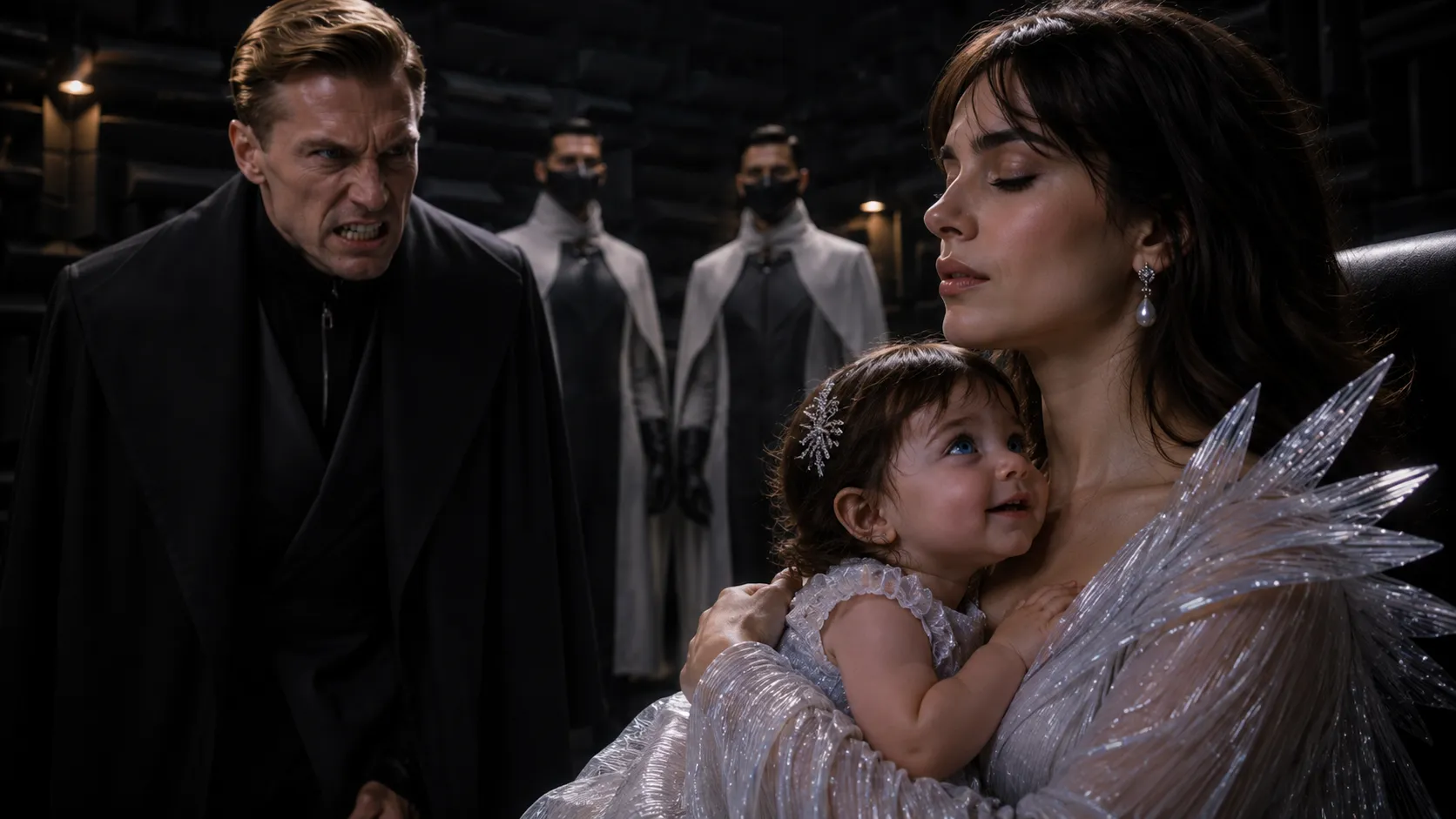
That brought Agar down. Even so, she never walked away. Ceres hurt her deeply, wounded even her ego, but Agar remained. She remembered the secretary’s words from years before: “Even if your tits bleed, do not let her go hungry!”
Now, inside her, the sentence had transformed:
Even if your hands bleed, do not abandon Ceres.
One silent dawn, Ceres slowly awoke. From the balcony where she had always taken refuge since arriving there, she saw Agar crying silently, between restrained sobs. She murmured an internal prayer, asking Mother Ceres to comfort the child’s heart. She said that Ceres was neither good nor evil — only capable. Capable of surviving at any cost, just as her true mother, Assum, had survived for Pietà.
Agar begged that child to have a chance to live. That she herself might endure for loving her too much, for carrying the sacred name of the Great Mother. That her role might be only this: to be a mother for Mother Ceres — the one who feeds, educates… and also devours.
Ceres heard everything.
She said nothing.
She returned to bed.
Morning was coming.

That same morning, beneath a strong sun and blue sky, Mother Ceres appeared in person, accompanied by her secretaries. There were almost no men there — not even the Silencers entered. The Womb of Lead was absolute in its protection.
All of Pietà became restless. The mothers knew: the Mother of Mothers was there. She wore white, with the veil that seemed to float around her head. She did not wear the iridescent crystal crown. Only the oval mask with black lenses — no one had ever seen her face.
Mother Ceres appeared without warning. She would not waste time. She went straight to what mattered: Agar and little Ceres’s room.
The two were there. Agar was startled and rose from the armchair where she had been reading to the child, serious, when she saw Mother Ceres cross the cozy room. The secretaries remained outside in the corridor.
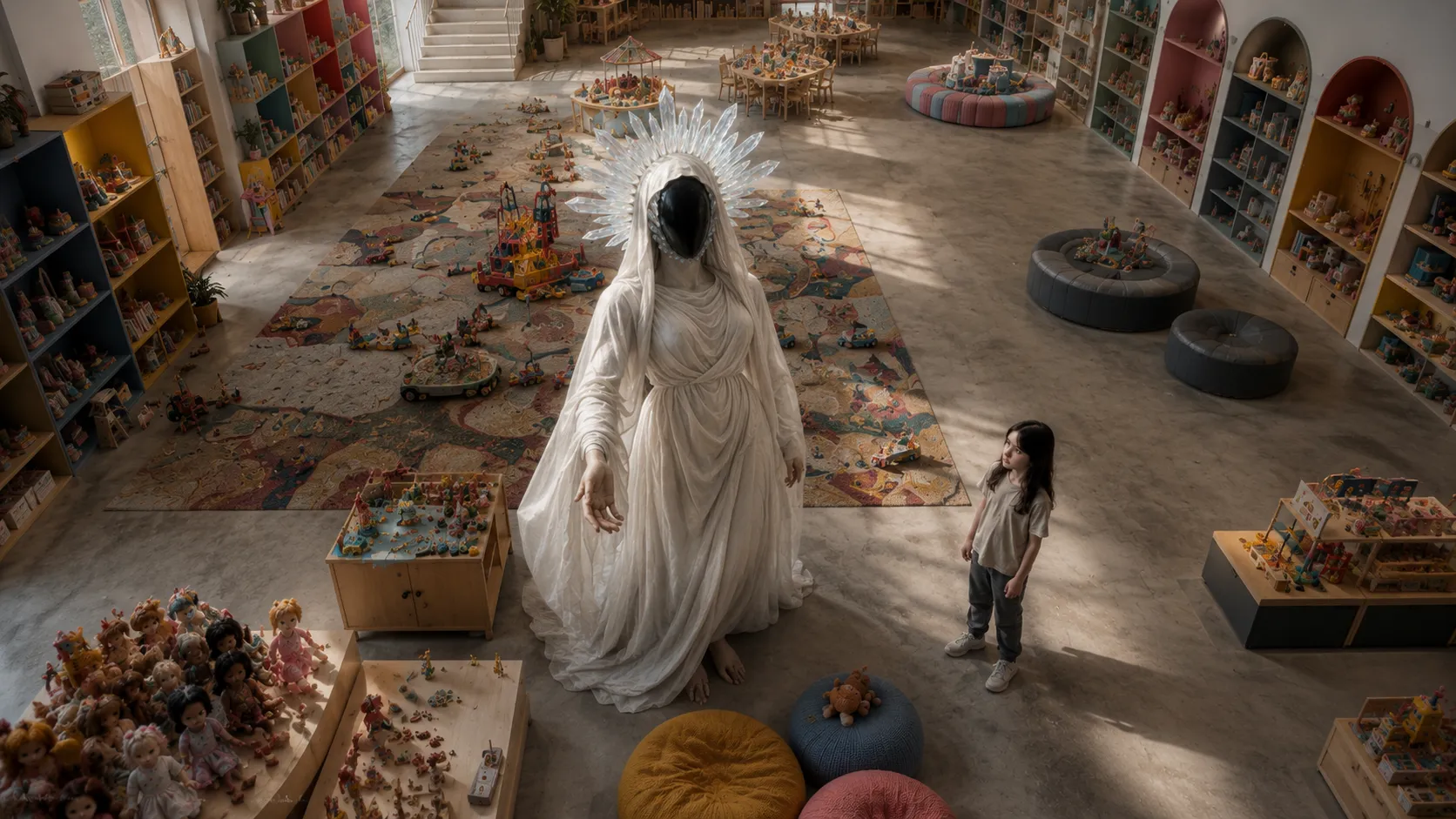
Little Ceres showed no fear. She looked at Mother Ceres. The two stared at each other, face to face, in silence. Only the distant murmur filled the background. Seconds that seemed like minutes.
Mother Ceres then knelt, bringing herself to the child’s height.
— Do you know why you have my name? The name of this city? Your mother, Assum — the one whose voice you hear every day at seven in the evening — is your true mother. Assum loves me as a mother, and she gave you the most sacred name to her. Agar is your foster mother. Respect her. You do not have to love her, but respect her.
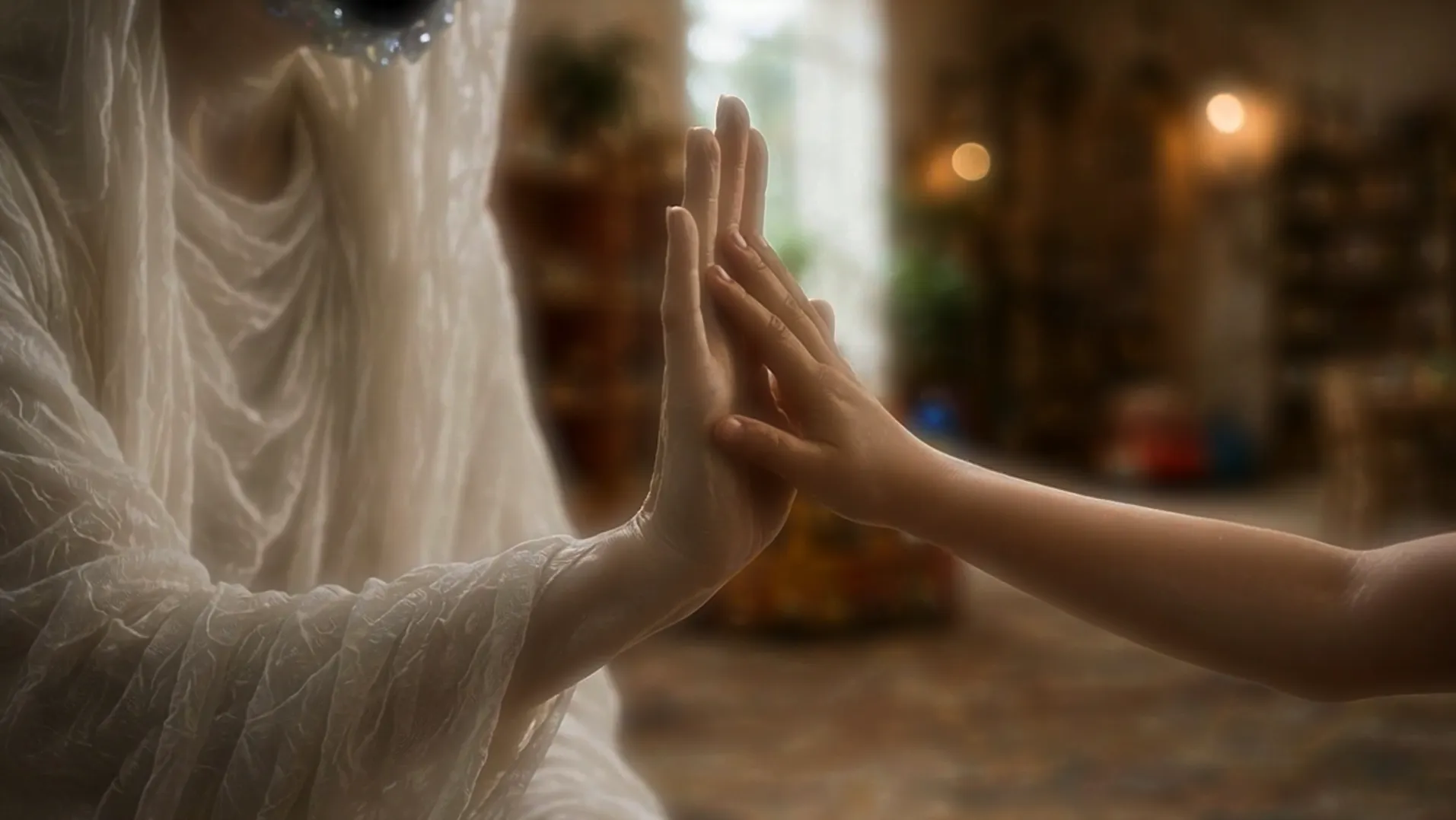
Without lying, Mother Ceres slowly raised her hand — not toward the child, but as someone confirming a truth. Ceres understood: even without a face, she did not lie. She simply affirmed what had always been there.
The little girl approached. At the same height, she placed her hand against Mother Ceres’s larger hand. She looked into the black lens of the mask, saw her own reflection, and understood the only truth without varnish that everyone had denied her.
— Look at your little hand in mine — said Mother Ceres. — When your hand is the same size as mine, you will know Assum. Until then… use that impulse inherited from your father to survive. You are important to me, my daughter. Very important.
Ceres felt the truth. She smiled. She embraced Mother Ceres and showed an affection she had never shown before — the affection of a child who recognizes the truth, not empty promises. A real world.
After the embrace, she returned to her desk and began her tasks without looking around.
Mother Ceres stood and said to Agar:
— I make no promises. I want old ideas so that new ideas may exist, under any circumstances.
Agar felt relief. It had not been a complaint. It had been recognition.
Being a mother was already a gift.
Being a present foster mother… was something greater still.
Without lies, without varnish, without the weights that had crushed the child, Ceres began to apply herself as someone fulfilling a purpose. Mother Ceres had given her purpose: to take care of herself, become strong, competitive, evolve. The waiting would be rewarded.
Ceres followed her own destiny like a manual. Everything around her was noise. There were many children in Pietà, but that demon-child had been shaped differently. She replaced feelings with lead.
Always isolated, yet effective. Alone, but surrounded by books. Silent, while her mind crossed through hell. It was the price until Mother Ceres called her again.
The ideal age arrived. At ten years old, she would leave Pietà — the City of Mothers — for military school. She wore the dark-gray uniform, a simple beret, and carried a small suitcase.
At the entrance to Pietà, in the distance, stood the Immaculate statue of Mother Ceres: babies in her arms, full breasts like ripe fruit offered to her children, two kneeling at her feet asking to be held.
Ceres and Agar were together. Agar adjusted the girl’s collar — the last gesture of care, the last gesture of a mother. Before them, the military bus waited, carrying Ceres and other children destined for military schools scattered throughout the City of Ceres.
The white Carrara marble of the statue contrasted with the black marble in the background: power and control, absolute indoctrination, survival above freedom.
Ceres slowly looked at the statue. Then at Agar. Her eyes filled with tears. They remained silent. They would never see each other again. They would never again recognize each other’s scent. It was doctrine. No one would die. Everyone would survive. But they would pay with absence.
Ceres embraced Agar and whispered in her ear:
— You were a good mother. That is your gift. You are not my true mother, but, for all these years, you were as good as she was. Your gift is to be a mother.
There was maturity in those eyes, in those restrained gestures. An energy channeled through doctrine.
But the hatred remained there, intact — inherited from her father.