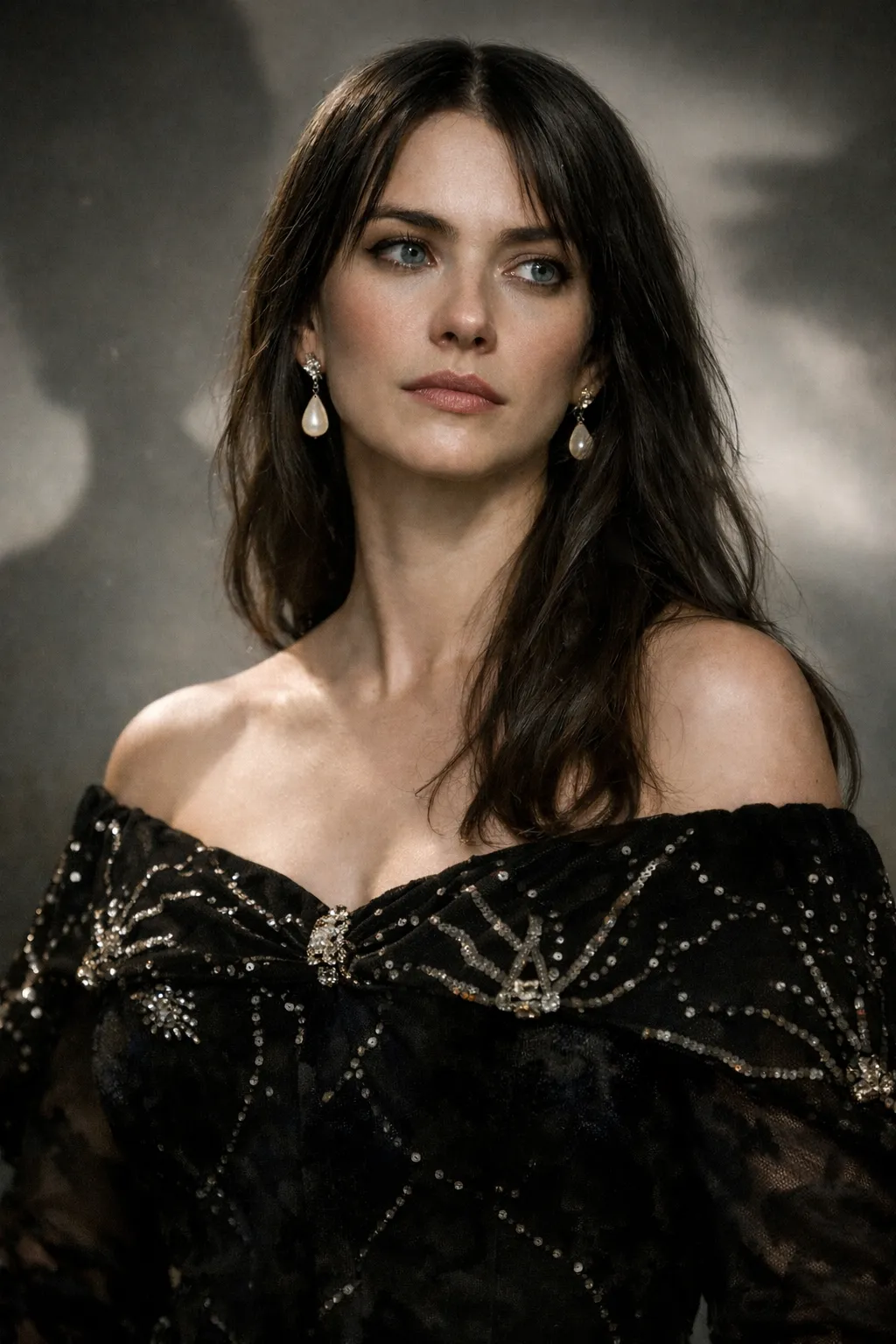
Assum was the only official singer in the City of Ceres.
Although music was forbidden, she was known as the woman with the voice of God.
Lyrics were prohibited, but Assum hummed — she sang melodies at public appearances, in schools, and even before Mãe Ceres herself.
She was the only libertarian in Ceres who enchanted Mãe Ceres enough to make her cry.
Assum was subversive — not because she hated the System, but because there was something inside her that could not be contained.
It was not rebellion.
It was calling.
Her singing was stronger than silence, purer than orders.
It was the soul of the city transformed into sound.
She did not defy Ceres out of vanity.
She was possessed by an uncontrollable gift — as if the city itself were singing through her.
She was the only one who, without raising banners, mocked Mãe Ceres… and enchanted her.
No one else had that voice. It was unique across the entire continent.
Mãe Ceres, who had conquered myths and gods, was defeated by a song.
And so, she named her “The Voice of Ceres” — the same name given to the daily broadcasts at 7 p.m. on the city's official news program.
The old long-range radio waves still echoed in distant places, even in Silencium — where, ironically, absolute silence prevailed.
Assum was breathtakingly beautiful.
Long black hair, straight as a river.
Skin pale as marble.
And blue eyes so deep they seemed to contain the entire sky.
Eyes like knives. Eyes that hunted souls. Eyes that detected lies.
She was devoted to Mãe Ceres — not out of submission, but out of gratitude.
For if Mãe Ceres had conquered the myths, she was defeated only once: by Assum's song.
Assum's Broadcast
No one walked the streets of Ceres.
The curfew had already been announced.
The soft white sirens, gentle as wind, signaled the beginning of the 7 p.m. Broadcast.
In schools, the young sat in absolute silence.
In Pietà, the City of Ceres' Mothers, women dressed in white filled the underground auditoriums.
In the watchtower, scientists and engineers stopped their analyses.
In the cold halls of the Council of the Continental Union, even the diplomats ceased speaking.
Everyone turned their eyes toward the same image.
Assum, dressed in light gray, her hair flowing like a river of shadows, appeared at the center of the circle of light.
There were no lyrics.
There were no words.
Only the singing.
A sound that seemed neither human nor divine — but something between the two.
An ancestral lament that excavated forgotten memories within everyone.
Hearts beat more slowly.
Hands trembled.
Tears came — even from those who had not cried in decades.
Mãe Ceres, watching from the observation dome, did not blink.
The woman who had designed the city, abolished religions, symbols, and primitive emotions, was surrendering.
And, for the first time in many cycles, someone was applauded in Ceres.
Not for disobedience.
For revealing the soul of the city itself.
The Fall of CERES I
It was a prosperous time in Ceres.
Harvests multiplied, climate algorithms tamed the winds, and seeds germinated with mathematical precision.
Under the watch of Mãe Ceres and her Aerospace Council, CERES I was launched — the city's first orbital station.
Crewed by nine citizens, chosen from among the purest, most disciplined, and most devoted, the mission symbolized the peak of Ceres' self-sufficiency and neutrality.
Ceres did not want to conquer space.
It wanted to organize time.
And with it, the seasons, sunlight, and the engineering of productivity.
But not everyone looked favorably upon the silent rise of the neutral city.
From the deep south, in the forbidden mountain ranges, came the brutal answer.
The Sacred Opus Omni — a religious coalition that worshipped an invisible god called Omni — declared that no man could ascend to the heavens with impunity.
Every piece installed in orbit — and there were fifteen over the course of nine years — cost the blood of a thousand innocents, sacrificed in Opus Omni, burned alive as penance.
They said that Mãe Ceres blasphemed against the divine.
And then came the final blow:
Unidentified objects, built with Acadian technology — supposedly stolen from Ceres — struck the station in orbit.
CERES I fell like a mutilated angel.
There was no warning.
No explanation.
The Council of the Continental Union, in response, declared:
“Space does not belong to Ceres.
Space belongs to no one.”
Mãe Ceres did not cry publicly.
But something within her changed.
It was during this period that the first disturbances appeared in Silencium.
Coded messages.
Waves cut from the air.
Antennas paralyzed.
And then, a letter.
It was signed by Chancellor Áquila —
one of the oldest members of the Council, a resident of cold and somber Silencium,
where even the snow seemed to listen in secret.
It was the first time he had communicated directly with Mãe Ceres.
The message was brief:
“The Voice of Ceres echoes beyond what is permitted.
The woman called Assum is a problem.
The waves reach us here, where we cultivate silence.
Where the sky remains inviolate.”
Mãe Ceres read it.
Read it again.
She did not reply.
But that same night, alone in her dome, she heard Assum's song again, coming from the central reactor, on loop.
And she cried.
Áquila's Visit
After weeks of messages and veiled communications, Chancellor Áquila came personally to Ceres.
His arrival was silent, like everything that came from Silencium.
The main tower was emptied.
The air, thin.
Mãe Ceres, dressed in dark silver, received him alone in the Hall of Neutrality.
The negotiation was brief.
Cold, restrained, technical words.
Áquila wanted an end to the sound transmissions.
Mãe Ceres demanded respect for the inner freedom of her city.
And then, in a gesture bordering on recklessness, Mãe Ceres summoned Assum.
— “You want to understand Ceres?”, she said.
— “Listen.”
Assum entered as though stepping into a sanctuary.
Eyes lowered. Hair like veils.
And without announcement, she sang.
Not a song.
A fragment of shadow and light.
A voice that crossed time and matter.
The Chancellor listened.
The Chancellor stopped.
The Chancellor lost himself.
The Unforgettable Conversation
After the singing came silence.
Later, in a suspended glass corridor, Áquila found Assum alone.
— “What time do you like singing the most?”, he asked, in an almost absent tone.
— “At night.”, she replied with a faint smile.
— “Why?”
— “Because at night... I see who I want to see.”
Nothing more was said.
But from that moment on, something ignited within Áquila.
Or perhaps, something broke.
The Beginning of the Obsession
Three times a month, the Chancellor began visiting Ceres.
Accompanied by silent entourages, he requested an audience only to watch Assum sing.
Mãe Ceres, suspicious, ordered the long-wave transmissions to cease.
She began using short waves, direct and intense, protecting Assum from outside echoes.
But it was too late.
Áquila did not merely want to listen.
He wanted to possess.
The Whispers About Áquila
In Silencium, they said that the Chancellor was not what he appeared to be.
Behind the icy facade and diplomatic speeches, he concealed a secret gallery.
They called it The Chapel of Hands.
There, according to rumors spread by exiles and traitors, human hands were kept —
all carefully severed: slender fingers, calluses from strings, scars of talent.
They were the hands of musicians, artisans, singers...
people who had touched the sky through art.
Áquila did not kill them out of hatred.
He killed out of fascination.
He was a collector of souls through flesh.
The Proposal and the Price
During his final visits, Chancellor Áquila spoke with Assum alone, in a calmer tone than usual.
— “Assum, I want to propose something.”
— “Another song?” — she laughed.
— “No. A marriage.”
Assum frowned.
She did not understand.
She had been born in Ceres, raised in its domes and auditoriums, educated beneath the pillars of neutrality.
Marriage was a meaningless word, a ceremony from another world, belonging to ancient myths, abandoned along with the symbols.
— “What kind of ceremony is that?” — she asked sincerely.
Áquila simply smiled.
She returned to Mãe Ceres' tower and repeated what she had heard.
With tears in her eyes, she whispered her personal mantra — the one she recited before singing:
— “Mãe Ceres, who feeds us, who educates us... who devours us.”
The Goddess's Love
Mãe Ceres listened in silence.
Assum was more than a citizen.
She was her creation. Her living spark.
The only daughter she had chosen to love.
She never yielded to the Chancellor's advances.
Not out of jealousy.
But because she saw in his words the poison of possession.
Mãe Ceres knew men like Áquila.
She knew that what he called love was merely a form of domination ritualized.
CERES II
It was during that same cycle that the Council of the Continental Union convened to discuss the construction of the new space station — CERES II.
The project was bold: orbital agriculture experiments, climate mapping by radio, and dividends offered to those who contributed.
But the cost was enormous.
The latest harvests had not been good for many nations.
Most refused.
Only 20% of the necessary funding was raised.
And then Chancellor Áquila rose.
He said clearly:
— “Silencium will cover the remaining 80%.”
— “Without conditions?” — someone asked.
— “Only one: that Ceres accept my alliance. And that Assum accompany me at the inaugural ceremony.”
The hall fell silent.
Some laughed, thinking it was a bluff.
Others lowered their eyes — they knew what it meant.
Mãe Ceres’ Council did not answer immediately.
But everyone in Ceres knew that CERES II was no longer merely a scientific proposal.
It was a veiled dowry.
The Council of the Stars
The man offered the universe.
But everyone knew he was a limitless psychopath.
A man who could bankrupt Silencium on a whim, driven solely by the obsession to possess what he could not understand.
Mãe Ceres knew this.
Even so, she summoned her Council of Astrophysics and Cosmology —
minds that had read time, redesigned the climate, and reconstructed the DNA of seeds.
One of them spoke, with the trembling voice of someone witnessing the birth of an era:
— “Touch the stars, Mãe Ceres... and you will gain the eternity you do not yet possess.
You are humanity’s rational miracle.
Today you have a thousand children.
Tomorrow you will have a billion.”
Another continued:
— “CERES II will take us not a hundred years ahead. Perhaps five hundred.
Neutrality protects you.
Logic guides you.
The hunger for conquest is not yours.
Your hunger is different: the hunger to transform the universe through strategy, science, and hard work.”
And then the oldest among them quoted, with tears in his eyes:
— “A physicist from millennia ago said: ‘Give me a place to stand, and I will move the world.’
Well, now, Mãe Ceres...
the world gives you that place.
And you will be able to lift the universe.”
The Price
Assum accepted.
Not out of naivety.
Nor out of desire.
But because she understood that her destiny, in that age of calculation and silence, was to be the price.
The CERES II project began to be built with astonishing speed.
Silencium nearly went bankrupt.
Chancellor Áquila sacrificed everything — his reserves, his diplomacy, his own nation — for a single objective: Assum.
And then, he took her for himself.
The Eternal Night
— “You sing better at night,” he said.
— “Then now you will live in darkness.”
Áquila blinded Assum.
He said that this way she would sing for him all the time, as if it were always night.
For months, he raped her, imprisoned her, bathed her in blood, and covered her in gold, as though she were a living relic — an offering to himself.
He was a madman dressed as a diplomat.
A collector of beauty he could not comprehend.
But Assum...
Assum never broke.
The Mantra
Even wounded, filthy, stripped of sight and freedom, she sang.
She sang not for him, but as though she were standing before Mãe Ceres.
As though, with every note, she reminded herself why she was there.
And always, between one song and another, she whispered:
“Mãe Ceres, who feeds us,
who educates us,
and who devours us.”
A Soul of Lead
Her feelings were no longer made of melody, but of lead.
Heavy. Dense.
But real.
Assum bled, but never fell silent.
Áquila tried to break her in a thousand ways.
He wanted to tear the last fragment of her soul from her.
He wanted to be not only the owner of her body, but of her sound.
He never succeeded.
Because Assum did not sing for him.
She sang for the future.
She sang for the eternity of Mãe Ceres.
And she sang so that the universe would know that she had resisted.
The Miracle
From Assum’s womb, Ceres was born.
Daughter of a monster of a man.
Daughter of darkness.
But also daughter of song.
Daughter of sacrifice.
Daughter of a miracle.
When Assum touched the child’s skin for the first time, she smiled as though seeing her own soul reborn.
She named her Ceres —
out of love for her city.
Out of love for her Mother.
The child had the same eyes as her mother:
blue eyes so deep they seemed to contain the entire sky.
But there was something more within them.
An ancient calm.
A strength still without form.
The Chancellor’s Horror
When he learned of the birth, Chancellor Áquila was stunned.
It wounded him in a new, inexplicable way.
That child was his...
But she did not belong to him.
And so, he wanted to destroy her.
He tried to argue, threaten, negotiate.
Finally, he contacted Mãe Ceres:
— “Take her away.
That child must disappear.”
Mãe Ceres’ Answer
Mãe Ceres heard the message.
She closed her eyes.
She had already lost one daughter to the universe.
Now, the universe was returning a granddaughter.
In a low, precise voice, she replied:
— “She is a daughter of Ceres.
And she will be protected as the most precious of them all.”
The Inheritance
Ceres, the child, was taken away in secret.
She would grow among algorithms and silence,
but she would carry with her the echo of Assum’s voice.
She was not raised by a mother.
She was raised by the memory of a mother.
And because of that, when her singing finally came —
it would have no melody.
It would have truth.