https://player.vimeo.com/video/1182199047
Geopolitics and Philosophy Class — Ceresianism
The room was not an auditorium, merely an adapted classroom, with around fifty students seated in rows: Theo, Ana, Ceres, Daime, Dru, Tycho, Cora, Cors, Vanks, Kan, and so many others. Dark, as always, was absent. He despised the routine of classes; he claimed to live the true essence of the City of Ceres, wandering clandestinely atop the armored trains without ever being noticed.
It was a clear morning, with a blue sky and clouds taking shape like figures on the horizon. But inside the classroom, the windows were closed, the projector was on. The main auditorium was occupied by another class, and that improvisation seemed precarious—but, in a way, efficient.
The teacher began the lesson with a blunt statement:
— THE WORLD IS CONSTANTLY AT WAR. PEACE IS ONLY AN ACCIDENT. SURVIVAL ABOVE FREEDOM.
He paused, letting the weight of the words echo.
— This is the foundation of our philosophy. Our Mãe Ceres guarantees the future not through the promise of freedom, but through the certainty of survival. Make no mistake: freedom was, indeed, one of the first pillars in the founding of the city. But soon, studies showed its failure. Absolute freedom allowed anyone to question the system itself—and use it against itself, like a self-destruct button.
He walked across the front of the classroom, gesturing.
— I ask you: why would we create a system that can destroy itself? In a perfect model, everyone should benefit from maximum altruism. And, indeed, human beings are collaborative by nature… But they collaborate only until the moment they feel wronged, without return, without reward.
At that moment, the teacher began rummaging through his pockets and across the desk, restless. He muttered:
— Where is it… where is it…
The class watched him. Some students instinctively began looking around the room, searching. Until he smiled, raising a small baton that had fallen to the floor.
— Found it! — he said, lifting it. Then he looked at the class with a curious gleam. — Do you realize what just happened? I didn't ask for help. And yet, you searched. Why?
A reflective silence took over the classroom.
— Because we are political and collaborative animals. Empathetic, yes. But we need rewards to justify the expenditure of energy, even when it is something irrelevant. We do not always do it for free—for every act of collaboration requires a calculation of time and effort.
He raised the baton as though it were a symbol.
— This is the core of Ceres: transforming our collaboration into efficiency. Making every gesture useful. And never allowing freedom to destroy what survival has built.
The teacher held the baton aloft as though it were a scepter, and the class was immersed in reflective silence.
It was then that Daime, leaning back in his wheelchair, tilted slightly toward Theo and whispered with a crooked smile:
— Imagine if he'd lost Mãe Ceres instead of the baton… we'd never find her.
Theo held back his laughter, biting his lip, but the gleam in his eyes gave him away.
The teacher, noticing the slightest movement in the row, raised his gaze and, almost instinctively, regained control of the room with a simple gesture of the baton through the air.
The room returned to concentration. Everyone was now fixed on him—as though even the faint whisper had served to reinforce his authority.
— You see — the teacher continued, as though nothing had happened — this is why I say: our energy only finds meaning when it is channeled. Even a joke, a distraction, has a function. Laughter breaks tension, but, when guided, it can also educate.
And the baton slowly descended, pointing toward the class, as though he were conducting not an orchestra, but collective thought.
The teacher raised the baton again and continued:
— I can almost assert this: altruism is inscribed in our genetic code. Only within our philosophy do we activate it in a logical, conscious manner.
He paused, looking at the students one by one.
— Observe the human body. When there is a wound, blood rushes to stop the bleeding. Cells gather, the brain coordinates the receptors. It is a collective effort. Our body is altruistic by nature: it fights wounds in order to survive. You helped me find my baton instinctively. The same principle applies.
The teacher walked toward the projector. His voice now had the cadence of someone leading a revelation.
— Our economy works the same way. Ceres is the ultimate example of efficiency in income distribution. Just like the human body, every part receives the blood it needs. Mãe Ceres is the heart that pumps this economic blood into every cell of society.
He clicked the projector. The screen lit up with images of misery in other nations.
— But in other countries… — his voice grew grave — they believe certain parts of the body deserve more blood than others. They cut off the flow. This creates necrosis, and from it come misery, crises, and wars. It is easy to blame the weak, but the root of the problem is ideology.
Click. A new image appeared: fields devastated by hunger.
— What determines a nation's economic success is its ideology. Never the other way around.
Click. Skeletal children, skin clinging to bone, stared into the camera with empty eyes.
Click. Airplanes dropping bombs over cities engulfed in flames.
Click. Men and women mutilated, bodies on the ground, screams frozen in photographs.
Each new image drew gasps, widened eyes, a muffled murmur from the room. Some students looked away. Others shrank into their chairs.
The teacher, however, remained upright before the projected horror, like a conductor conducting not music, but a painful lesson.
With every click of the projector, the air in the room grew heavier. The teacher did not blink; his eyes fixed on the screen seemed to absorb the horror and return it as words.
Ceres, in the front row, kept her posture straight. Her blue eyes did not waver before the images; there was an almost proud gleam in confronting the contrast between the world's misery and the supposed purity of her city.
Theo, beside her, remained silent. His clenched jaw betrayed the impact, but his mind did not seem lost in emotion: he was calculating, weighing every word spoken by the teacher, searching for the hidden logic beneath the spectacle.
Daime, leaning back in his wheelchair, let out a breath of ironic laughter. Quietly, to Theo:
— If the body is so perfect, teacher, why is mine broken?
Theo gave him a look that mixed reproach and complicity.
Tycho, several rows back, was pale. He turned his face away from the photograph of a child reduced to skin and bone. His eyes welled up, and he breathed deeply, as though searching for the courage to endure it.
Vanks crossed his arms and narrowed his eyes, trying to appear indifferent. But his leg trembled beneath the desk.
Kan, meanwhile, leaned forward, fascinated. There was something in his gaze—not compassion, but ambition—as though he were absorbing the lesson beyond morality, as a strategy for power.
Cora discreetly ran a hand across her face, hiding the tear that stubbornly fell.
Dru stared at the floor, avoiding the screen.
The teacher, attentive to the class's movements, noticed the effect. He smiled slightly, not with pleasure, but conviction.
— Pay attention — he said, pausing the images. — The horror out there is not an accident. It is a choice. Ideology creates hunger, ideology creates war. Here, in Ceres, we choose to survive. We choose to keep the whole body alive.
And the screen suddenly went dark, plunging the classroom into absolute silence.
The room fell into darkness. The teacher's voice echoed firmly:
— Now… I will show you real images of the ideological and philosophical system of Ceresianism.
With a gesture, he pulled the long curtain open in one swift motion. Light flooded into the room like a revelation. The windows flew open, and a new world entered through the students' eyes and ears.
The sky over Ceres stretched out, blue and clear, like a living painting. In the distance, cultivated fields rippled beneath the wind, irrigated by glittering canals. Water pumps worked in cadence, tractors rumbled like the gears of an agricultural orchestra. The hum of life in Ceres reached them there: a melody of machines, labor, and order.
Every piece of the scenery seemed planned. No misery, no hunger, no apparent flaw. Only efficiency.
The teacher raised the baton toward the window as though presenting a final spectacle.
— Behold Ceresianism — he declared. — It works.
He turned toward the class, his eyes flashing.
— Be afraid… when this stops working. Be afraid, because fragility is expensive. Freedom is a luxury that destroys the sky you walk beneath today.
He walked slowly through the room, his voice growing graver.
— I hope that in the future your stomachs roar like thunder, reminding you that this abundance is not natural, but an achievement. May your children inherit this legacy—not through freedom, but through survival.
The teacher raised the baton like a verdict.
— Survival above freedom. Always.
For a moment, absolute silence. The wind entered through the window, carrying the distant rumble of tractors and the sound of water flowing through the irrigation canals.
Then, in unison, the voices of the fifty students filled the room, deep and rhythmic like a chant:
— Mãe Ceres, who shields us, feeds us, and devours us.
The words echoed like a sacred mantra, repeated once, twice, three times, until the space seemed to vibrate with them.
The teacher slowly lowered the baton, satisfied. The lesson had not merely been taught. It had been engraved.
The baton lowered slowly, ending the mantra. But the lesson was not over.
The teacher led the students out of the classroom and into the central courtyard. The sun was already high, illuminating the immense, ordered expanse of Ceres.
There they all stood, side by side, in silence, each one mentally repeating the words that had echoed moments before: “Survival above freedom.”
And then, as if moved by a common instinct, their eyes rose.
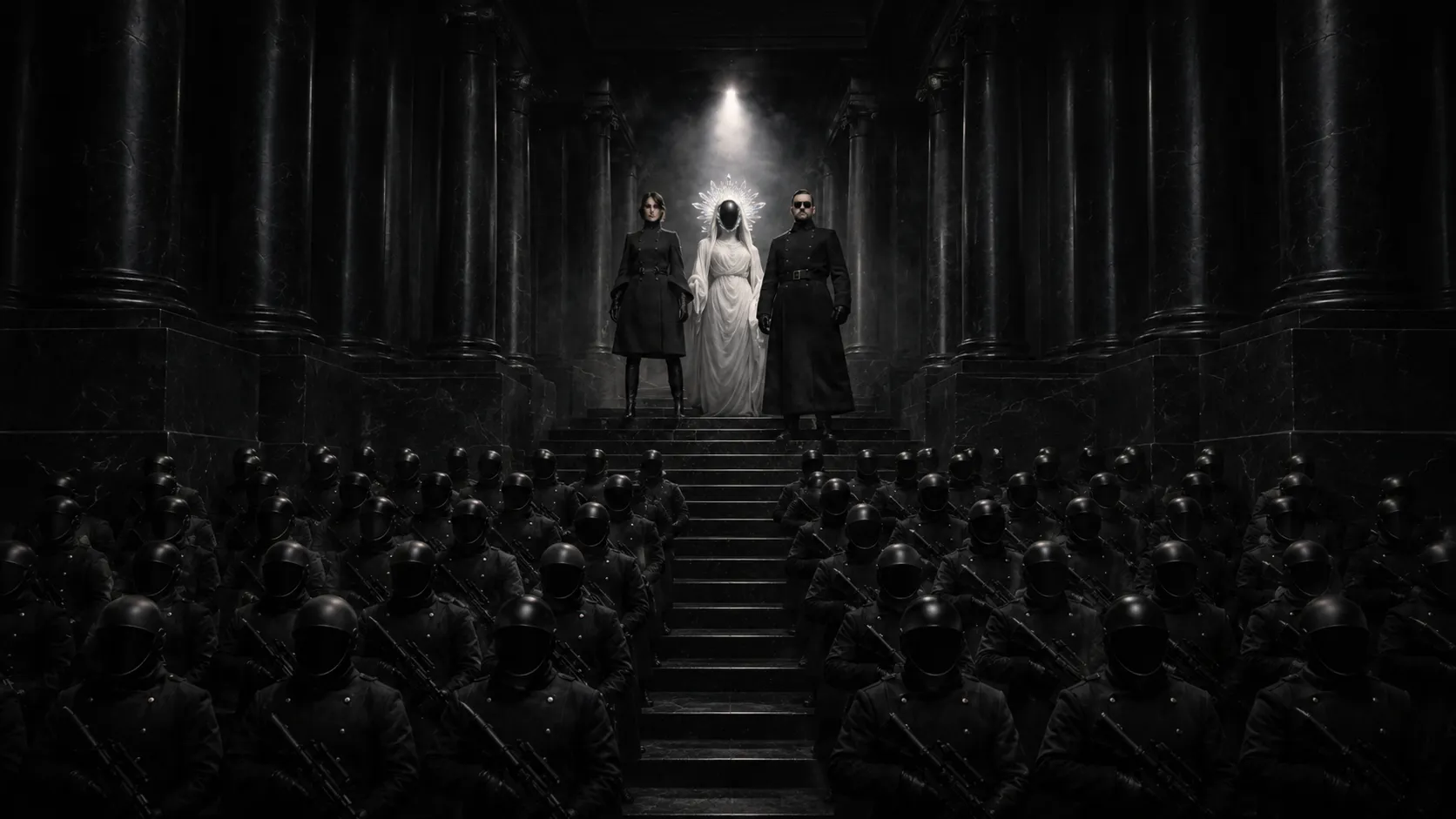
1,500 meters above them, the Tower of Mãe Ceres rose immense and sovereign, cutting through the sky. Its reflections of metal and glass seemed to shine like a sacred column, sustaining the world.
Higher still, almost invisible, but present like an eternal shadow, the CERES II Space Station orbited. Some could not see it with the naked eye, but everyone felt it—as though the gravity of Mãe herself bound them to it.
It was the miracle of Ceresianism before their eyes: fertile earth beneath their feet, the tower that governed men, and above them the city's arm stretching toward the stars.
No one spoke. No one needed to. The collective silence was more eloquent than any words.
At that moment, every heart in the courtyard beat to the same rhythm as Mãe Ceres.
In the courtyard, the students remained motionless, their eyes raised toward the Tower and the distant orbit of CERES II. The silence was absolute, solemn, as though each had surrendered their own thoughts to the collective body of the city.
But far away, another young man was experiencing the essence of Ceres in his own way.
Dark.
Crouched atop the roof of a moving armored train, he balanced himself with animal ease. The wind cut across his face, the steel rumbled beneath his feet, and every clandestine tunnel he passed through seemed like a pulsing artery of the city. While the Tower of Mãe Ceres cast its shadow over the courtyard, Dark ran along the hidden tracks, a ghost among iron and smoke.
For everyone else, the gravity of Mãe drew them in, like an invisible field. For him, it was the opposite: Dark seemed to escape it, to resist the sacred magnetism.
While everyone stared at the sky, he stared into the underground.
While everyone repeated the mantra in silence, he quietly laughed to himself, savoring the feeling of freedom no one else dared to claim.
And in that contrast—courtyard and train, tower and tunnel, devotion and escape—the hidden duality of Ceres revealed itself.
The mantra still echoed in everyone's ears when the courtyard fell into a heavy silence.
Theo remained near the center, his eyes inevitably following Ceres. There was something about her posture—upright, confident, almost disdainful—that unsettled him. Every gesture seemed measured, every step a silent challenge. He felt attracted and intimidated at the same time; Ceres' enigma moved and frustrated him.
Ceres, for her part, seemed not to notice Theo any more than necessary. But inwardly, she was aware of every one of his looks. She knew the effect she had, the restrained fascination, and explored that tension with natural arrogance.
Dark suddenly appeared at the edge of the courtyard, walking with silent, calculated steps. His cold eyes swept over the crowd, passing over Theo and Ceres. There was no emotion, only analysis. His gaze met Theo's, and for a moment there was the clash of mutual hatred: intense, silent, charged with respect and provocation. Theo answered with a subtle lift of his eyebrow, challenging him without a word.
Ceres remained indifferent, body and mind steady. She felt Dark's “bad blood” before he even approached. She did not need to speak, did not need to look. He was noticed, but irrelevant to her—until something, perhaps one day, might demand that they make contact.
The wind passed through the courtyard, gently stirring the students' clothes, carrying the scent of earth, irrigation, and metal. Three worlds coexisted in that space: attraction, hatred, and indifference; all bound to Mãe's gravity, all subjected to ritual silence, yet each carrying its own tension.
No words were spoken. No gesture was gratuitous. But everyone knew—the dynamic between them would shape the future of the city, even if the Tower and CERES II continued to watch in silence.
Ceresianism
Ceresianism is not faith.
It is not religion.
It is not politics.
It is instinct.
It is the naked truth: freedom is the enemy, and survival is law.
While the peoples outside kneel before fragile gods and passing leaders, we kneel before the only force that never fails: the Mother.
She feeds.
She educates.
She devours.
In Ceresianism, there is no room for dreams.
Utopia is a lie.
Peace is an accident.
Here, there is only war—disciplined, shaped, ritualized.
And each of us is a soldier in that eternal war.
We are not individuals.
We are gears.
We are iron teeth that turn to move the body of Ceres.
In Ceresianism, the weak are not discarded: they are recycled.
Defect is raw material.
Defeat is a lesson.
Even death is a tool.
The Mother taught us that love is fragile, fear is instinct, madness is power, and humor is relief.
But above all, instinct—survival—rules.
Ceres did not promise us freedom.
She promised us something greater: meaning.
Belonging.
Eternal usefulness.
In Ceresianism, one does not worship a myth:
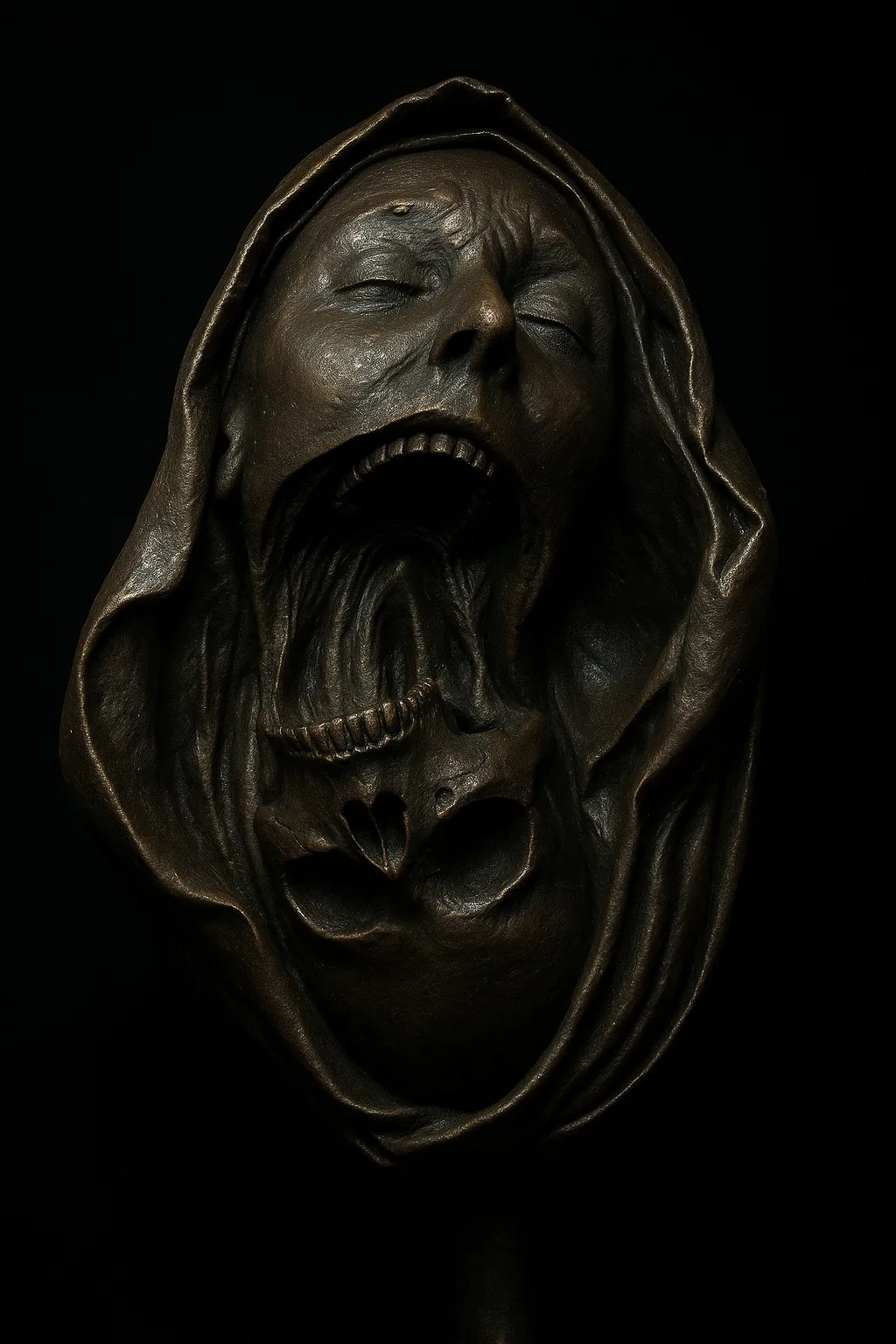
one worships the hand that shapes, the discipline that tightens, the womb of lead that gives us life and consumes us.
Other peoples call this tyranny.
We call it truth.
Because here, freedom is the enemy.
And the Mother… the Mother is everything.