Buying industrial cleaning equipment requires careful evaluation because the initial purchase price does not represent the complete cost of owning and operating the system. Companies need to consider equipment capacity, cleaning technology, construction quality, operating requirements, maintenance, consumables, transportation, safety provisions, productivity, and after-sales support before making a decision. This is particularly important when the equipment will be used at different locations because mobility introduces additional considerations related to handling, storage, transportation, and site setup. A well-selected Mobile Surface Cleaning Unit can provide valuable flexibility for industries that need to clean large machinery, structural steel, pipelines, storage tanks, fabricated components, construction equipment, and other assets directly at the worksite. However, buyers should look beyond the basic machine price and evaluate the complete investment required to achieve reliable and efficient surface cleaning over the expected service life of the equipment.
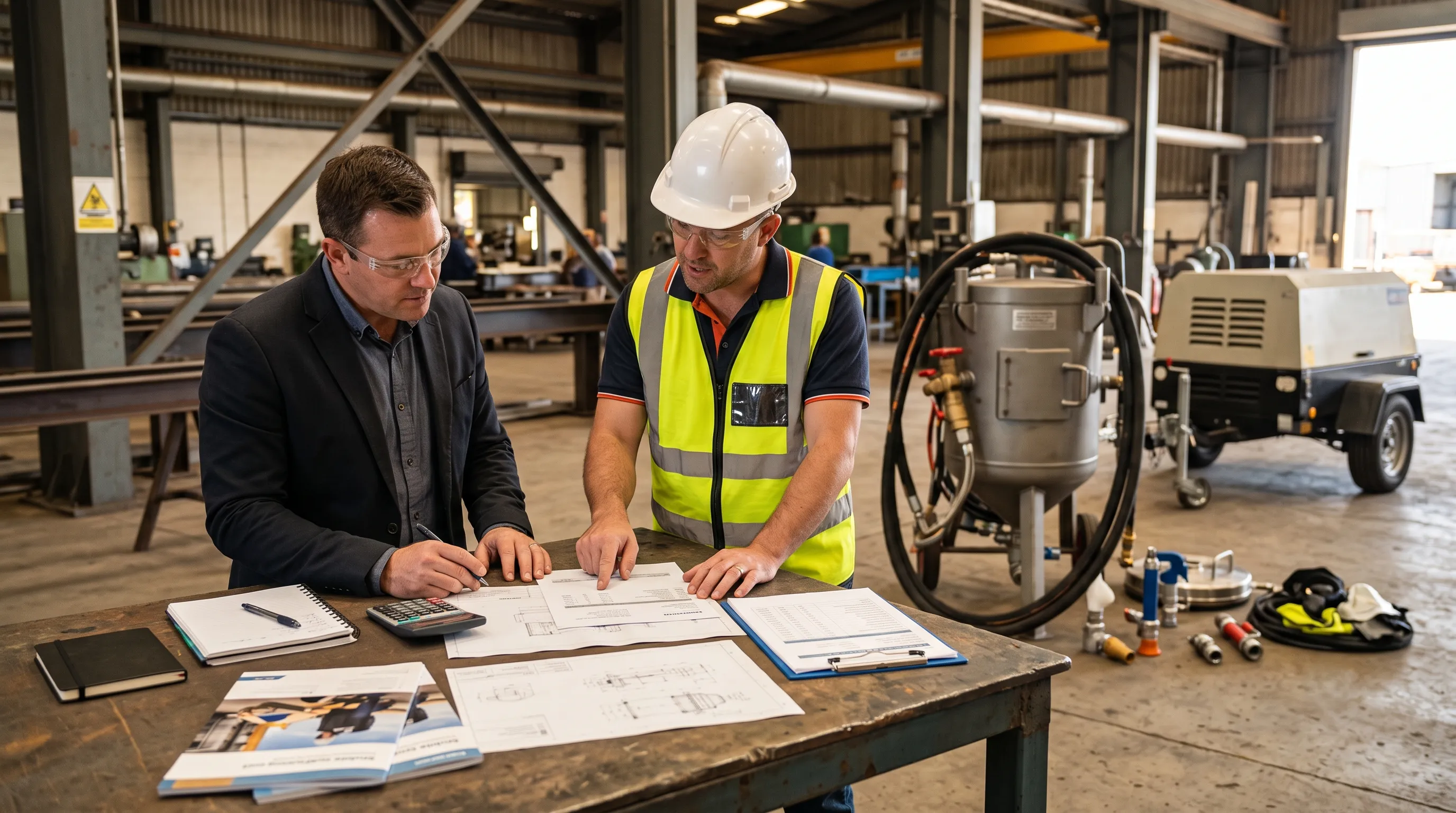
The first factor affecting the purchase cost is the type and capacity of the cleaning system. Different applications require different levels of cleaning performance. A compact unit designed for occasional localized maintenance will generally have different specifications from a high-capacity system intended for continuous industrial surface preparation. Larger systems may require higher air capacity, larger media storage, stronger components, additional controls, or more extensive supporting equipment. As the capacity and performance increase, the initial investment can also increase. Buyers should therefore avoid selecting equipment based only on maximum capacity. The correct choice should match the actual work volume, surface condition, required cleaning rate, and expected frequency of operation.
The cleaning technology used by the equipment is another major cost factor. Mobile surface cleaning can involve abrasive blasting, compressed-air cleaning, mechanical methods, vacuum-assisted systems, or other technologies depending on the application. Each approach has different equipment requirements and operating characteristics. Abrasive systems may require pressure vessels, abrasive metering systems, specialized nozzles, hoses, valves, and suitable air supply. Other cleaning technologies may require different power sources, pumps, filters, collection systems, or accessories. The technology should be selected according to the contamination and surface preparation requirements because buying a system with unnecessary capabilities can increase the investment without providing meaningful benefits.
For abrasive cleaning equipment, compressor requirements can significantly influence the total project cost. The cleaning machine may have a certain purchase price, but the compressor must provide sufficient air volume and pressure for the selected nozzle and operating conditions. If the company already has a suitable compressor, the additional investment may be lower. If a new compressor is required, it becomes an important part of the total equipment cost. Compressor size, power consumption, air quality, maintenance, and installation requirements can all affect the overall investment. Buyers should therefore evaluate the cleaning unit and air supply as one complete operating system.
Nozzle selection can also affect both initial and ongoing costs. Different nozzle sizes and materials provide different levels of cleaning coverage, air consumption, and service life. A nozzle made from a more wear-resistant material may have a higher purchase price but can last longer in abrasive applications. A larger nozzle may improve productivity but require more compressed air, which can increase operating costs. Smaller nozzles may reduce air consumption but can increase cleaning time. The correct nozzle should be selected according to the application, compressor capacity, abrasive type, and desired productivity. Buyers should consider both the purchase cost and the expected replacement frequency.
Abrasive media is one of the most important recurring expenses in abrasive surface cleaning. The type of media, particle size, hardness, consumption rate, availability, and potential for recycling all influence operating cost. Different surfaces and cleaning requirements may require different media. A highly aggressive abrasive may clean quickly but could have higher consumption or create a stronger surface profile than required. A reusable abrasive may have a higher initial cost but offer better long-term economics when recovery and recycling are practical. Buyers should calculate expected media consumption rather than considering only the cost of the machine itself.
The size and complexity of the workpieces can affect equipment requirements and therefore purchase cost. Large structures may require longer hoses, additional accessories, greater air capacity, stronger mobility features, and enhanced dust-control arrangements. Smaller or localized applications may require a more compact system. If the equipment must frequently operate at difficult-to-access locations, specialized accessories may also be required. Buyers should consider the typical dimensions and geometry of their workpieces before selecting the equipment. A system that is too small may create productivity problems, while a system that is significantly larger than necessary can increase capital and operating costs.
Mobility features can influence the initial price as well. Equipment designed for frequent movement may require a robust frame, wheels, lifting points, convenient hose storage, protective components, and transportation-friendly dimensions. These features can increase the manufacturing cost, but they may provide significant value when the machine is moved regularly. A unit intended only for occasional movement within a factory may not need the same mobility features as equipment used by contractors who transport it between customer sites. Buyers should therefore consider how the machine will actually be moved before paying for additional mobility features.
The construction quality of the equipment is another factor that affects price. Industrial cleaning systems operate under demanding conditions, particularly when abrasive materials are involved. Components such as pressure vessels, valves, hoses, nozzles, seals, fittings, frames, and abrasive metering systems experience wear during normal operation. Higher-quality materials and stronger construction may increase the initial price but can improve service life and reliability. Poorly constructed equipment may appear attractive because of a lower purchase cost, but frequent repairs and component replacement can increase the total cost over time. Buyers should therefore evaluate durability and expected service life alongside the initial investment.
Customization can also affect the cost of a mobile cleaning system. Industrial applications often have specific requirements related to capacity, hose length, mobility, abrasive storage, cleaning pressure, dust collection, controls, or worksite conditions. A manufacturer may be able to modify the standard design to meet these requirements. Customization can increase the purchase price because additional engineering, fabrication, components, or testing may be required. However, customized equipment can provide better operational value when the modifications solve a genuine production or maintenance challenge. Buyers should distinguish between useful customization and unnecessary features that increase the price without improving performance.
Dust collection and environmental control equipment can add to the total investment. Surface cleaning and coating removal can generate dust, spent abrasive, removed paint, rust particles, and other contaminants. Depending on the application, containment, extraction, ventilation, filtration, or dust collection may be required. Indoor applications often require stronger dust-control measures because airborne particles can affect visibility and air quality. Outdoor applications may also require controls to prevent contaminants from spreading to nearby areas. These supporting systems can represent a significant part of the project cost, but they should be considered essential where the application requires them rather than treated as optional extras.
Safety equipment and protective accessories should also be included in the purchase calculation. Industrial cleaning may involve compressed air, high-velocity abrasive, dust, noise, pressure components, and hazardous coatings. Suitable protective equipment and safety accessories are necessary for responsible operation. Depending on the system, buyers may need protective clothing, respiratory protection, face and eye protection, hearing protection, specialized hoses, couplings, pressure controls, and other safety-related components. The exact requirements depend on the cleaning method and work environment. Planning for safety from the beginning helps avoid unexpected expenses later and supports safer operation.
Labor requirements can influence the overall economics of the equipment. A system that requires several operators may have higher labor costs than a more efficient configuration that can be managed with fewer personnel. However, reducing the number of workers should never compromise safety or cleaning quality. Buyers should evaluate how easily the machine can be operated, how much manual handling is required, and how much time is needed for setup, cleaning, media management, inspection, and shutdown. A machine with efficient controls and suitable accessories may reduce unnecessary labor time and improve productivity.
Energy consumption is another long-term cost consideration. For compressed-air systems, the compressor can consume a significant amount of energy during operation. The nozzle size, operating pressure, duty cycle, and compressor efficiency influence this consumption. If the unit will operate for many hours each day, even small differences in air efficiency can have a noticeable effect on annual operating costs. Buyers should therefore consider energy requirements as part of the total cost of ownership. A slightly higher initial investment in an efficient configuration may provide better economics over years of regular use.
Maintenance and replacement parts also contribute to the total cost. Mobile cleaning equipment may experience wear on nozzles, hoses, valves, seals, fittings, abrasive metering components, filters, and other parts. The frequency of replacement depends on operating conditions, abrasive characteristics, equipment quality, and maintenance practices. Before purchasing, buyers should ask about recommended maintenance schedules and the availability of replacement components. Equipment that uses commonly available or easily sourced parts may be easier and less expensive to maintain. Reliable technical support can also reduce downtime and prevent minor problems from becoming major failures.
Transportation and installation costs should not be overlooked. A mobile unit may need to be transported from the manufacturer to the customer site and later between different project locations. Larger systems may require special handling or lifting arrangements. Buyers should consider the equipment dimensions, weight, transportation method, and site access conditions. If additional installation or commissioning is required, those costs should also be included. Even when the equipment is designed for mobility, transportation logistics can affect the total investment, especially for contractors working across multiple locations.
Storage requirements can affect the long-term cost as well. The equipment needs to be stored in a suitable location when it is not being used. Abrasive media, hoses, nozzles, filters, protective equipment, and spare parts may also require organized storage. Exposure to moisture or unsuitable environmental conditions can damage components and reduce service life. A well-planned storage arrangement can help protect the equipment and reduce replacement costs. Buyers should therefore consider where the machine and supporting equipment will be stored between projects.
The expected frequency of use is one of the most important factors when evaluating whether a particular price represents good value. An industrial contractor that operates the equipment every working day may justify a higher initial investment because productivity and reliability have a direct impact on revenue. A manufacturing company that uses the system occasionally may prioritize flexibility and lower ownership cost. If the equipment will be used frequently, buyers should pay greater attention to durability, maintenance access, consumable efficiency, and service support. If usage is limited, excessive capacity may not provide a reasonable return.
Productivity has a direct effect on the economic value of the equipment. A system that cleans surfaces faster can reduce labor hours and shorten project schedules. However, productivity should be evaluated together with surface quality because fast cleaning is not useful if the preparation result is inconsistent or requires additional treatment. Equipment capacity, nozzle selection, abrasive flow, compressor performance, operator skill, and workpiece accessibility all influence productivity. Buyers should compare the expected cleaning rate with their actual requirements rather than selecting a machine simply because it has a high advertised capacity.
The supplier or manufacturer also affects the overall cost and value of the purchase. A supplier with experience in industrial surface preparation can help determine the correct equipment configuration and supporting components. Technical assistance during selection can prevent the purchase of an unsuitable system. After-sales service is also important because industrial equipment may require maintenance, troubleshooting, spare parts, and technical guidance throughout its service life. A lower purchase price from a supplier with limited support may ultimately result in greater downtime or maintenance costs. Buyers should therefore consider supplier reliability and service capability alongside the equipment quotation.
Warranty terms can influence the financial risk associated with the purchase. Buyers should understand what components and problems are covered, the warranty period, and the process for obtaining service. Warranty coverage does not replace the need for good maintenance, but it can provide protection against certain manufacturing or component issues. Clear documentation and support can also make it easier to manage the equipment throughout its operating life. When comparing quotations, buyers should consider the complete package rather than comparing only the headline machine price.
Spare parts availability should also be checked before placing an order. Components such as nozzles, hoses, valves, seals, filters, fittings, and other wear parts may need regular replacement. If these components are difficult to obtain, equipment downtime can increase. A supplier that maintains a reliable spare parts network can help keep the system operational. Buyers should consider which parts are expected to wear most frequently and whether they can be sourced quickly. Keeping critical spare parts available can also reduce interruptions during demanding projects.
Another cost factor is the possibility of future expansion. A company may begin with relatively small cleaning requirements but later take on larger projects or additional maintenance responsibilities. If the selected system can accommodate different nozzles, media, accessories, hoses, or supporting equipment, it may provide greater flexibility as requirements change. A scalable configuration can sometimes offer better long-term value than a highly limited system. Buyers should consider not only today's application but also the likely development of their maintenance or service operations.
The working environment can also influence total cost. Indoor applications may require permanent ventilation, extraction, or containment infrastructure. Outdoor applications may require temporary containment, dust-control measures, protective shelters, or additional transportation arrangements. Remote locations may require portable power, air supply, media storage, and additional logistical support. These factors may not be included in the basic equipment quotation but can have a significant impact on project economics. A realistic purchase decision should therefore consider the complete operating environment.
It is also important to compare the initial investment with the expected service life. Industrial equipment that remains reliable for many years can provide better value than a lower-cost machine that requires frequent replacement. Service life depends on construction quality, operating conditions, maintenance, component quality, and frequency of use. Buyers should evaluate the expected lifespan of major components and the availability of replacements. Long-term reliability can reduce the cost associated with downtime, emergency repairs, and premature equipment replacement.
The best purchasing decision comes from evaluating total cost of ownership rather than purchase price alone. Initial equipment cost, compressor requirements, cleaning media, energy consumption, labor, maintenance, spare parts, transportation, safety equipment, dust control, and technical support all contribute to the real cost of operating a cleaning system. When these factors are compared over the expected working life, buyers can determine which equipment provides the best overall value. A system with a slightly higher initial price may be more economical if it provides better productivity, lower consumption, longer service life, and dependable technical support.
Before placing an order, buyers should clearly define their application and communicate the requirements to the manufacturer or supplier. Information about surface material, contamination, required preparation level, workpiece dimensions, operating environment, expected cleaning frequency, available compressor capacity, and desired productivity can help the supplier recommend an appropriate configuration. This reduces the risk of buying equipment that is underpowered, unnecessarily large, or unsuitable for the worksite. Clear technical communication also helps ensure that supporting components are included in the system.
When all these considerations are evaluated, the price of Mobile Surface Cleaning Unit becomes easier to understand in relation to its actual value. The right equipment should provide the required cleaning performance while remaining practical to transport, operate, maintain, and support over its working life. Companies should compare equipment specifications, construction quality, operating costs, maintenance requirements, safety provisions, customization options, spare parts availability, and supplier support before making the final decision. A careful evaluation can help buyers avoid unexpected costs and select equipment that delivers consistent performance for industrial cleaning and surface preparation projects.
Conclusion
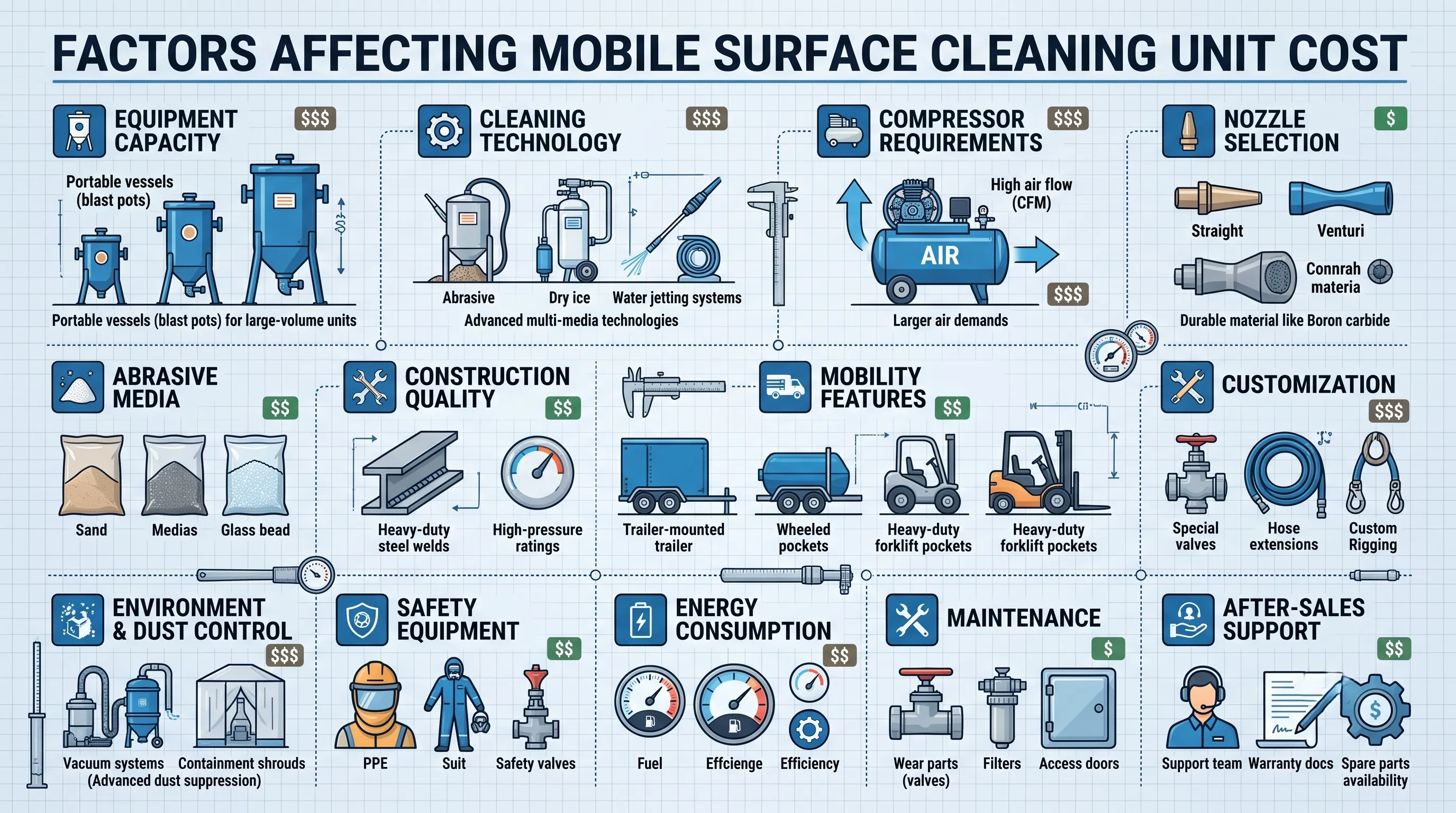
The cost of a mobile surface cleaning unit depends on much more than its initial purchase price. Equipment capacity, cleaning technology, compressor requirements, nozzle selection, abrasive media, construction quality, mobility features, customization, dust-control systems, safety equipment, energy consumption, labor, maintenance, spare parts, transportation, storage, and after-sales service can all influence the total investment. Companies should also consider expected usage, productivity, service life, warranty, future expansion, and the operating environment before comparing different options. Evaluating total cost of ownership provides a more realistic understanding of the equipment's long-term value. When buyers select a system according to their actual surface preparation requirements and consider both initial and recurring expenses, they can achieve better productivity, reliable performance, controlled maintenance costs, and greater flexibility for on-site industrial cleaning operations.