Selecting the right fume extraction equipment for an industrial laser or plasma cutting operation requires much more consideration than simply choosing a machine with a large blower or high airflow rating. Every cutting application produces different quantities and types of fumes and fine particles depending on the material, thickness, cutting speed, machine power, production volume, and operating conditions. A properly selected Laser/Plasma Fume Extractor should therefore be matched to the actual cutting process, machine configuration, workspace, and filtration requirements. The objective is to create an extraction system that captures contaminants close to their source, transports them effectively through the ducting, separates particulate through appropriate filtration, and manages collected material safely. OSHA's ventilation guidance emphasizes that local exhaust systems should provide sufficient airflow and velocity to capture and convey contaminants rather than allowing them to disperse into employee work areas. For this reason, businesses should evaluate the complete system design instead of comparing equipment only by fan horsepower, filter count, or advertised capacity.
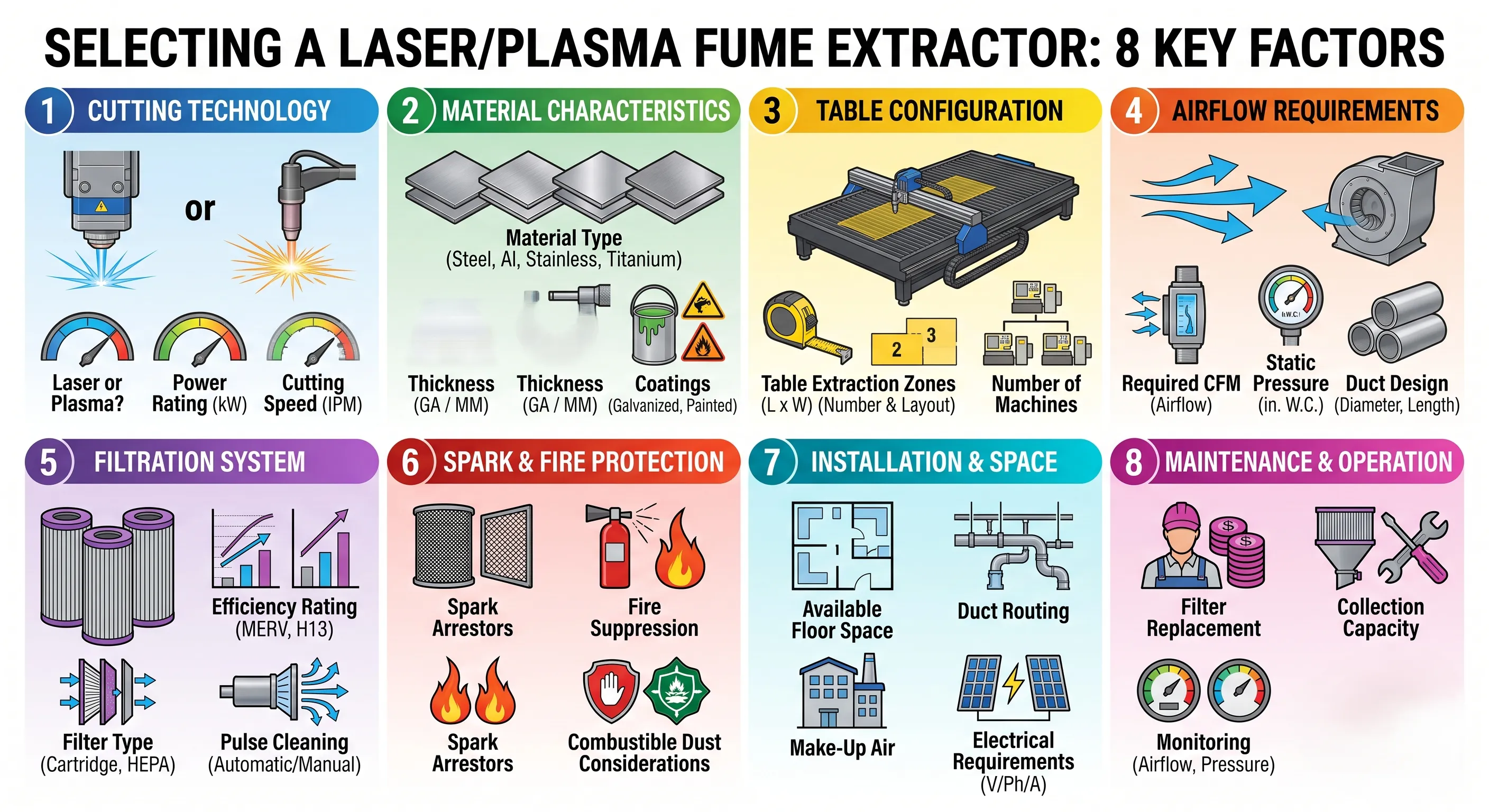
The first factor to consider is the type of cutting technology being used. Laser and plasma cutting are both thermal cutting processes, but their operating characteristics can differ significantly. A fiber laser may be used for precision cutting of relatively thin sheet metal at high speeds, while plasma systems are often selected for thicker conductive materials and heavy-duty applications. The quantity and characteristics of generated smoke and particulate can vary between these processes. Therefore, an extraction system designed for one application should not automatically be assumed to be ideal for another. The equipment supplier should understand whether the machine uses fiber laser, CO2 laser, conventional plasma, high-definition plasma, or another configuration. This information helps establish the expected emission profile and the appropriate extraction approach.
Material type is equally important. Mild steel, stainless steel, aluminum, galvanized steel, painted metal, coated material, and specialty alloys can all produce different airborne contaminants during thermal cutting. The surface coating can also influence the nature of the generated fumes. For example, cutting galvanized or painted materials may require additional consideration because the coating itself can contribute to the emissions. OSHA notes that contaminants generated by thermal cutting can vary according to the material and coatings involved. A manufacturer should therefore provide accurate information about the materials normally processed. If several materials are cut on the same machine, the extraction and filtration strategy should account for the full range of expected applications.
Material thickness should also be evaluated carefully. Cutting thin sheet metal and cutting thick steel plate can create different process conditions and contaminant loads. Thicker materials may require higher cutting energy and longer cutting durations, which can influence the amount of smoke and particulate generated. Plasma cutting applications involving heavy plate may therefore require a substantially different extraction arrangement from a small laser cutting machine used for thin sheet. The maximum material thickness is not the only factor, because the percentage of machine utilization and cutting duty cycle also influence the total contaminant load. The system should be selected according to realistic production conditions rather than only the maximum theoretical thickness.
The size of the cutting table is another critical consideration. A small CNC cutting table may require a relatively compact extraction arrangement, while a large-format table may need multiple extraction zones. If the entire table is connected to one extraction chamber, the airflow requirements can become significant. Zoned extraction can help concentrate suction beneath the section where cutting is actually taking place. This can reduce unnecessary airflow from inactive portions of the table and can support more efficient operation. The number and arrangement of zones should be determined by the machine design, cutting pattern, table construction, and required capture performance.
Cutting speed and machine power should also be considered. High-speed laser cutting can process a large quantity of material within a relatively short period, while high-capacity plasma systems can cut thick plate continuously. As production intensity increases, the extraction system may need to handle a greater contaminant load. The supplier should therefore know the approximate cutting speed, laser or plasma power, expected operating hours, and typical production schedule. These details provide a more realistic basis for determining extraction capacity than simply looking at the machine model name.
Production volume is another important selection factor. A machine used for occasional cutting does not necessarily have the same extraction requirements as a system operating continuously across multiple shifts. A high-volume facility may generate fumes for many hours each day, placing greater demand on the filters, blower, collection system, and maintenance schedule. The extraction system should be capable of maintaining performance throughout the expected production cycle. If production is expected to increase in the future, it may also be sensible to consider potential expansion when designing the extraction infrastructure.
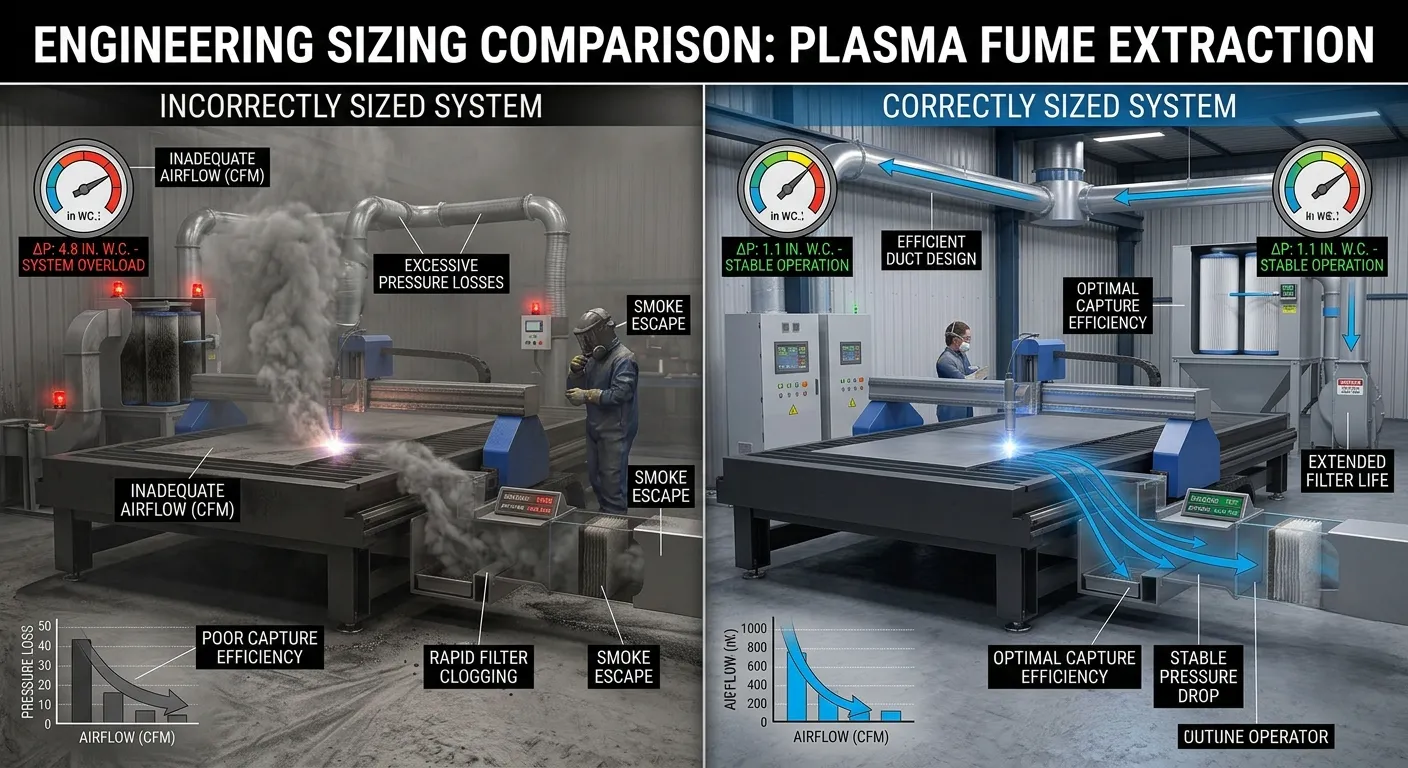
The required airflow is one of the most important technical factors. Airflow determines how much air the system can move, but airflow alone does not guarantee effective fume capture. The extraction system must also overcome resistance created by the cutting table, ductwork, filters, dampers, bends, and other components. This is why static pressure should be evaluated alongside airflow. A blower selected only for its free-air capacity may perform very differently once connected to the complete system. Proper engineering should determine the required operating point based on both airflow and pressure.
Duct design should receive careful attention during selection. Long duct runs, multiple bends, branches, changes in diameter, and poorly designed transitions can increase pressure losses. If the extraction unit is installed far away from the cutting machine, the ducting must be designed to maintain adequate airflow at the source. The number of machines connected to a central system also affects the design. A centralized system may require carefully calculated branches and dampers so that each cutting machine receives appropriate airflow. For smaller installations, a dedicated extraction unit may provide a simpler arrangement. The right choice depends on the number of machines, layout, production schedule, and available space.
Filtration technology is another major factor. The filter should be selected according to the type and size of particulate generated by the cutting process. Industrial extraction systems may use cartridge filters, bag filters, or other specialized filtration media. The filter's surface area, filtration efficiency, pressure drop, cleaning method, service life, and replacement cost should all be considered. A filter that offers high efficiency but creates excessive pressure resistance may influence energy consumption and airflow. Similarly, a filter with insufficient surface area may become loaded quickly under heavy production. A balanced filtration design is therefore essential.
Automatic filter cleaning can be particularly valuable in high-production environments. Pulse cleaning systems can periodically remove accumulated dust from filter surfaces, helping maintain airflow and extending useful filter life when properly designed. However, automatic cleaning does not eliminate the need for maintenance. Operators should still monitor filter condition and pressure differential and inspect the system regularly. If filter cleaning becomes less effective, it may indicate a problem with compressed air quality, cleaning pressure, filter loading, or another system component. Selecting an extraction unit with appropriate filter monitoring and cleaning provisions can make long-term operation more manageable.
The dust collection arrangement should also be evaluated. Once particulate is removed from the airflow, it must be collected in a suitable container or hopper. The collection capacity should match the expected production volume so operators do not need to empty the system excessively frequently. For high-volume applications, a larger collection arrangement may reduce interruptions. The design should also allow safe and practical access for removing collected material. The nature of the collected particulate should be considered because different metals and coatings may have different handling requirements.
Spark and fire protection should be carefully considered when selecting equipment. Thermal cutting processes involve high temperatures and can produce sparks, hot particles, and potentially combustible particulate depending on the material and process. The extraction system should therefore be evaluated for suitable spark management and dust-handling provisions where applicable. The appropriate protection depends on the material being processed, particle characteristics, cutting parameters, system configuration, and applicable safety requirements. Manufacturers should provide the equipment supplier with accurate information about materials and coatings rather than assuming that a standard dust collector is suitable for every cutting application.
Make-up air is another factor that is sometimes overlooked. When an extraction system removes a large amount of air from an enclosed workshop, replacement air must enter the building. If the facility cannot provide adequate make-up air, the pressure balance may change and extraction performance can be affected. Replacement air should be introduced without creating disruptive drafts across the cutting area. In large industrial facilities, the interaction between extraction and HVAC or ventilation systems should therefore be evaluated. OSHA ventilation requirements for certain cutting operations emphasize the importance of clean replacement air in conjunction with exhaust ventilation.
Available floor space and installation location are also practical considerations. Some factories have limited space near the cutting machine, while others have enough room for a centralized filtration unit outside the production building. The location affects duct length, maintenance access, noise, electrical requirements, and collection arrangements. Outdoor installation may provide additional space but can introduce weather protection and other design considerations. Indoor installation may simplify access but require careful planning for noise, dust collection, and available floor area. The extraction supplier should understand the physical layout before recommending a final configuration.
Noise should also be considered. The blower, airflow, vibration, and duct system can all contribute to operating noise. In a busy fabrication facility, excessive noise can add to the already demanding workplace environment. Proper fan selection, vibration isolation, duct design, and equipment placement can help manage this issue. The objective should be to achieve the required extraction performance without creating unnecessary acoustic problems. Noise considerations become particularly important when extraction equipment is installed near operators, inspection stations, offices, or other regularly occupied areas.
Electrical requirements should be checked before installation. The motor size, voltage, phase configuration, control panel, starter or variable-frequency drive, sensors, automatic dampers, and other components must be compatible with the facility's electrical infrastructure. Large industrial extraction systems can require significant electrical capacity, particularly when operating continuously. Variable-speed control may provide additional flexibility in applications where extraction demand changes. The electrical design should be coordinated with the machine and facility requirements to avoid installation delays.
Control integration can provide additional benefits. Modern CNC cutting operations may use automatic signals to activate extraction when cutting begins and stop or reduce extraction when the machine is idle. Zoned extraction can also use dampers or control logic to direct suction toward the active cutting section. These features can improve system usability and may reduce unnecessary energy consumption. However, control systems should be reliable and easy for operators to understand. A complicated system that is difficult to maintain can create operational problems even if the underlying extraction equipment is technically capable.
Maintenance requirements should be considered before purchasing the equipment. Buyers should understand how often filters need inspection, how filter cleaning works, how collection containers are emptied, how ducts should be checked, and what components require periodic servicing. Easy access to filters and collection areas can significantly reduce maintenance effort. Spare filter availability is also important because unexpected replacement delays can affect production. A supplier that can provide technical support and replacement components can be valuable over the long term. The initial purchase price should therefore not be the only consideration. Total operating cost, maintenance requirements, energy consumption, filter replacement, and service support should also be evaluated.
The expected operating environment matters as well. Temperature, humidity, dust levels, corrosive conditions, available compressed air, and general workshop cleanliness can influence equipment performance. A filtration system installed in a harsh industrial environment may require different construction and maintenance practices from one installed in a controlled facility. The supplier should understand whether the equipment will operate continuously, intermittently, indoors, outdoors, or in a location exposed to other industrial processes. These details can influence material selection, enclosure design, electrical protection, and maintenance planning.
The future expansion plans of the business should also be taken into account. A company may begin with one cutting machine but add another machine later as production increases. If this possibility is known in advance, the extraction infrastructure can sometimes be designed to accommodate future expansion. A centralized system may be more suitable for multiple machines, while independent units may be preferable when machines operate independently or are located far apart. Planning for future growth can prevent expensive modifications later. However, oversizing the system without a realistic expansion plan can also increase initial and operating costs, so the design should remain commercially sensible.
Compliance and workplace safety requirements should be considered as part of the selection process, but companies should avoid assuming that purchasing a particular extractor automatically guarantees regulatory compliance. Compliance depends on the complete workplace, exposure assessment, equipment design, operating procedures, maintenance, material hazards, and applicable local requirements. The extraction system should instead be viewed as one engineering control within a broader industrial safety strategy. OSHA guidance emphasizes the importance of local exhaust for controlling airborne contaminants at their source, but actual workplace requirements vary according to the operation and jurisdiction.
Supplier experience is another valuable selection criterion. A manufacturer familiar with industrial cutting applications can evaluate the cutting table, material type, production schedule, airflow requirement, filtration technology, duct arrangement, and maintenance needs together. This can be more useful than purchasing a generic unit based solely on catalogue specifications. Before finalizing the system, businesses should provide accurate information about their machines and materials. Drawings, table dimensions, machine specifications, production hours, material types, cutting thickness, and workshop layout can help the supplier develop a more appropriate solution.
The quality of construction should also be evaluated. Industrial extraction equipment operates in demanding environments and may be exposed to continuous vibration, particulate, heat, and frequent operation. Robust construction, suitable filter housing, reliable blower components, strong duct connections, accessible maintenance areas, and appropriate controls can contribute to long service life. The system should be designed for the actual duty rather than treated as a light-duty workshop accessory. Long-term reliability can have a major effect on the total value of the investment.
Ultimately, selecting the right extraction equipment requires a complete understanding of the cutting operation. Material type, material thickness, laser or plasma technology, machine power, cutting speed, table dimensions, production hours, airflow, static pressure, duct length, filtration method, filter cleaning, dust collection, spark protection, make-up air, floor space, electrical supply, noise, maintenance, and future expansion all need to be considered. The best system is not necessarily the largest or most expensive one. It is the system that provides the required capture and filtration performance while remaining practical, efficient, maintainable, and appropriate for the actual production environment. Businesses looking for a reliable industrial solution can discuss these application details with an experienced manufacturer before finalizing their equipment. A properly engineered Laser/Plasma Fume Extractor can provide effective contaminant control and dependable long-term performance when the extraction capacity, filtration, airflow design, and operating requirements are correctly matched to the cutting process.
Conclusion
Choosing suitable fume extraction equipment for laser and plasma cutting requires a detailed evaluation of the complete production environment. The cutting technology, material type, material thickness, machine power, cutting speed, table size, production volume, airflow, static pressure, duct layout, filtration technology, dust collection method, spark protection, make-up air, installation space, electrical requirements, noise, maintenance, and future expansion can all influence the final selection. Businesses should focus on actual operating conditions instead of relying on a single specification such as blower horsepower or nominal airflow. A properly designed system should capture contaminants near their source, transport them efficiently, filter the air appropriately, and collect particulate in a manageable way. Regular inspection and maintenance are also essential for maintaining performance over time. When the equipment is selected through a complete application-based assessment, industrial manufacturers can achieve better control of cutting fumes and fine particles while creating a cleaner, more organized, and more controlled production environment.