Selecting the right spray booth is an important decision for any industrial facility that regularly applies paint or protective coatings. The booth needs to provide enough working space, suitable airflow, effective overspray capture, appropriate filtration, and practical maintenance access while fitting into the available production area. A Dry Spray Booth can be an effective solution for applications where dry filter media are suitable for collecting airborne paint particles, but its performance depends heavily on how well the system matches the actual painting process. Before choosing a booth, manufacturers should evaluate the dimensions and weight of the products, type of coating, spray equipment, production volume, operating hours, required airflow, filter capacity, exhaust arrangement, workplace conditions, energy consumption, safety requirements, and future production plans. Considering these factors together helps prevent problems such as inadequate extraction, restricted operator movement, frequent filter replacement, excessive energy consumption, or insufficient space for larger products. The best selection is therefore not necessarily the largest or most powerful booth. It is the system that provides the required performance while remaining practical, safe, maintainable, and economical for the intended application.
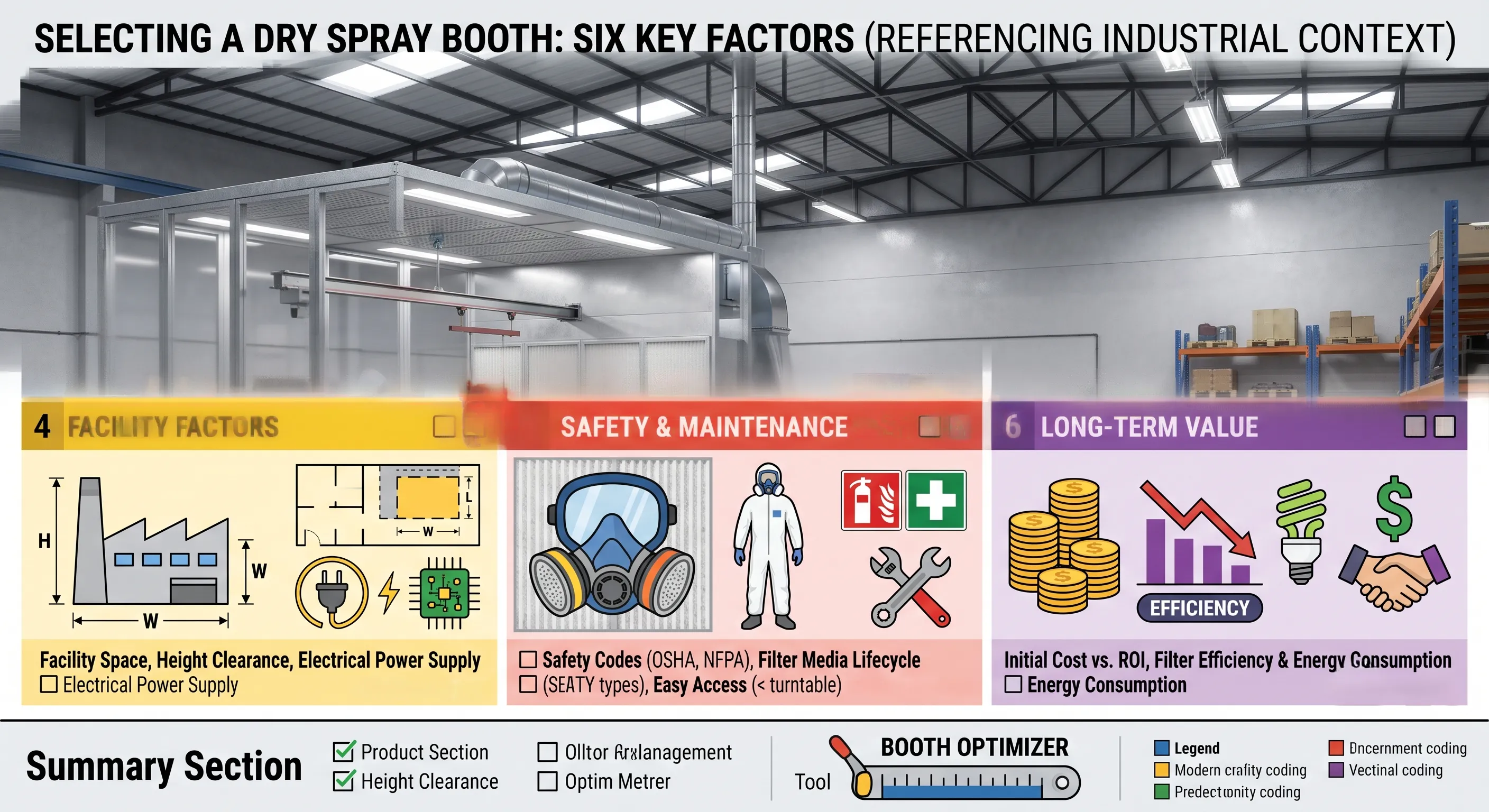
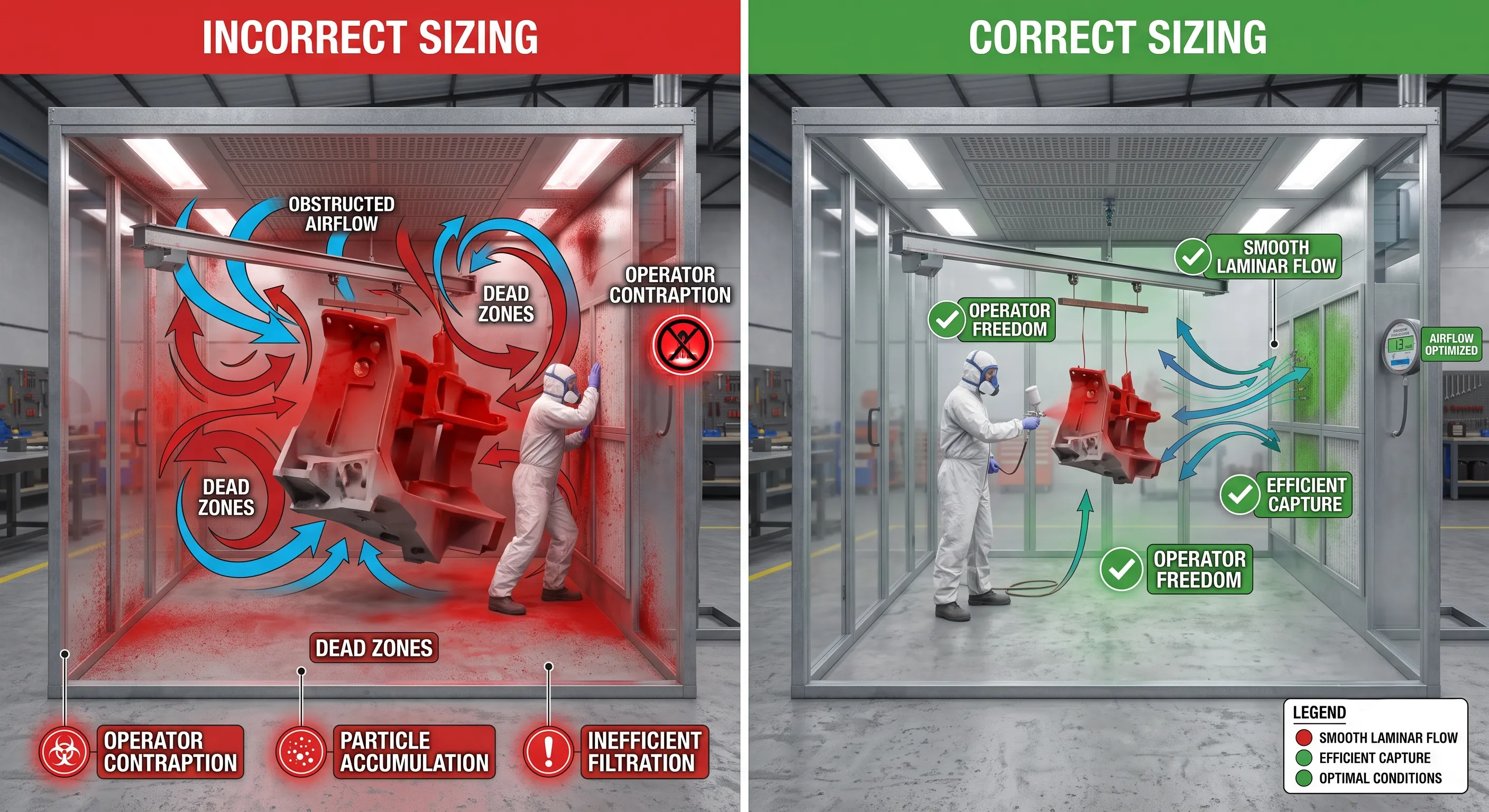
The first consideration should be the size of the products that will be painted. The booth must provide sufficient internal space for the largest workpiece while allowing the operator to move around it safely when necessary. Product dimensions should include not only length, width, and height but also the space required for spray-gun movement and access to difficult surfaces. If the product nearly fills the enclosure, airflow can be obstructed and the operator may find it difficult to maintain a consistent spraying position.
Product shape also matters. A simple rectangular component may have a relatively predictable effect on airflow, while a large fabricated structure with frames, recesses, corners, and enclosed sections can create more complex air movement. The booth should therefore be evaluated according to the actual geometry of the products rather than only their maximum external dimensions.
The weight of the workpiece can influence material handling and booth layout. Heavy components may require cranes, hoists, trolleys, conveyors, or other handling equipment. The booth should accommodate the chosen handling method without creating unnecessary obstruction to the extraction system. Entry and exit routes should also be practical so that products can be moved efficiently through the production process.
The type of coating is another major consideration. Different paints and finishing materials have different properties and can generate different amounts of overspray. The filter media must be compatible with the coating being applied and capable of handling the expected particle load. Coatings containing solvents or other potentially hazardous substances may also require specific ventilation and safety provisions.
The amount of coating used during production should be assessed as well. A facility that sprays small quantities each day will place a different load on the filtration system than a high-volume manufacturer applying large quantities over several shifts. Paint consumption provides useful information when determining filter capacity and expected maintenance frequency.
The spray application method must also be considered. Manual spray guns require sufficient operator working space and airflow around the painter. Automatic equipment can introduce different spray patterns and production rates. Robotic applications may require specific enclosure dimensions, access arrangements, and extraction configurations. The booth should be designed around the actual equipment rather than assuming that every spray process has the same requirements.
Production volume directly affects booth capacity. If the facility paints only a few components occasionally, a large high-capacity system may not be necessary. Continuous production, multiple shifts, or high coating consumption may require greater extraction and filtration capacity. The booth should be sized according to the expected workload so that it can operate efficiently without becoming a production bottleneck.
Operating hours are closely connected to production volume. A booth that runs for several hours every day will experience different filter loading and fan operating conditions from one used intermittently. Longer operating periods can increase filter replacement frequency and electricity consumption. These factors should be included when estimating long-term operating costs.
Airflow requirements should be evaluated carefully. Effective overspray capture depends on moving contaminated air away from the spraying area and toward the filtration section. The required airflow is influenced by booth dimensions, opening configuration, product size, spray process, and filter resistance. The objective is to achieve suitable capture without creating excessive turbulence.
Airflow distribution is just as important as total airflow. A booth may have a powerful exhaust fan but still perform poorly if air does not move evenly through the working area. Uneven airflow can leave stagnant zones where overspray accumulates or create strong currents that interfere with coating application. The extraction layout should therefore be designed to produce a suitable and predictable airflow pattern.
The exhaust fan should be selected based on the complete system resistance. This includes the booth, filters, ductwork, bends, fittings, and exhaust arrangement. Choosing a fan solely by its nominal capacity can lead to poor results if it cannot maintain the required airflow at the actual operating pressure. Proper fan selection supports stable ventilation and can help control energy consumption.
Filter selection deserves particular attention because dry filtration is central to the booth's operation. The filter should provide suitable particle capture while allowing the required volume of air to pass through the system. Its capacity should correspond to the expected overspray load. A filter that loads too quickly can increase maintenance requirements and operating costs.
Filter availability should also be considered. Replacement media should be reasonably accessible so that maintenance does not create unnecessary production delays. If filters are difficult to source or require long delivery periods, a facility may be forced to operate with heavily loaded media or experience unexpected downtime.
The expected filter life can influence total operating cost. Two filter systems with similar initial prices may have different replacement requirements. The actual cost should therefore be evaluated over the expected operating period rather than based only on the initial purchase price.
Maintenance access is another essential factor. Operators need to inspect filters and replace them when required. Technicians may need access to fans, duct connections, lighting, controls, and other components. A booth that is difficult to service can increase maintenance time and encourage delayed servicing.
Internal cleaning requirements should also be considered. Paint can gradually accumulate on booth surfaces, extraction areas, and other components. The enclosure should allow practical cleaning without requiring excessive disassembly. Easy cleaning supports better housekeeping and can help maintain the condition of the equipment.
The available installation space should be measured before finalizing the booth. The required footprint includes more than the visible enclosure. Space may also be needed for fans, filters, ductwork, access doors, electrical equipment, maintenance areas, and product movement. A design that fits only when considering the booth shell may not work once the complete system is installed.
Ceiling height can be particularly important for large industrial products. The booth may need sufficient vertical clearance for the workpiece, lifting equipment, lighting, duct connections, and exhaust components. These requirements should be checked before installation planning begins.
The factory layout should also be evaluated. Products may need to move from surface preparation to painting and then to drying, inspection, assembly, or packaging. The booth should be positioned so that this flow is efficient. Unnecessary movement can increase handling time and raise the risk of damaging freshly coated surfaces.
Material handling equipment should be compatible with the booth. If products are moved using overhead cranes, the booth may need suitable openings or structural arrangements. If trolleys or conveyors are used, the floor and access configuration should accommodate them. These details can have a significant effect on practical usability.
The booth's access arrangement should be considered as well. Operators need convenient entry and exit, while large products require openings that allow safe movement into the enclosure. Doors should not interfere with the intended airflow more than necessary. The access design should balance material handling, operator movement, containment, and ventilation.
Lighting is an important part of selection because operators need clear visibility during painting. Poor illumination can make it difficult to identify surface imperfections and coating irregularities. Lighting should be positioned to provide adequate visibility while remaining compatible with the booth environment and airflow arrangement.
The exhaust discharge arrangement should be evaluated before installation. Extracted air needs to be directed to an appropriate location without creating avoidable problems around building openings, air intakes, or occupied areas. The discharge design should comply with applicable environmental and ventilation requirements for the facility.
Workplace safety requirements must be considered alongside the coating process. Some paints and solvents can create flammable or hazardous conditions. The selection of fans, motors, electrical equipment, lighting, controls, and other components should reflect the actual materials and operating environment. Applicable safety standards and local requirements should be reviewed before equipment is finalized.
The booth should also be compatible with the facility's fire protection strategy. The risks associated with the specific coating materials, storage practices, spray equipment, and waste handling should be assessed as part of the overall installation. The booth itself should not be treated as an isolated safety system.
Waste management is another consideration. Dry filters collect paint overspray and eventually need replacement. Used filters may contain coating residues and should be handled according to the material's properties and applicable waste requirements. The facility should understand how filter waste will be stored, handled, and disposed of before selecting the system.
Energy efficiency can affect long-term operating expenses. The exhaust fan may run for significant periods during production, so fan efficiency, duct resistance, and filter pressure drop can influence electricity consumption. A properly engineered system balances the airflow requirement with reasonable energy demand.
Filter loading has a direct relationship with energy use. As the filter becomes more resistant, the fan may need to operate against greater pressure. Timely filter replacement can help maintain airflow and avoid unnecessary resistance. Maintenance therefore supports both performance and operating efficiency.
Noise should also be considered. Exhaust fans and airflow can generate sound, particularly in large industrial systems. The selected equipment should provide suitable performance without creating unnecessary noise problems for operators or nearby workers. Where required, additional noise-control measures can be incorporated into the overall design.
Environmental conditions within the factory may influence the selection. Temperature, humidity, dust levels, and surrounding production activities can affect the painting process. If the booth is located near grinding, welding, machining, or other dust-generating operations, the layout should minimize cross-contamination between processes.
Surface preparation should also be separated appropriately from spray painting. Grinding and sanding can produce dust that may affect freshly painted surfaces. If preparation and coating occur in nearby areas, suitable separation and extraction arrangements should be considered. The goal is to prevent preparation dust from entering the controlled painting environment.
The required finish quality can influence the booth specification. Products intended for visible applications may require particularly clean and consistent coating conditions. If appearance standards are strict, the booth should provide suitable filtration, airflow, lighting, and cleanliness for the process.
Inspection requirements should also be considered. Some manufacturers inspect the product immediately after painting, while others allow curing or drying before inspection. The booth and surrounding production area should support the required workflow without exposing freshly coated surfaces to unnecessary contamination.
Future production requirements deserve attention before selecting the final configuration. A company may increase output, introduce larger products, change coating materials, or add automation. Designing only for current conditions can make the booth restrictive later. Reasonable future needs should be considered without unnecessarily oversizing the system.
Budget is naturally an important factor, but it should not be the only selection criterion. A low initial purchase price can become expensive if the booth requires frequent filter replacement, consumes excessive energy, provides inadequate extraction, or causes production interruptions. Total operating cost provides a more useful basis for comparing alternatives.
The expected service life should also be considered. Industrial equipment is often expected to operate for many years. The construction quality, component availability, maintenance requirements, and suitability of the design can affect how well the system performs over time. Selecting durable and serviceable equipment can improve long-term value.
Supplier capability can influence the success of the installation as well. The manufacturer should understand industrial ventilation, filtration, spray-painting requirements, and the specific application. Proper engineering before fabrication can prevent problems that may otherwise become difficult or expensive to correct after installation.
Technical support and after-sales service can also matter for long-term operation. Filters and replacement components may be needed during the booth's working life. Access to suitable technical assistance can help resolve maintenance or performance issues more efficiently.
The booth should be evaluated as a complete system rather than as an enclosure purchased separately from the extraction equipment. The booth structure, filters, fan, ductwork, lighting, controls, access arrangements, and exhaust system all affect performance. Components should work together according to the intended airflow and production conditions.
A practical selection process should begin with the actual painting requirements. Manufacturers should establish what products will be painted, how they will be coated, how much material will be sprayed, how often the booth will operate, and what finish quality is expected. These details provide the foundation for selecting the appropriate booth configuration.
The final decision should also account for maintenance and daily operation. Operators should be able to use the booth comfortably, replace filters without excessive difficulty, clean internal surfaces, and access service components safely. Practical usability often determines whether equipment continues to perform properly after installation.
A Dry Spray Booth should ultimately be selected according to the complete requirements of the painting operation. Product dimensions determine the required working space, while coating type and spray method influence filtration and airflow needs. Production volume affects fan capacity and filter loading, and factory layout determines material movement and installation requirements. Safety, maintenance access, energy consumption, exhaust routing, lighting, waste handling, and future production plans also influence the final design. By evaluating these factors together, manufacturers can select a booth that provides effective overspray control without unnecessary capacity or operating expense. The right system is one that fits the production process, supports reliable extraction, remains practical to maintain, and provides suitable conditions for the required coating work.
Conclusion
Selecting a Dry Spray Booth requires more than checking the available booth dimensions or comparing purchase prices. The system should be designed around the actual painting process and the conditions in which it will operate.
Product size and shape are among the first factors to evaluate because they determine the required working area and can influence airflow around the component. Large or complex products may require additional space for operator movement and material handling.
The coating material and spray method also have a direct effect on booth requirements. Different coatings can produce different overspray characteristics, while manual, automatic, and robotic applications can require different airflow and enclosure arrangements.
Production volume should be considered because it influences filter loading, fan operation, maintenance frequency, and energy consumption. A booth used continuously will have different operating requirements from one used occasionally.
Airflow should be properly balanced. The system needs enough extraction to capture overspray effectively, but excessive airflow can increase energy consumption and interfere with the painting process. Fan capacity, filter resistance, ductwork, and booth geometry should therefore be evaluated together.
Filter selection is equally important. The media must be suitable for the coating and capable of handling the expected overspray load. Replacement availability and filter service life should be considered because they influence ongoing operating costs.
Installation space, product movement, access doors, ceiling height, lighting, exhaust routing, and maintenance access can determine whether the booth works efficiently within the factory. These practical factors should be evaluated before the equipment is finalized.
Safety requirements must also be matched to the coating materials and operating conditions. Fans, motors, electrical equipment, lighting, controls, and ventilation components should be appropriate for the application and applicable requirements.
Long-term value should be considered alongside the initial investment. Energy consumption, replacement filters, cleaning, maintenance, component availability, and potential downtime all contribute to the overall cost of operating the booth.
Future production should not be ignored. Changes in product dimensions, coating materials, automation, or production volume may affect the suitability of the original system. Reasonable future requirements can be considered during the initial design stage.
The most suitable Dry Spray Booth is therefore the one that matches the complete production process. When dimensions, airflow, filtration, coating requirements, safety, maintenance, material handling, and operating costs are properly evaluated, manufacturers can select a system that provides dependable overspray control and practical long-term performance.