Choosing the right dust collection equipment is an important decision for any industrial facility that generates airborne particulate matter. A collector that is too small may struggle to maintain the required airflow, while an unnecessarily large system can increase installation costs, space requirements, and operating expenses. The selection becomes even more important when the dust is fine, abrasive, hot, moist, chemically reactive, or potentially combustible. A Pulse Jet Type Bag Filter should therefore be selected according to the actual characteristics of the industrial process rather than simply based on the desired collector size or nominal airflow capacity. The filter media, filtration area, air-to-cloth ratio, dust concentration, particle size, temperature, moisture content, chemical properties, airflow requirement, pressure drop, pulse cleaning arrangement, compressed-air supply, hopper capacity, dust discharge method, fan performance, duct layout, installation environment, maintenance requirements, and safety conditions all influence the final design. Understanding these factors before purchasing the equipment helps ensure that the collector can perform consistently under real operating conditions. A properly selected system should capture dust effectively at the source, maintain suitable airflow through the production process, clean its filter bags reliably, discharge collected material efficiently, and remain practical to maintain throughout its operating life. The objective is not simply to buy a bag filter but to select a complete dust collection system that matches the production process and provides reliable long-term performance.
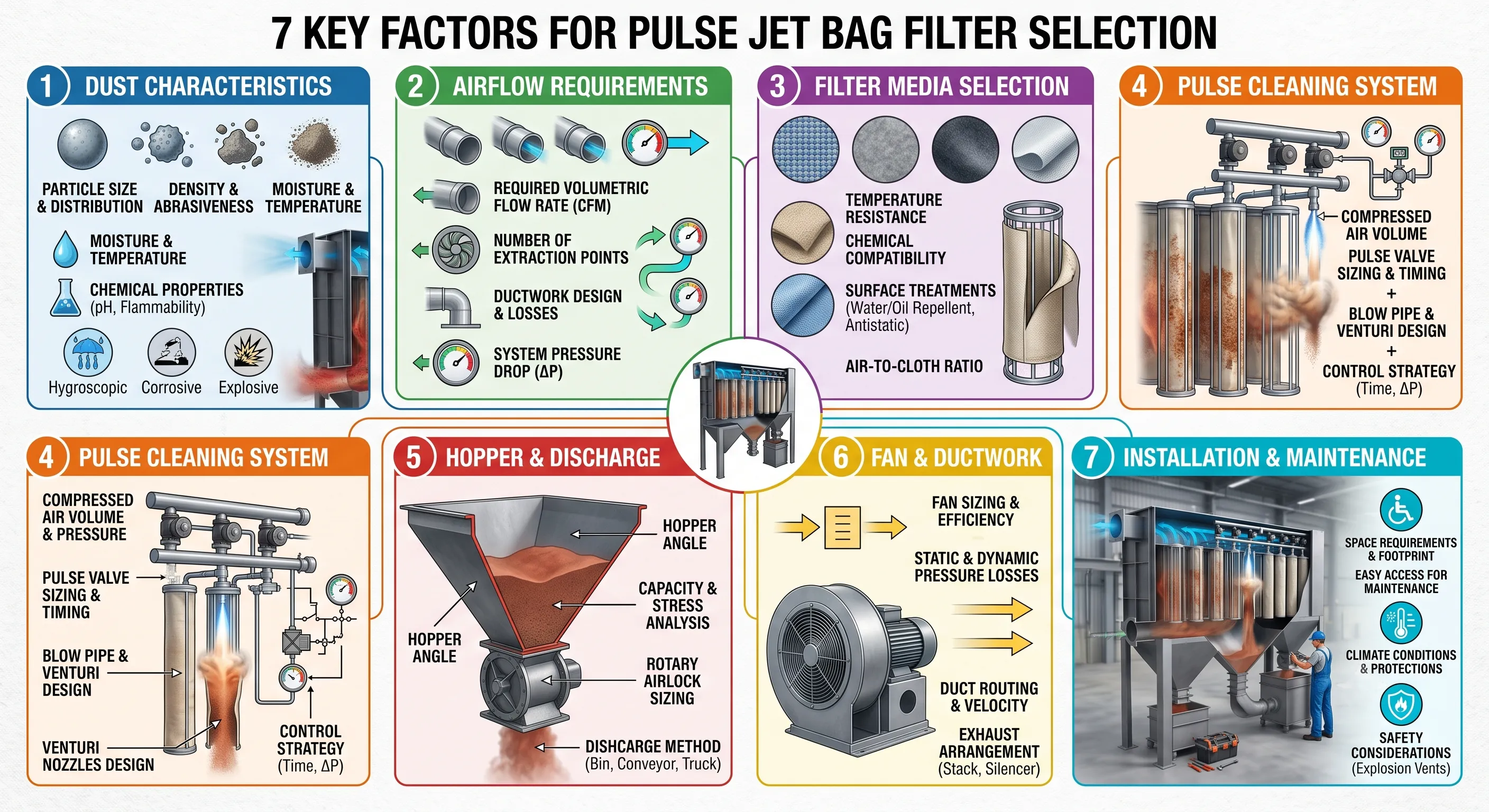
The first factor to consider is the type of dust being generated. Industrial dust is not a single uniform material. Metal grinding dust behaves differently from wood dust, cement powder, plastic particles, ceramic material, chemical powder, or agricultural dust. Particle size, shape, density, abrasiveness, moisture, chemical composition, and surface characteristics can all affect filtration behavior. Before selecting a collector, the material should therefore be identified as accurately as possible.
Particle size is particularly important because fine particles can remain suspended in the air for longer periods than larger particles. A process producing very fine powder may require different filter media and airflow conditions from a process generating larger particles. The expected particle-size distribution should be considered rather than looking only at the average particle size.
Dust concentration is another important consideration. A process producing a small quantity of particulate matter may require considerably less filtration capacity than a heavy-duty grinding, crushing, or material-handling operation. If the collector is exposed to a very high dust concentration, adequate filtration area and an effective cleaning arrangement become especially important.
The physical density of the dust can also influence system design. Dense particles may settle more readily in the inlet or hopper, while lightweight particles can remain airborne and travel further through the filtration chamber. Understanding how the material behaves in the air stream helps determine the appropriate collector configuration.
Abrasiveness should also be evaluated. Materials such as mineral dust, sand, cement, certain metal particles, and other hard substances can wear against ductwork and collector components. If the dust is abrasive, inlet design, airflow distribution, material thickness, and wear protection may need additional consideration.
Moisture content can strongly affect bag filter performance. Dry, free-flowing dust is generally easier to separate and discharge than sticky or damp material. Moisture can cause particles to adhere strongly to the filter surface, making pulse cleaning less effective. Condensation inside the collector can create additional problems when the process operates near the dew point.
The operating temperature of the air stream is another major selection factor. Filter fabrics have defined temperature capabilities, and exposure to excessive heat can cause premature deterioration. If the process generates hot gases, the filter media and complete collector design need to be suitable for those temperatures.
Temperature variations should also be considered rather than focusing only on the maximum process temperature. Startup, shutdown, cleaning cycles, seasonal conditions, and changes in production can create different temperature conditions. If temperatures fall too low, condensation may occur, while excessive temperatures can damage filter media.
Chemical properties of the dust and air stream must also be examined. Some particles or gases can attack filter fabrics, housing materials, seals, or other components. Where corrosive or reactive substances are present, materials should be selected according to the chemical environment.
The required airflow is one of the most important engineering parameters. The collector must process enough air to capture dust effectively at each extraction point. Insufficient airflow can allow dust to escape into the workplace before reaching the filter.
Airflow should be determined from the actual process requirements. Different machines and operations require different capture volumes. A grinding station, shot blasting machine, mixing unit, conveyor transfer point, and powder-filling station may each require a different extraction arrangement.
The number of extraction points also matters. If multiple machines are connected to a common collector, the system needs to account for which machines operate simultaneously. Designing only for average airflow without considering peak demand can result in insufficient extraction when several processes run at the same time.
The ductwork must also be considered during collector selection. Duct diameter, length, bends, branches, transitions, and material can affect pressure losses. A collector with sufficient nominal airflow may still fail to provide effective source capture if the duct system creates excessive resistance.
The distance between the dust-generating equipment and collector can influence fan requirements. Longer duct runs generally create additional resistance, especially when the system includes numerous bends and branches. The collector and fan should therefore be selected as part of the complete extraction system.
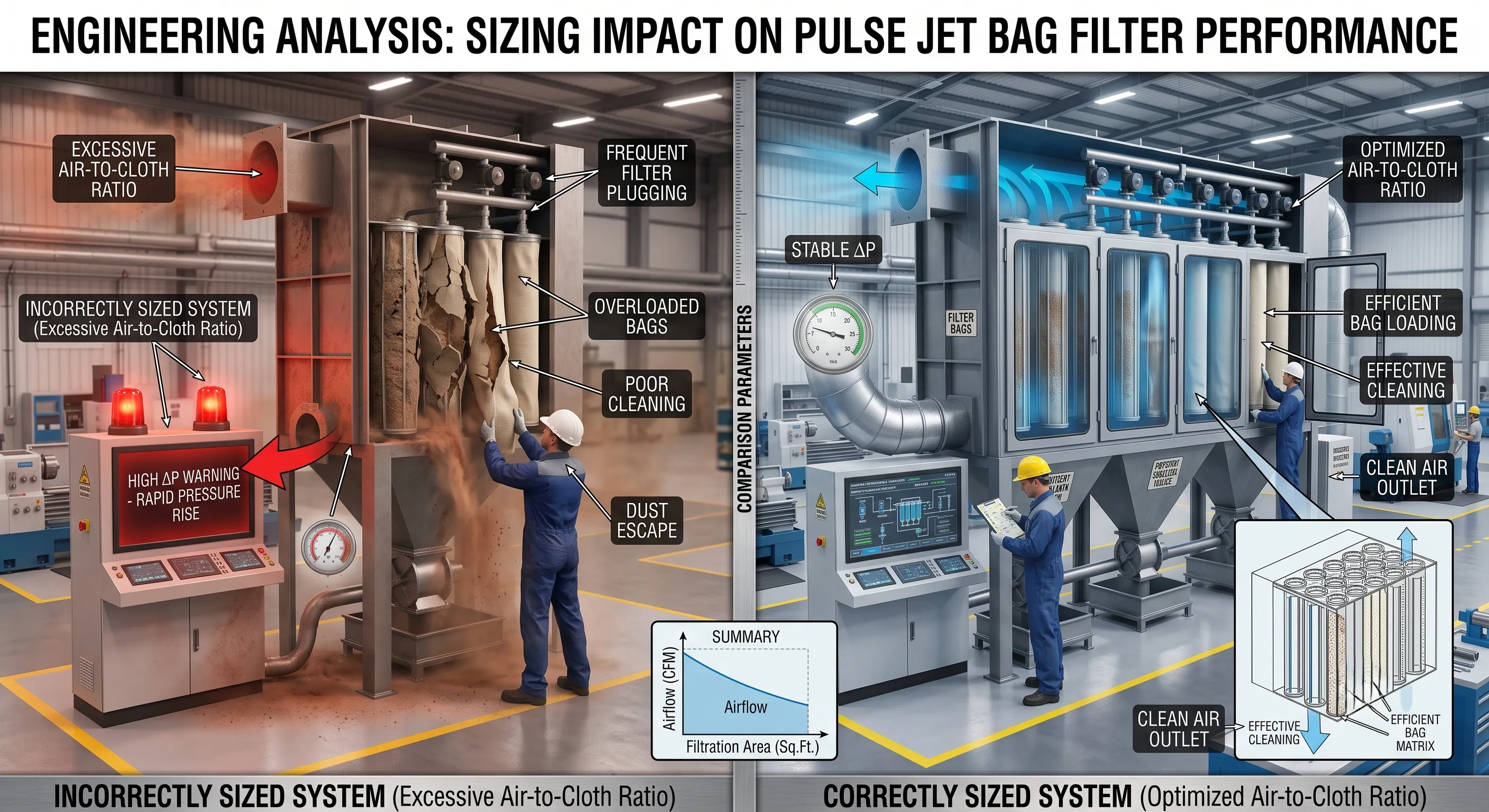
The air-to-cloth ratio is another critical factor. This parameter describes the volume of air passing through a specific amount of filter area. If the ratio is too high for the particular dust and media, the filter bags can become overloaded and pressure drop may rise rapidly.
A suitable air-to-cloth ratio provides sufficient filtration surface for the required airflow while maintaining manageable loading conditions. The appropriate value depends on dust characteristics, filter fabric, temperature, cleaning method, and operating conditions.
The total filtration area should therefore be calculated rather than selected only from the physical dimensions of the collector. More filter area is not automatically better, because excessive equipment size can increase cost without providing proportional benefits. The objective is to provide the right filtration area for the required process conditions.
Filter media selection is closely connected to filtration area and dust characteristics. Bags may be manufactured from different synthetic or natural fibers and may include specific treatments designed to improve dust release, temperature resistance, moisture resistance, or chemical compatibility.
The surface characteristics of the filter media can affect how easily dust releases during pulse cleaning. A dust that is difficult to remove may require a fabric with suitable surface treatment or construction. The selected material should therefore be evaluated according to both filtration and cleaning requirements.
Temperature resistance is particularly important when selecting fabric. A filter media may provide excellent particle capture under normal conditions but fail prematurely if continuously exposed to temperatures above its rated capability.
Moisture resistance may also be required in applications where humidity or condensation is present. The goal is to prevent dust from forming a sticky layer that cannot be effectively removed through pulse cleaning.
The pulse cleaning arrangement should be evaluated as another major selection factor. The system needs sufficient compressed-air capacity to clean the required number of bags effectively. Pulse valves, blow pipes, nozzles, air reservoirs, and control equipment should all be appropriate for the collector size.
Compressed-air quality matters as well. Moisture, oil, and other contaminants in the compressed-air supply can affect pulse valve operation and filter performance. A reliable air preparation system helps maintain consistent cleaning.
Cleaning frequency is also important. A collector operating under heavy dust loading may require more frequent cleaning than one serving a lighter process. The control system should provide a suitable cleaning strategy without excessive compressed-air consumption.
Differential pressure monitoring can improve the cleaning strategy. By measuring the pressure difference across the filter, the system can identify when the bags require cleaning. This can be more responsive than using a fixed cleaning interval when dust loading varies.
The collector should also have an appropriate hopper configuration. The hopper needs enough capacity to hold the expected quantity of removed dust between discharge cycles. If it is too small, frequent emptying may be required. If it is excessively large, the equipment may take up unnecessary space and cost more.
The hopper angle and internal design should encourage dust to move toward the discharge outlet. Material that remains stuck in the hopper can reduce effective capacity and create additional maintenance requirements.
The dust discharge system should match the material and production rate. Small applications may use drums or collection bins, while larger facilities may require rotary airlocks, screw conveyors, or other continuous discharge equipment.
A rotary airlock can provide controlled discharge while helping maintain pressure separation between the collector and downstream dust-handling equipment. Its size and operating speed should be appropriate for the expected dust volume and material characteristics.
The extraction fan is another major component. The fan must provide the required airflow at the total system pressure. This includes resistance from the hood, ductwork, filter bags, collector housing, discharge arrangement, and exhaust system.
Fan selection based only on airflow without considering pressure can lead to poor performance. The fan needs to operate at a point where it can deliver the required volume under the actual resistance of the complete system.
Energy consumption should also be considered. A fan operating against excessive pressure can require substantial electrical power. Maintaining a reasonable pressure drop across the filter and designing efficient ductwork can help control energy requirements.
The compressed-air energy used for pulse cleaning should also be included in the operating assessment. Frequent unnecessary cleaning can increase compressed-air consumption. The cleaning control system should therefore be configured to provide sufficient cleaning without excessive pulsing.
The expected operating hours influence equipment selection as well. A collector running continuously throughout multiple shifts will experience greater filter loading and component use than a system operating occasionally. High-duty applications may require more durable components and more structured maintenance planning.
Production growth should also be considered. If the facility expects to add machines or increase production in the future, the dust collection system may need some expansion capability. Designing the system only for today's minimum requirement can create limitations when production increases.
The physical space available for installation is another practical factor. The collector requires room for the main housing, hopper, fan, duct connections, access doors, dust discharge equipment, and maintenance activities. The available height may also be important because many collectors use vertical filter arrangements.
Maintenance access should be evaluated before final installation. Technicians need sufficient space to inspect and replace filter bags, service pulse valves, check seals, clean components, and inspect the hopper. A collector that performs well but is difficult to maintain can create unnecessary downtime.
Filter bag replacement should be practical. The collector design should allow technicians to access the bags without excessive dismantling. Easy access can reduce maintenance time and make preventive servicing more likely to occur on schedule.
The environment where the collector will operate should also influence the design. Outdoor installations may experience rain, humidity, wind, dust, and temperature changes. Indoor installations may have restrictions related to floor space, ventilation, noise, and nearby machinery.
Electrical requirements should be checked as part of the installation planning. The fan motor, control panel, pulse cleaning controls, sensors, and other electrical components need to match the available power supply and site conditions.
Noise can also be relevant, particularly when the collector is installed close to workstations. The fan and compressed-air pulses can generate sound. Equipment placement and appropriate engineering measures can help manage the acoustic impact.
Safety requirements deserve special attention when the collected material is combustible, toxic, reactive, or otherwise hazardous. Some industrial dusts can present fire or explosion risks under specific conditions. The system should be evaluated according to the material characteristics and applicable safety requirements.
Combustible dust should never be treated as ordinary particulate matter without assessment. The collector, ductwork, dust discharge system, and protective measures may need specialized design. The risk can depend on particle characteristics, concentration, moisture, ignition sources, and other conditions.
Hot dust or gases may also require additional precautions. If particles enter the collector at elevated temperatures, the filter media and housing must be capable of handling the heat. Cooling or temperature management may be required in some processes.
Corrosive dust can similarly require specialized materials. Standard steel components may not be suitable for every chemical environment. The expected exposure should be evaluated before the equipment is fabricated.
The required level of filtration is another factor. Different processes may have different emission-control objectives. The desired outlet performance should be considered when selecting filter media, filtration area, airflow conditions, and overall collector design.
The collector should also be evaluated for pressure drop at both clean and loaded conditions. The difference provides useful information about how the system will behave during normal operation. A system designed around unrealistic pressure assumptions may not provide the expected airflow.
The control system should offer suitable monitoring and automation. Depending on the application, this may include differential pressure monitoring, pulse sequencing, fan control, alarms, and other operating indicators. Automation can make the system easier to operate and maintain.
The quality of construction is important because industrial dust collectors often operate under demanding conditions. Housing strength, welding quality, sealing, filter support components, access doors, and surface treatment can all influence long-term reliability.
The collector should also be designed to minimize leakage. Air leakage around doors, seals, tube sheets, or other connections can reduce the effectiveness of the filtration system. Proper fabrication and routine inspection help maintain the intended airflow path.
Another important consideration is the expected filter bag life. Filter media eventually require replacement, but appropriate selection and balanced cleaning can extend service life. Excessive abrasion, high temperature, chemical exposure, poor cleaning, and unsuitable air-to-cloth ratios can shorten the useful life of the bags.
The type of production process should therefore be described clearly to the equipment manufacturer before a collector is selected. Information about the machine, material, dust generation rate, operating temperature, moisture, production hours, extraction points, and available installation space can help the manufacturer develop a more suitable design.
Site conditions should also be communicated accurately. A collector intended for an indoor factory should not automatically be specified the same way as one intended for an exposed outdoor installation. Environmental and maintenance conditions can influence the final configuration.
Budget is naturally another consideration, but the lowest purchase price should not be the only selection criterion. A cheaper collector that requires frequent filter replacement, consumes excessive energy, provides inadequate airflow, or creates frequent maintenance problems may cost more over its operating life.
Total ownership cost provides a better basis for comparison. This includes initial equipment cost, installation, electrical consumption, compressed-air consumption, filter replacement, maintenance, dust disposal, and potential production downtime.
Reliability can have significant financial value. If poor dust collection causes frequent machine cleaning, product contamination, worker disruption, or unplanned shutdowns, the indirect costs can exceed the initial equipment difference between two systems.
The availability of replacement filter bags and service components should also be considered. A collector may operate for years, so the ability to obtain suitable replacement media, pulse valves, seals, and other components can affect long-term maintainability.
Technical support is another practical consideration. The equipment supplier should be able to understand the application and assist with sizing, filter media selection, installation, commissioning, and maintenance requirements. A properly engineered system is more likely to provide reliable results than a generic collector selected only from a catalogue.
Customization can be valuable when the production process has unusual requirements. Industrial facilities may have specific space restrictions, multiple extraction points, high temperatures, special dust characteristics, or unique discharge arrangements. A customized collector can be designed around these conditions instead of forcing the process to fit a standard configuration.
The collector's future maintenance requirements should be understood before purchase. Operators should know how filter condition will be monitored, how bags will be replaced, how pulse valves will be inspected, how dust will be discharged, and what indicators can identify developing problems.
The relationship between all system components should remain central to the selection process. A high-quality filter housing cannot compensate for poor source capture. Excellent filter media cannot compensate for insufficient airflow. A powerful fan cannot solve incorrect duct design. A sophisticated control system cannot compensate for unsuitable filter bags.
The most effective selection process therefore begins with the dust source and follows the complete airflow path. The material is generated at the machine, captured through a hood or enclosure, transported through ductwork, filtered through the bags, cleaned through pulse jets, collected in the hopper, discharged through an appropriate mechanism, and finally exhausted through the fan and outlet arrangement.
A Pulse Jet Type Bag Filter should be selected only after these operating conditions have been evaluated together. Dust type, particle size, concentration, temperature, moisture, chemical characteristics, airflow demand, filtration area, air-to-cloth ratio, filter media, pressure drop, pulse cleaning capacity, hopper design, dust discharge, fan performance, duct resistance, installation space, maintenance access, energy consumption, safety requirements, and future production needs can all influence the correct configuration. A properly matched collector can provide stable dust filtration while supporting continuous production and manageable operating costs. By discussing the actual process requirements with an experienced industrial dust collection manufacturer, businesses can avoid common problems associated with undersized equipment, unsuitable filter media, insufficient cleaning capacity, excessive pressure drop, or difficult maintenance. The goal should always be to select a system that performs reliably under real production conditions rather than simply choosing equipment based on a nominal capacity or initial purchase price.
Conclusion
Selecting a Pulse Jet Type Bag Filter requires a complete understanding of the industrial process it will serve. The collector should be treated as part of an integrated dust extraction system rather than as an isolated piece of equipment.
The characteristics of the dust are among the first factors that should be evaluated. Particle size, density, abrasiveness, moisture, chemical composition, temperature, and concentration can all affect filtration performance and equipment life.
Airflow requirements are equally important. The collector must provide sufficient capacity to support effective source capture at the dust-generating equipment. Multiple extraction points need to be assessed according to their operating schedules and peak airflow requirements.
The ductwork should be designed together with the collector and fan. Pressure losses from long runs, bends, branches, and other components can affect the airflow available at the source. A suitable fan must be capable of delivering the required air volume at the total system resistance.
Filter media selection requires careful attention to process conditions. Temperature, moisture, chemical exposure, dust characteristics, and required filtration performance can determine which fabric is appropriate.
The air-to-cloth ratio should also be suitable for the application. Insufficient filtration area can lead to high loading and pressure drop, while excessive capacity can unnecessarily increase equipment size and cost.
The pulse cleaning system must provide reliable and sufficient compressed-air energy. Pulse valves, blow pipes, air reservoirs, control equipment, and compressed-air quality all contribute to effective filter cleaning.
Differential pressure monitoring can help manage cleaning cycles and provide useful information about collector condition. A suitable control strategy can reduce unnecessary cleaning while maintaining acceptable pressure resistance.
The hopper and dust discharge system must match the expected volume and characteristics of the collected material. Continuous processes may require automated discharge equipment, while smaller applications may use simpler collection arrangements.
Installation conditions should also be considered. Available floor space, height, maintenance access, weather exposure, electrical supply, noise, and future expansion can all influence the final collector configuration.
Safety deserves particular attention when dealing with combustible, toxic, corrosive, or high-temperature dust. Such applications may require specialized materials, protective equipment, and additional engineering measures.
Purchase price should not be the only financial consideration. Energy consumption, filter replacement, compressed-air use, maintenance, dust disposal, service availability, and potential downtime all contribute to the total cost of ownership.
A reliable supplier should be able to evaluate the complete process before recommending equipment. Providing accurate information about dust generation, airflow, material characteristics, operating hours, temperature, moisture, site conditions, and future production plans allows the collector to be engineered more effectively.
Ultimately, the right Pulse Jet Type Bag Filter is the one that matches the actual requirements of the process. Correct sizing, suitable filter media, balanced airflow, reliable pulse cleaning, efficient dust discharge, appropriate fan capacity, and practical maintenance access all contribute to dependable performance.
When these factors are considered together, the resulting dust collection system can provide effective particulate control, stable airflow, automatic filter cleaning, improved workplace conditions, and reliable long-term operation. Careful selection at the beginning can also reduce maintenance problems and operating costs throughout the equipment's service life.