Choosing the right blasting equipment is an important decision because the machine must match the actual working conditions, surface preparation requirements, production expectations, and available site utilities. When buyers begin comparing a Portable Shot Blasting Machine, they often focus mainly on tank capacity or purchase price. However, these are only two parts of a much larger decision. A suitable machine should work efficiently with the required abrasive, deliver consistent blasting performance, remain practical to move around the job site, and support the required level of surface preparation. The right selection can improve productivity, reduce abrasive and compressed-air waste, simplify maintenance, and provide more predictable results during demanding industrial work. Therefore, the machine should be selected according to the complete application rather than based on one specification.
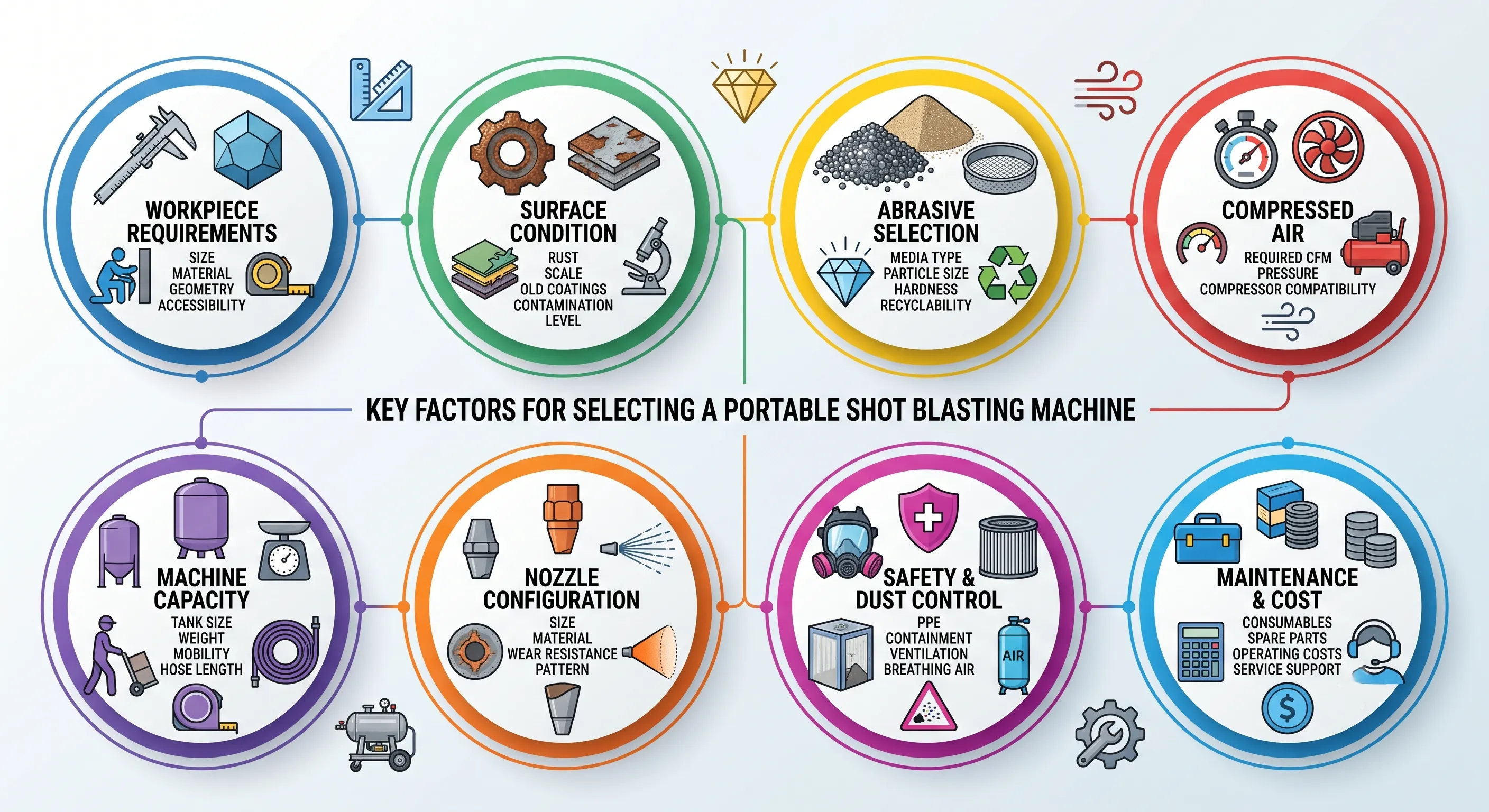
The first factor to evaluate is the type of workpiece that needs to be blasted. Different applications create different equipment requirements. A machine used for small fabricated components may not need the same capacity or configuration as one used for large structural steel, storage tanks, pipelines, bridges, heavy machinery, or industrial maintenance work. The material of the workpiece also matters because steel, cast iron, concrete, and other substrates may require different abrasive media, pressure levels, nozzle arrangements, and blasting techniques. Before selecting equipment, it is useful to understand whether the primary objective is rust removal, old paint removal, scale removal, weld cleaning, surface roughening, coating preparation, general cleaning, or a combination of these operations. Defining the actual application helps narrow down the equipment specifications and prevents buyers from paying for features that are unnecessary for their work.
The size and geometry of the component are equally important. Large flat surfaces can usually be accessed more easily than narrow sections, corners, internal surfaces, curved structures, tanks, pipes, beams, and complicated fabricated assemblies. A portable system is often selected specifically because the workpiece cannot conveniently be transported to a fixed blasting machine. In such situations, mobility and accessibility become major selection criteria. The equipment should be easy to position near the work area, while the blast hose should provide enough reach without creating excessive handling difficulty. If the project involves confined spaces or difficult access points, the overall equipment arrangement should be examined before purchase. A machine that performs well technically but is difficult to move or position may reduce the practical advantage of portability.
Surface condition should also be studied before deciding on machine specifications. Light oxidation, heavy rust, thick paint, mill scale, contamination, and multiple coating layers can require different blasting conditions. The condition of the surface influences abrasive selection, operating pressure, nozzle size, blasting distance, and expected productivity. For example, aggressive coating removal may require a different approach from light cleaning before painting. The objective should therefore be defined clearly. If the required finish is not established, it becomes difficult to select the correct abrasive and operating configuration. A good equipment supplier should be able to discuss the intended surface condition and recommend a suitable machine configuration instead of simply offering the largest available model.
The required surface preparation standard is another important consideration. Surface preparation is not only about making a component look clean. It can also involve creating a suitable surface profile for a subsequent coating system. Paint, primer, protective coatings, and corrosion-control systems depend on proper surface preparation for reliable performance. Abrasive type, particle size, hardness, pressure, nozzle configuration, and operator technique can all influence the final result. Abrasive blasting parameters such as media type and size, pressure, nozzle design, blasting angle, and stand-off distance directly affect cleaning and texturing performance. Therefore, buyers should discuss the required finish with the equipment manufacturer before choosing the machine and accessories.
Abrasive compatibility should receive special attention. Different blasting applications can use different abrasive materials depending on the substrate, required profile, cleaning intensity, operating cost, and environmental considerations. The equipment should be capable of handling the abrasive selected for the application without creating feeding or flow problems. Abrasive particle size also matters because media characteristics influence cleaning speed, surface profile, and consumption. A buyer should therefore ask which abrasive sizes and types are suitable for the proposed machine. It is also important to consider whether the abrasive will be recycled or disposed of after use. In applications where abrasive recovery is possible, the overall system design may differ from open-site blasting where spent abrasive is collected and managed separately.
Blast pot or abrasive tank capacity is another factor, but it should not be considered in isolation. A larger tank can provide longer operating time between refills, which may be useful for large surfaces and extended jobs. However, greater capacity can also increase equipment weight and make transportation or positioning more difficult. A smaller tank may be more practical for short maintenance tasks, localized repairs, and jobs where the machine must frequently be moved. Blast-machine sizing should therefore be based on the work pattern, available operators, expected blasting duration, refill arrangements, and site accessibility. Equipment sizing guidance also shows that pot capacity should be considered in relation to job profile and operating time rather than simply selecting the largest available vessel.
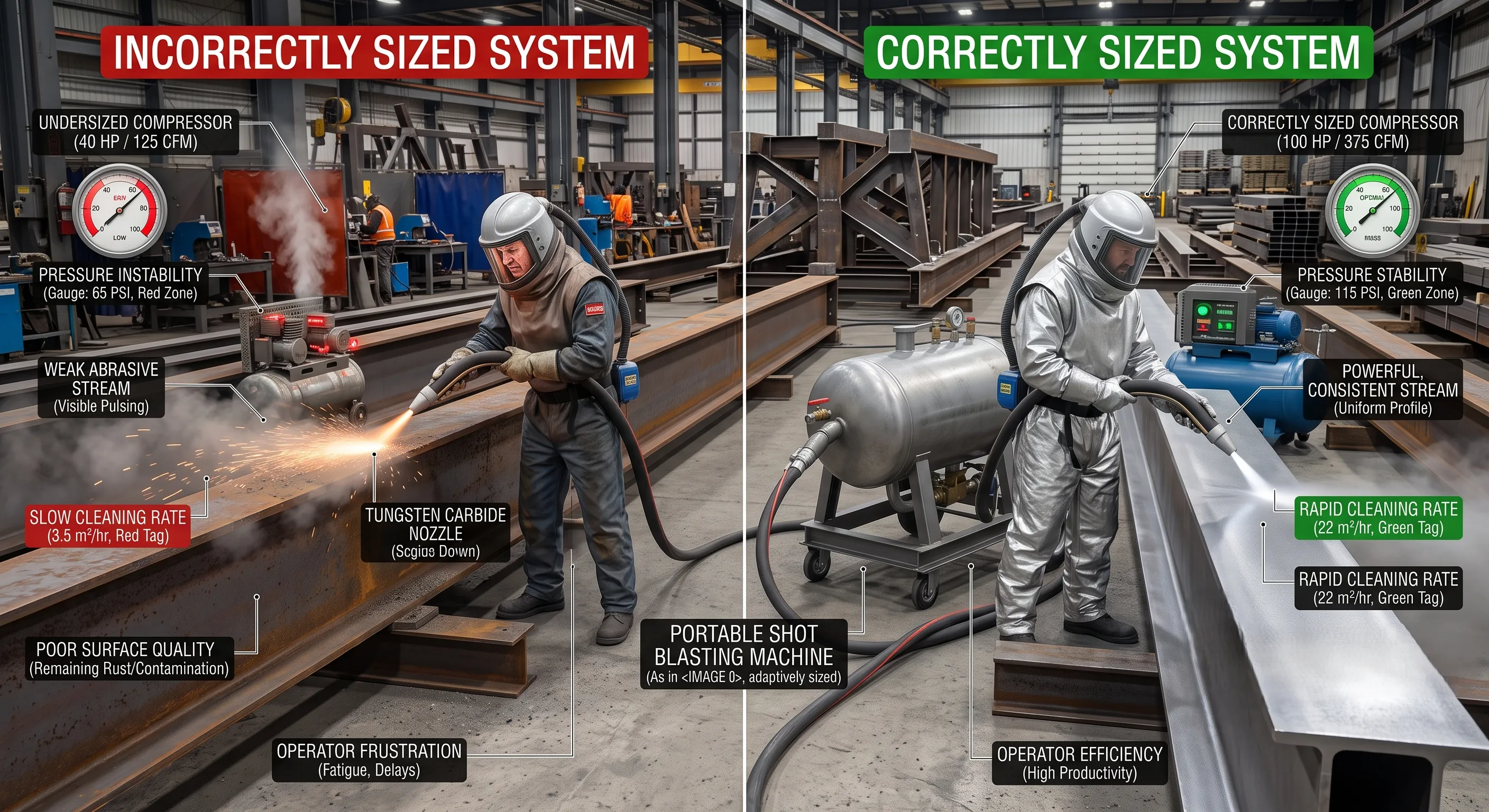
Compressed-air requirements are among the most important technical factors. A blasting system requires an adequate and stable supply of compressed air to maintain consistent performance. Buyers should not select a compressor simply by looking at horsepower. The required airflow must be matched to the nozzle size, working pressure, duty cycle, and other equipment connected to the same air supply. An undersized compressor can cause pressure drops and inconsistent blasting, while an unnecessarily oversized compressor can increase energy costs. Current industrial guidance emphasizes that blasting requires continuous high-volume airflow and that nozzle diameter has a major effect on air demand.
Nozzle selection should therefore be considered at the same time as compressor selection. A larger nozzle can increase production potential, but it also demands substantially more airflow. Nozzle condition is important as well because wear can enlarge the orifice and increase air consumption. A worn nozzle can reduce efficiency and increase operating costs. The buyer should ask the manufacturer to specify suitable nozzle sizes and the corresponding compressor requirements rather than choosing a nozzle independently after purchasing the machine. This approach helps ensure that the blast pot, abrasive metering system, hose, nozzle, and compressor operate as a balanced system.
Blast hose length and internal diameter should also be evaluated. Long hoses can be useful when blasting large structures because they provide greater working reach. However, excessive hose length, undersized hoses, restrictive fittings, and sharp bends can affect air delivery. For this reason, hose configuration should match the compressor, nozzle, and working environment. If operators need to move around a large structure, the hose should provide adequate flexibility without becoming unnecessarily heavy or difficult to control. The goal is to provide sufficient reach while maintaining efficient airflow and comfortable handling.
Expected cleaning rate is another practical factor. Buyers should estimate how much surface area must be prepared per hour or per shift. A machine designed for occasional maintenance work may not be suitable for a high-volume industrial operation. Conversely, investing in an unnecessarily high-capacity system for occasional spot repairs may not provide good value. Cleaning rate depends on several variables, including abrasive type, surface condition, nozzle size, pressure, operator technique, and workpiece geometry. Published machine specifications may provide approximate cleaning rates, but actual production should always be treated as application-dependent. Some portable blasting specifications, for example, provide different cleaning rates for different nozzle sizes and corresponding airflow requirements.
Duty cycle is closely connected with productivity. Buyers should determine whether the equipment will operate for short periods, several hours per day, or continuous industrial shifts. Intermittent blasting may allow a different compressor and equipment configuration than continuous blasting. If the machine is expected to operate for long periods, durability, heat management, component quality, abrasive flow stability, and serviceability become increasingly important. Continuous work can also expose weaknesses in hoses, valves, nozzles, seals, pressure controls, and other wear components much faster than occasional use. Therefore, the expected daily workload should be explained clearly to the manufacturer.
Mobility is obviously a major consideration for portable equipment, but portability involves more than simply adding wheels. The machine should be practical to move across the actual work environment. Buyers should consider wheel design, overall weight, center of gravity, handle arrangement, site terrain, loading requirements, and transportation method. If the equipment must be moved between different floors, fabrication areas, construction sites, or remote maintenance locations, the machine should be designed around those conditions. A compact configuration can be valuable when access is restricted, while a larger configuration may be better for high-capacity industrial work. The best choice is the configuration that balances capacity with practical movement.
Operator control and safety features should never be treated as secondary considerations. Abrasive blasting involves high-pressure air, abrasive particles, dust, noise, and high-velocity material. The equipment should therefore include appropriate control arrangements and safety features for the intended application. Remote or deadman-style controls can allow blasting to stop when the operator releases the control, depending on the machine design. Pressure controls, valves, gauges, properly rated hoses, fittings, and other protective components should also be considered. Safe blasting additionally requires suitable protective equipment, ventilation or containment, dust management, and proper operator training. Industrial guidance emphasizes the importance of dust protection, air treatment, and certified breathing-air arrangements where applicable.
Dust management is particularly important when selecting equipment for indoor or populated working environments. Open abrasive blasting can generate significant dust from both the abrasive and the material being removed. Depending on the application, buyers may need containment, ventilation, dust extraction, or abrasive recovery arrangements. A portable machine intended for outdoor structural maintenance may be configured differently from equipment used inside a workshop. The surrounding environment, nearby workers, ventilation conditions, and local requirements should therefore be considered before purchasing the equipment. Choosing the blasting machine without considering dust management can create operational and safety problems later.
Air quality should also be included in the equipment planning process. Moisture in compressed air can interfere with abrasive flow and contribute to clogging, while oil contamination can affect the blasted surface. Proper air treatment can help maintain consistent blasting performance and reduce avoidable interruptions. Buyers should therefore examine whether their existing compressor has suitable moisture separation and filtration or whether additional air-treatment equipment will be necessary. This is especially important when surface preparation is being performed immediately before a high-quality coating application.
Machine construction and durability are equally important for industrial use. Portable equipment is often transported, repositioned, loaded, unloaded, and exposed to demanding site conditions. The pressure vessel, valves, piping, wheels, handles, abrasive control system, hoses, and fittings should therefore be suitable for the intended operating environment. Buyers should ask about fabrication quality, pressure ratings, inspection requirements, wear components, and expected service life. A low purchase price may become expensive if components wear quickly or if replacement parts are difficult to obtain. Long-term reliability should always be considered alongside initial cost.
Maintenance and spare-parts availability can have a major effect on total operating cost. Abrasive blasting equipment naturally contains components that experience wear. Nozzles, hoses, valves, seals, fittings, and abrasive control components may require periodic inspection or replacement. A machine is more useful when these components are readily available and easy to service. Before purchasing, buyers should understand which parts are considered consumables, how frequently they may need replacement, and whether the manufacturer can supply genuine spares. Easy maintenance can reduce downtime and help keep the machine operating consistently.
Supplier support is another factor that should not be overlooked. A reputable manufacturer should be able to understand the application, recommend suitable specifications, explain compressor requirements, advise on abrasive selection, and provide operating guidance. Technical support becomes especially valuable when the equipment is customized for a specific project. Buyers should consider installation assistance, operator training, troubleshooting support, spare-parts availability, warranty terms, and after-sales service. The relationship with the manufacturer can influence the equipment's long-term value just as much as the original machine specification.
Customization may also be valuable when standard equipment does not perfectly match the application. Industrial blasting projects can vary considerably in tank capacity, hose arrangement, nozzle configuration, mobility requirements, control systems, abrasive compatibility, and operating environment. A manufacturer capable of modifying the equipment can provide a more application-specific solution. Instead of selecting a machine only from a standard catalogue, buyers should discuss their workpiece dimensions, daily production requirement, abrasive type, available compressor capacity, working location, and surface preparation objective. This allows the equipment to be configured around the actual job.
Energy and operating costs should be evaluated over the entire life of the equipment. The initial machine price is only one part of ownership cost. Compressed-air consumption, abrasive consumption, nozzle wear, hose replacement, maintenance, downtime, labor, transportation, and spare parts can significantly affect the long-term expense. A machine that costs slightly more initially but delivers better efficiency and reliability may provide greater value over several years. Similarly, an oversized machine may consume more resources than necessary. The correct objective is not simply to purchase the cheapest equipment but to achieve the required surface preparation at a sustainable operating cost.
Future workload should also influence the decision. A business may begin with small maintenance projects but later take on larger fabrication, infrastructure, or industrial refurbishment work. Selecting equipment with reasonable capacity for future requirements can prevent an early replacement. However, buying far beyond realistic requirements can create unnecessary capital and operating expenses. The best approach is to evaluate expected workload for the next several years and discuss future expansion with the manufacturer. A scalable and serviceable system can provide greater flexibility as production needs change.
A practical application test can be extremely useful before making a final decision. If possible, buyers should provide representative workpieces, coating samples, surface-condition details, or photographs of the actual application to the equipment manufacturer. Sample blasting can help determine suitable abrasive type, nozzle size, operating pressure, expected cleaning rate, and surface profile. This reduces the risk of selecting equipment based purely on catalogue specifications. It also allows the buyer to see whether the proposed setup can achieve the required finish within the expected production time.
Ultimately, selecting a Portable Shot Blasting Machine should be treated as a complete engineering decision rather than a simple equipment purchase. Workpiece size, material, surface condition, required finish, abrasive compatibility, tank capacity, compressor airflow, nozzle size, hose arrangement, duty cycle, mobility, safety, dust control, maintenance, spare availability, supplier support, and total operating cost all work together to determine whether the equipment will perform effectively. Buyers who evaluate these factors before placing an order are more likely to receive a machine that fits their application and delivers reliable results. For industrial users looking for application-focused equipment and surface preparation solutions, exploring the available capabilities of Portable Shot Blasting Machine solutions can be a useful step toward matching equipment specifications with actual project requirements.
Conclusion
Choosing suitable blasting equipment requires a balanced view of performance, application requirements, safety, mobility, operating cost, and long-term serviceability. The ideal machine is not necessarily the largest or the least expensive option. It is the one that provides the right combination of abrasive capacity, air requirements, nozzle performance, productivity, durability, operator control, and practical mobility for the intended job. Buyers should clearly define their surface preparation objective and discuss the complete application with an experienced manufacturer before making the final selection. Careful planning at the purchasing stage can prevent compressor limitations, excessive abrasive consumption, unnecessary downtime, poor surface preparation, and avoidable maintenance expenses. When equipment is properly matched to the job, portable abrasive blasting becomes a dependable and efficient solution for industrial cleaning, coating preparation, corrosion removal, refurbishment, and maintenance work.