Choosing the right industrial extraction equipment requires more than simply selecting a machine based on its size or advertised airflow capacity. Every production environment has different materials, processes, working conditions, and contamination-control requirements. A system suitable for a small manual sanding station may not be appropriate for heavy metal grinding, while equipment designed for dry particulate extraction may not be suitable for processes involving moisture, heat, or fumes. A Downdraft Table should therefore be selected after carefully evaluating the actual operation, the contaminants generated, the size and weight of the components, the required extraction capacity, and the available installation space. The right selection can provide consistent source capture and help create a more controlled workstation, while an incorrectly sized system may deliver inadequate extraction or unnecessary operating costs. For this reason, industrial buyers should consider the complete system rather than focusing on one specification in isolation.
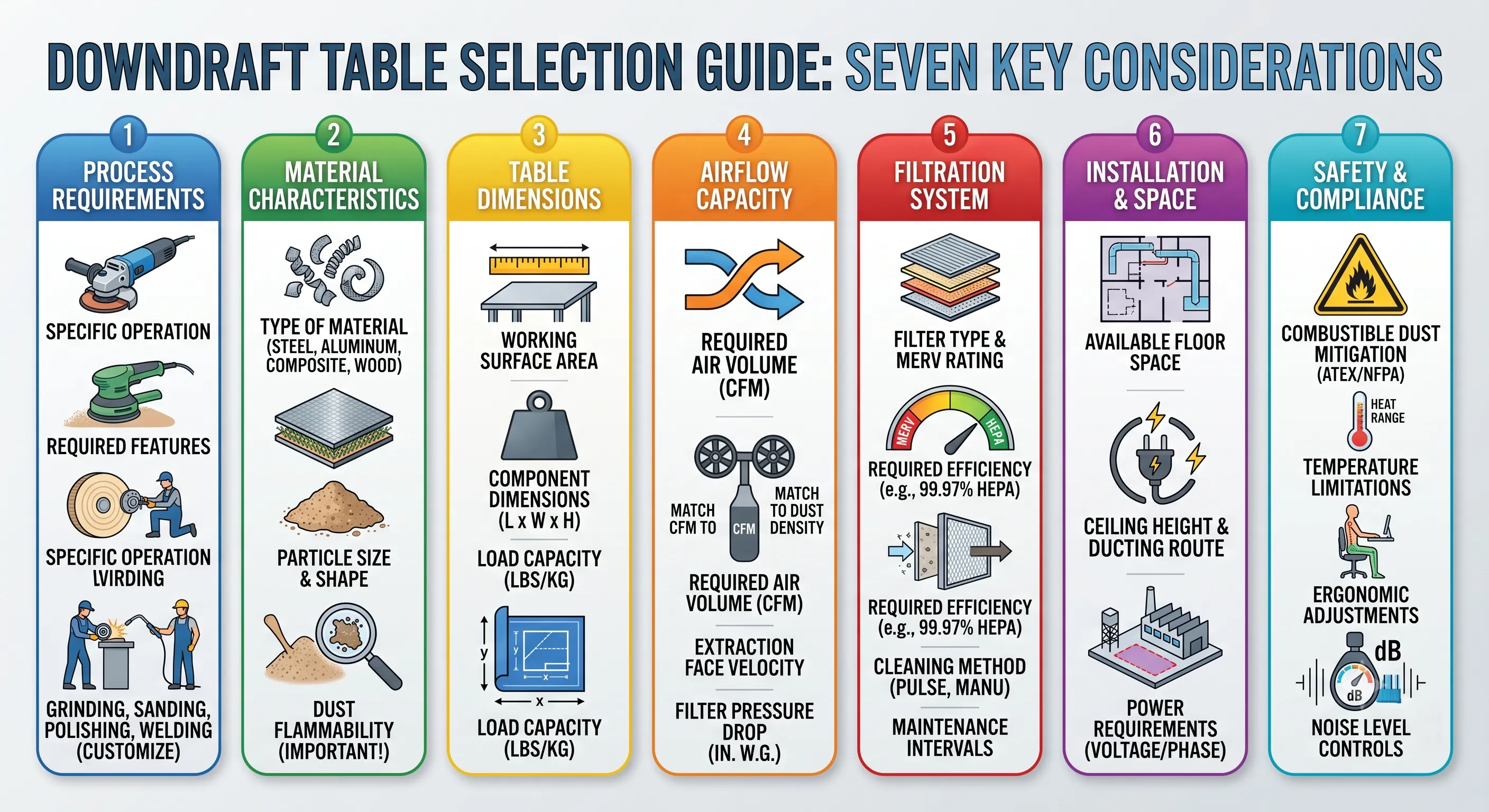
The first factor to evaluate is the type of industrial process that will be performed on the workstation. Grinding, sanding, polishing, deburring, welding-related preparation, cutting, and finishing operations can all generate different types of contaminants. Grinding may create metallic particles and abrasive residues, while sanding may generate fine particulate matter. Welding can produce smoke and fumes, and thermal processes may involve hot particles or elevated temperatures. The extraction system must be capable of handling the specific contaminant generated by the process. Before selecting equipment, businesses should clearly identify what operations will take place on the table and how frequently those operations will be performed. This provides the foundation for determining the appropriate design.
The material being processed is equally important. Different metals, woods, composites, coatings, plastics, and other materials can produce different dust characteristics. Particle size, density, moisture content, chemical composition, temperature, and potential combustibility can influence the extraction and filtration requirements. A system designed for one material should not automatically be assumed suitable for another. For example, fine dust from composite sanding may behave differently from heavier metallic particles generated during grinding. Understanding the material helps determine the appropriate filtration technology and dust-handling arrangement. It also allows safety considerations to be incorporated into the system design from the beginning.
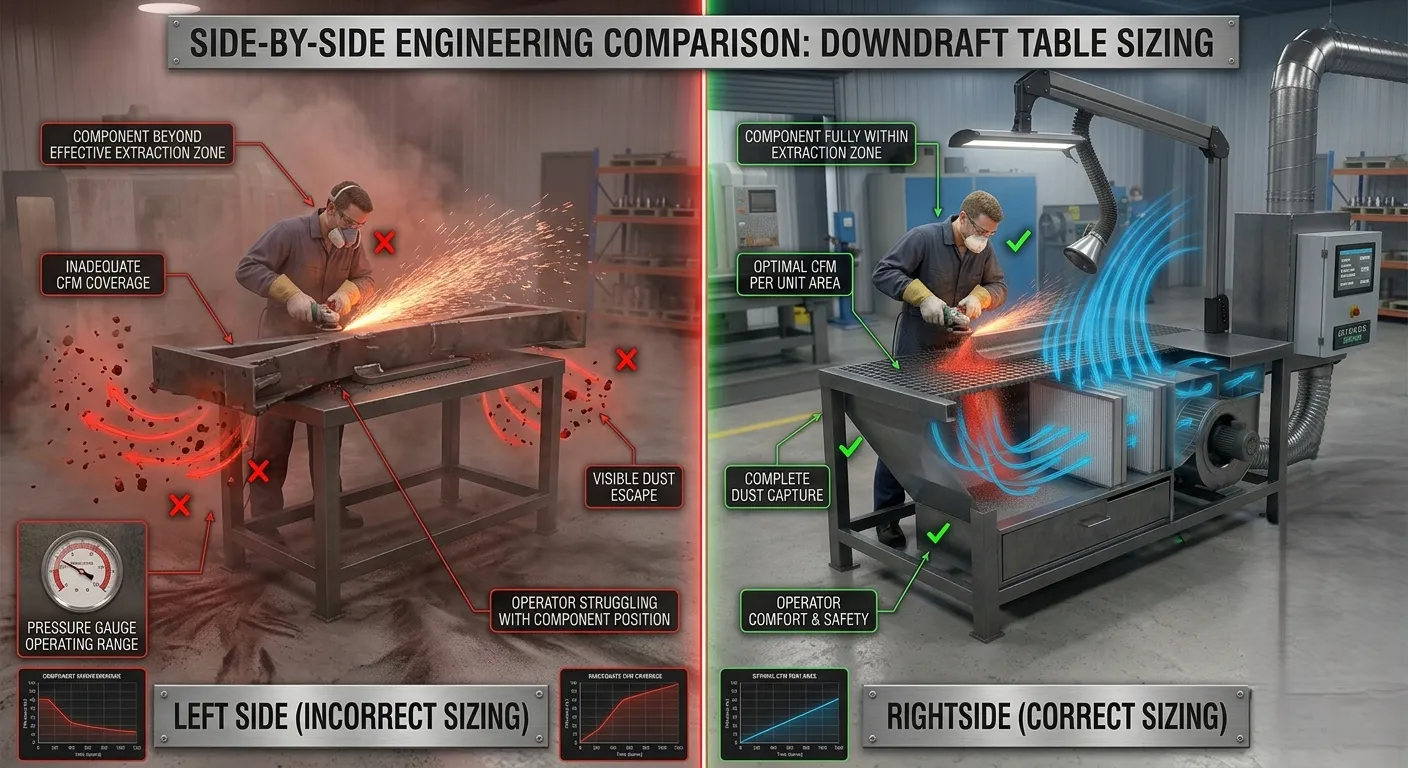
Table dimensions should be matched to the components being processed. If the working surface is too small, operators may be forced to position components outside the most effective extraction zone. This can reduce source-capture performance and make the workstation inconvenient to use. On the other hand, selecting an unnecessarily large table can increase the overall system size and airflow requirement. The ideal dimensions should provide enough working space for the typical components while maintaining practical airflow distribution across the active extraction area. Businesses should consider both current component sizes and potential future requirements when determining the table dimensions.
The weight of the workpieces is another major consideration. Industrial components can range from lightweight small parts to large and heavy fabricated assemblies. The table must have sufficient structural strength and loading capacity for the intended application. Heavy components may require reinforced construction, stronger support structures, and suitable material-handling arrangements. The work surface must remain stable during operation while allowing airflow through the extraction openings. A workstation that is structurally unsuitable for the workload can create operational and safety problems, even if its extraction system is technically capable of moving the required amount of air.
Airflow capacity is one of the most important technical factors. The extraction system must provide enough airflow to capture the contaminants generated during the process. However, simply choosing the machine with the highest airflow rating is not necessarily the best approach. Actual system performance depends on the extraction surface, ductwork, filter resistance, blower characteristics, and operating conditions. The required airflow should be determined based on the size of the extraction area and the nature of the process. A properly engineered system balances capture performance with energy consumption and equipment requirements.
The blower or fan should therefore be selected as part of the complete extraction system. Its operating point needs to account for pressure losses throughout the system. Duct bends, transitions, filters, extraction chambers, dampers, and other components all create resistance to airflow. A blower that provides a high airflow figure under low resistance may not provide the same performance once connected to the complete system. Industrial buyers should therefore look at the fan's performance under actual operating pressure rather than relying solely on a free-air capacity figure. Proper blower selection helps ensure that the workstation maintains effective airflow during real operating conditions.
Filtration technology is another critical factor. Once dust or fumes are pulled through the work surface, the contaminants must be separated from the air stream. The appropriate filter depends on the type of contaminant, particle size, concentration, temperature, moisture, and desired level of filtration. Some applications may require high-efficiency particulate filtration, while others may need a more robust industrial dust collection arrangement. The filter should also be capable of handling the expected dust loading without becoming excessively restrictive. Selecting filtration based only on general equipment descriptions can lead to poor performance if the actual contaminant characteristics are not considered.
Filter cleaning is closely related to filtration selection. As dust accumulates on filter media, resistance to airflow can increase. A suitable cleaning system can help maintain filter performance and extend service life. Depending on the equipment design, cleaning may be manual, mechanical, pulse-assisted, or based on another method. The appropriate cleaning approach depends on the filter type and application. Businesses should ask how the filter is cleaned, how often maintenance is expected, how collected dust is removed, and what signs indicate that servicing is required. These details can have a significant effect on long-term operating costs.
Dust collection capacity should also be considered. If the extraction system captures large quantities of material, the collection compartment needs enough capacity to prevent frequent interruptions. A small collection arrangement may require repeated emptying, which can increase downtime and maintenance effort. A larger hopper, tray, drawer, or other collection mechanism may be more appropriate for high-volume applications. The method of dust removal should also be practical for the facility. Businesses should consider how collected material will be handled, transported, stored, and disposed of after it has been removed from the extraction system.
The nature of the dust can influence collection design as well. Heavy particles may settle readily, while fine dust may remain suspended within the air stream until it reaches the filter. Some dusts can be sticky and may load filters differently from dry, free-flowing particles. Moisture can also change the behavior of collected material. These characteristics should be discussed with the equipment manufacturer before finalizing the design. A system that works well for one type of dust may require modifications when the material characteristics change significantly.
The operating temperature should be evaluated for processes that generate heat. Grinding and thermal cutting can produce hot particles, while some manufacturing processes generate elevated-temperature air. Filters, seals, ductwork, collection components, and other system parts must be suitable for the expected temperature conditions. If sparks or hot particles are generated, appropriate engineering controls may also be necessary. Industrial buyers should provide accurate information about the process so that the extraction system can be designed with the relevant operating conditions in mind.
Combustible dust considerations are particularly important in certain industries. Fine particles from materials such as wood, some metals, plastics, composites, and other substances may create specific fire or explosion hazards under certain conditions. The risk depends on material properties, particle size, concentration, ignition sources, and other factors. A standard extraction arrangement should not automatically be considered safe for combustible dust applications. Businesses should identify the material and process and seek appropriate engineering and safety guidance before purchasing equipment. Where necessary, the dust collector, ducting, filtration, grounding, spark-control arrangements, and other components may need to be designed specifically for the application.
The table's working height should also be considered from an ergonomic perspective. Operators may spend several hours each day working at the station, so the workstation should support comfortable and practical handling. A table that is too high or too low can make repetitive work more difficult. Component positioning, tool access, operator movement, and loading procedures should all be considered. Good ergonomics can support productivity while reducing unnecessary physical strain. The extraction system should fit naturally into the operator's workflow rather than creating obstacles.
Accessibility for maintenance is another factor that is sometimes overlooked during equipment selection. Filters, collection chambers, blower components, electrical panels, ducts, and other serviceable parts should be accessible without excessive difficulty. If maintenance requires significant disassembly, routine servicing may be delayed. A practical design should allow operators and maintenance personnel to inspect and service important components efficiently. Easy access can reduce downtime and make it more likely that maintenance tasks are completed according to schedule.
The available installation space must be measured before purchasing the equipment. Businesses should consider not only the footprint of the table but also the space required for filtration equipment, blower assemblies, ductwork, access doors, electrical connections, and maintenance activities. If the system is connected to a centralized dust collector, the routing of ducts needs to be planned carefully. The installation should also leave sufficient space for operators to work safely around the table. A machine that technically fits into a room may still be unsuitable if it restricts access or creates an inefficient workflow.
The existing ventilation and extraction infrastructure should also be reviewed. Some facilities already have centralized dust collection systems, while others require a dedicated extraction package. If the table is connected to an existing system, the available airflow and pressure capacity should be evaluated before adding another extraction point. The existing duct network may not have sufficient capacity for additional equipment. Conversely, a properly designed centralized system may allow several workstations to share filtration and blower capacity. Understanding the existing infrastructure can prevent costly modifications after installation.
Energy consumption is another important purchasing consideration. The blower operates whenever extraction is required, so its power consumption can contribute significantly to ongoing operating costs. Filter resistance can also influence energy demand because higher system resistance requires the blower to work harder to maintain airflow. Proper system sizing can help balance extraction performance and energy efficiency. Businesses should therefore consider expected operating hours, motor power, airflow requirements, filter condition, and control methods when evaluating long-term costs rather than focusing only on the initial purchase price.
Noise levels should also be considered, particularly when the workstation is located close to other employees. Blowers, motors, airflow, and ductwork can contribute to overall operating noise. The actual sound level depends on the system design and installation conditions. Businesses should discuss noise expectations with the manufacturer and consider appropriate engineering measures where necessary. A well-designed workstation should provide effective extraction without unnecessarily increasing the noise burden in the production area.
Control and automation options can also influence the selection. Some facilities may benefit from automatic start and stop functions, airflow monitoring, filter condition indicators, or other control features. These options can help operators manage the equipment more consistently and make maintenance easier. However, automation should be selected according to actual operational requirements rather than added without purpose. Simple systems may be appropriate for occasional use, while high-volume production facilities may benefit from more advanced controls.
Customization is particularly valuable when standard dimensions or configurations do not match the production process. Industrial manufacturers may be able to modify the table size, loading capacity, extraction zones, filtration arrangement, collection system, blower configuration, or other components. Customization can be useful for companies handling unusual component sizes, high production volumes, specialized materials, or limited installation spaces. Before requesting a customized system, businesses should provide accurate information about the application so that the manufacturer can design the equipment around actual operating conditions.
The quality and reliability of construction should also be evaluated. A workstation used in a demanding industrial environment should be built to withstand the mechanical and operational conditions of the process. The table surface, extraction chamber, support frame, duct connections, filter housing, blower, electrical components, and collection system all contribute to overall durability. Buyers should evaluate the manufacturer's engineering capability, fabrication quality, service support, and ability to provide suitable spare parts and maintenance assistance. A reliable supplier can be important because industrial extraction equipment is often expected to operate consistently over many years.
After-sales service is another practical consideration. Even a well-designed system requires maintenance, filter replacement, inspections, and occasional troubleshooting. Businesses should understand what type of technical support is available after installation. Access to replacement filters, blower components, electrical parts, and other consumables can reduce downtime. Installation guidance and operator training can also help the equipment reach its intended performance. A supplier that understands the application can provide more useful support than a seller focused only on delivering a standard machine.
Businesses should also consider future production changes. A table selected only for today's workload may become unsuitable if component sizes increase, production volume grows, or new materials are introduced. Planning for reasonable future requirements can make the investment more useful over the long term. However, future-proofing does not mean purchasing an excessively large system. The goal is to identify realistic production changes and select equipment that can accommodate them without creating unnecessary operating costs.
A proper evaluation should ultimately bring all of these factors together. Process type, material characteristics, dust and fume properties, table dimensions, component weight, airflow, filtration, dust collection, temperature, safety requirements, installation space, energy use, maintenance, and future production needs are interconnected. Changing one factor can affect another. For example, increasing table size may increase airflow requirements, which can influence blower selection and energy consumption. Choosing a different filter may change pressure drop and maintenance frequency. Therefore, equipment selection should be approached as an engineering decision rather than a simple product comparison.
For industrial businesses, the most reliable approach is to communicate detailed application information to the manufacturer before ordering. Providing photographs or drawings of the workstation area, component dimensions, material specifications, process descriptions, expected operating hours, and dust characteristics can help the manufacturer understand the requirement. The supplier can then recommend an appropriate configuration and identify any application-specific considerations. This approach can reduce the risk of selecting equipment that looks suitable on paper but does not provide the required extraction performance in actual production.
A well-selected extraction workstation can provide long-term value when it is properly matched to the process. It can support better contaminant capture, cleaner work areas, easier housekeeping, and more controlled production conditions. However, these benefits depend on proper engineering rather than on the equipment name alone. The system must provide appropriate airflow, filtration, dust collection, structural strength, and maintenance access while fitting naturally into the production layout. For companies evaluating equipment for industrial grinding, sanding, polishing, deburring, or other dust-producing operations, carefully reviewing these requirements before purchasing a Downdraft Table can help ensure that the selected system provides reliable performance, practical maintenance, and a configuration suited to the actual working environment.
Conclusion
Choosing the right extraction workstation requires a complete understanding of the industrial process rather than relying on a single specification. The material being processed, type of contaminant, table size, component weight, airflow requirement, filtration technology, dust collection method, blower capacity, installation conditions, operating temperature, safety considerations, maintenance requirements, energy consumption, and future production needs should all be evaluated before making a final decision.
The best equipment is the system that fits the real production requirement. A properly engineered solution can provide effective source capture while supporting cleaner workstations, practical maintenance, and consistent industrial operation. Businesses should therefore discuss their exact process conditions with an experienced manufacturer and select equipment based on actual performance requirements. Careful planning before installation can help avoid airflow problems, unnecessary operating costs, unsuitable filtration, and difficult maintenance later.