Industrial filtration plays an important role in manufacturing facilities where dust, fine particles, fumes, and other airborne contaminants are generated during production. Industries use filtration systems to control dust emissions, maintain cleaner working environments, protect machinery, and support consistent product quality. However, the cost of installing an industrial filtration system can vary considerably because every manufacturing process has different operating requirements. A small workshop collecting dust from one machine may need a compact unit, while a large factory with multiple production lines may require a high-capacity collector, extensive ductwork, automated cleaning, and specialized safety features. Industrial Filter Equipment is available in different configurations and capacities, so its purchase price depends on the filtration technology, airflow requirements, filter media, construction materials, automation, and installation conditions. Understanding these cost factors helps manufacturers compare suitable options, estimate the overall investment, and select equipment that delivers reliable performance without creating unnecessary operating expenses.
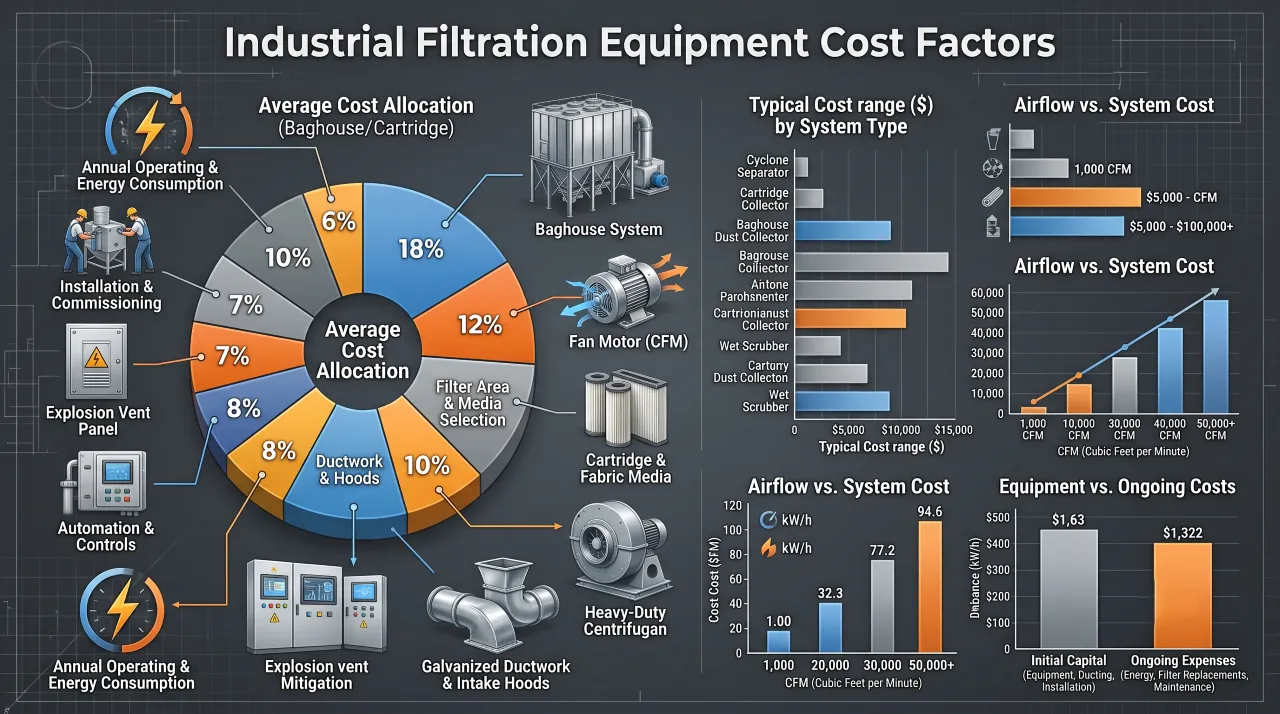
One of the main factors affecting filtration equipment cost is the type of system required. Bag filter collectors, cartridge filter systems, cyclone separators, wet dust collectors, and multi-stage filtration units use different technologies and components. A cyclone separator designed mainly to remove heavier particles may have a different construction and operating arrangement from a cartridge collector designed for fine dust. Similarly, a wet filtration system requires liquid handling, drainage, and sludge management components that may not be necessary in a dry dust collection system. Multi-stage systems can include several separation units, increasing the number of components and the complexity of installation. The most suitable technology depends on the contaminant and required filtration performance, so manufacturers should establish the technical requirements before comparing prices.
The required airflow capacity has a direct influence on equipment cost. Airflow determines how much contaminated air the system can collect and process within a given period. A small extraction unit serving one workstation generally has different requirements from a centralized system serving several machines simultaneously. Higher airflow capacity may require a larger filter housing, more filter media, a higher-capacity fan, stronger structural components, and larger duct connections. The collector must also overcome resistance created by the filter media and ductwork. Consequently, selecting equipment with greater airflow capacity can increase the initial investment. However, insufficient capacity can lead to poor contaminant capture and production difficulties. Manufacturers should choose a system according to calculated airflow demand rather than selecting the cheapest or largest available model.
The size and number of filter elements also affect the purchase price. Bag filter systems use fabric bags, while cartridge collectors use pleated filter elements. The total filtration area must be suitable for the airflow, dust concentration, particle characteristics, and operating conditions. A system handling a heavy dust load may need more filter area to maintain acceptable airflow and cleaning performance. Larger filtration capacity can increase the equipment's dimensions and the quantity of filter media required. It can also influence the housing design and cleaning mechanism. The objective is to provide sufficient filtration area for reliable operation without paying for unnecessary capacity.
Filter media selection is another important cost consideration. Industrial filters are available in different materials and constructions to handle varying temperatures, moisture levels, particle sizes, and chemical conditions. Standard media may be suitable for some dry-dust applications, while demanding processes may require specialized materials. Media designed for higher temperatures, particular chemical environments, or specific filtration performance may cost more than conventional alternatives. The material being collected can also influence the expected service life of the filters. Manufacturers should compare media based on suitability, durability, replacement availability, and operating conditions rather than choosing solely according to the initial price.
The characteristics of the dust being collected can increase system costs. Coarse, dry particles may be relatively straightforward to separate in certain applications, while fine dust can require more carefully selected filter media and additional filtration stages. Sticky or moist material may require special consideration because it can accumulate on filter surfaces and interfere with cleaning. Abrasive particles can wear certain components, while corrosive contaminants may require compatible construction materials. Some hazardous or combustible dusts need specialized equipment and additional engineering controls. These requirements can increase the initial investment, but they are essential to ensure that the system is appropriate for the application. Manufacturers should accurately describe the contaminant and its properties when requesting a quotation.
The fan or blower is another major component influencing the overall price. It must deliver the required airflow while overcoming the resistance of the duct network, extraction hoods, filter media, and other system components. Higher airflow or static pressure requirements may call for a larger motor and a more robust fan assembly. The fan design, construction material, motor rating, and control arrangement can all affect the cost. Selecting a fan based only on motor power may not provide the best result because airflow and pressure must be matched to the complete installation. A properly selected fan supports effective collection and can help avoid unnecessary energy consumption during regular operation.
Ductwork and extraction points can add substantially to the total project cost. A filtration system may require ducts, elbows, branch connections, dampers, hoods, flexible connections, support structures, and installation accessories. A simple installation serving one machine may need relatively little ductwork. In contrast, a centralized system connecting several production areas may require an extensive network with multiple branches and carefully balanced airflow. Duct diameter, material, length, routing, and installation difficulty all influence the final expense. Existing buildings can present additional challenges if ducts must pass through restricted spaces or around existing machinery. Manufacturers should therefore request a quotation that clearly identifies whether ductwork and extraction arrangements are included.
The installation location can also affect costs. Equipment installed inside a workshop may have different requirements from a collector positioned outdoors or in a separate utility area. Available floor space, access routes, foundation requirements, structural supports, weather protection, and maintenance clearance can influence the installation plan. In some facilities, the collector may need to be positioned close to the production machine. Other installations may require a centralized location to serve several processes. If the equipment must be moved through restricted doorways or installed in a difficult-to-access area, additional handling and installation work may be necessary. Evaluating the site before purchasing the system helps manufacturers identify these expenses early.
Automation and control features can influence the initial investment. Basic systems may use straightforward controls, while more advanced installations can include automatic filter cleaning, pressure monitoring, motor protection, variable-speed control, operating indicators, and other electrical components. Automatic cleaning can help maintain filter performance, particularly in systems designed for continuous or demanding operation. Monitoring devices may also help operators identify increasing filter resistance or other operating problems. However, the value of these features depends on the application. Manufacturers should identify which controls are necessary for safe and reliable operation and which features are optional. Selecting controls according to actual operating requirements helps avoid unnecessary complexity.
The filter cleaning mechanism is another cost factor. Bag and cartridge collectors may use pulse jet cleaning, mechanical shaking, reverse-air cleaning, or other arrangements. Pulse jet systems require compressed-air components, valves, controls, and associated connections. Mechanical or reverse-air systems use different mechanisms and may have different maintenance requirements. The most suitable cleaning arrangement depends on the filter type, dust characteristics, operating schedule, and system design. A cleaning mechanism that is unsuitable for the application may lead to poor filter performance or shortened filter life. Manufacturers should evaluate the complete cleaning arrangement instead of comparing equipment only by the number of filters or the motor rating.
Dust discharge and collection arrangements can also affect the final price. Collected material may be discharged into a hopper, removable drum, collection bag, sealed container, or automated handling system. A small installation may require a simple collection container, whereas a high-capacity system may need a larger hopper or mechanical discharge equipment. If dust must be transferred continuously or handled in a controlled manner, additional components may be required. The characteristics of the collected material can also influence storage and disposal requirements. Manufacturers should estimate how much dust the process generates and how frequently the collection section must be emptied before selecting a suitable arrangement.
Safety provisions can add to the investment when the process involves hazardous contaminants. Certain industrial dusts may be combustible, corrosive, reactive, or otherwise hazardous. Depending on the material and the applicable requirements, the filtration installation may need specialized construction, explosion protection, isolation equipment, grounding, monitoring, or other engineering measures. Some applications involving fumes or chemical contaminants may also require dedicated filtration or treatment stages. These features should be determined through an appropriate assessment rather than treated as optional upgrades. The system must be suitable for the actual hazard, and using ordinary equipment for a specialized application can create unacceptable risks.
Energy consumption is a major part of the long-term cost of filtration equipment. Fans and blowers require electricity to move air through the extraction network and filter media. Higher airflow, excessive pressure loss, long operating hours, and inefficient system design can increase energy expenses. Filter loading can also affect resistance and system performance. Manufacturers should evaluate the expected operating schedule, fan specifications, airflow controls, and maintenance requirements when estimating running costs. A filtration system with a lower purchase price may become more expensive over time if it consumes excessive energy or cannot maintain the required collection performance efficiently.
Replacement filters and spare parts contribute to ongoing expenses. Bag and cartridge elements eventually require servicing or replacement, depending on their material, dust load, cleaning method, and operating conditions. Valves, seals, sensors, electrical components, and other parts may also require maintenance. Replacement costs vary according to the filter design, material specifications, equipment model, and availability of compatible parts. Before purchasing the system, manufacturers should confirm the price and availability of replacement filters and commonly serviced components. A system that relies on difficult-to-source parts may create additional downtime and procurement costs.
Routine maintenance also affects the total cost of ownership. Industrial filtration equipment needs inspection to ensure that filters, cleaning mechanisms, duct connections, fans, and dust discharge components remain in suitable condition. Depending on the system, maintenance may involve checking pressure differences, inspecting filter media, removing accumulated dust, cleaning components, and replacing worn parts. The time required for these tasks can influence labour costs and production scheduling. Equipment with accessible service points and a clear maintenance procedure may be easier to manage over its operating life. Manufacturers should consider serviceability when comparing models, especially if the filtration system will operate for long hours or support critical production processes.
The choice between a portable unit and a centralized system can change the overall investment. Portable equipment may be suitable for individual workstations or applications that require flexibility. Dedicated collectors can be installed near particular machines, while centralized systems can connect multiple extraction points to one main filtration installation. A centralized system may reduce the need for separate collectors, but it can require extensive ductwork, airflow balancing, and more complex planning. Several smaller units may be easier to install in some facilities, although they may require additional maintenance points and separate electrical connections. The correct option depends on the factory layout, number of machines, operating schedule, and expected production growth.
Installation, testing, and commissioning should be included when estimating the project budget. The total expense may include equipment positioning, mechanical assembly, electrical connections, duct installation, control setup, and airflow adjustments. The system should be checked after installation to confirm that it operates according to the agreed specifications. Inadequate commissioning can result in poor extraction performance even when the equipment itself is correctly manufactured. Manufacturers should clarify which services the supplier includes in the quotation and whether additional costs may apply for site preparation, travel, lifting equipment, or other installation requirements.
Supplier experience and after-sales support can influence the practical value of a purchase. A supplier who understands industrial dust collection can help identify the correct technology, estimate airflow requirements, and recommend appropriate filter media. Technical guidance is especially important when the process produces fine dust, abrasive particles, or potentially hazardous contaminants. Warranty conditions, installation assistance, replacement-part availability, and service response can also affect long-term costs. Manufacturers should compare quotations on the basis of equipment specifications and support services rather than choosing solely according to the lowest price. A clear proposal should explain the system capacity, filtration arrangement, included components, exclusions, maintenance requirements, and applicable warranty terms.
Future expansion should be considered before finalizing the system. A factory planning to add machinery, increase production volume, or introduce new processes may need additional collection capacity later. Designing the system with realistic expansion requirements in mind can help reduce the need for major modifications. However, buying equipment that is substantially larger than current and planned requirements may increase purchase and operating costs unnecessarily. Manufacturers should discuss anticipated changes with the supplier and determine whether additional capacity can be introduced through modular components, new duct branches, or other practical upgrades.
For businesses planning a new filtration installation, Industrial Filter Equipment should be evaluated through both its purchase price and its expected operating performance. The main cost factors include system type, airflow capacity, filter area, media selection, fan specifications, ductwork, automation, cleaning mechanisms, dust discharge, safety features, installation, and long-term maintenance. Energy consumption, replacement filters, spare parts, and after-sales support can also affect the total investment throughout the equipment's service life. Comparing these elements helps manufacturers understand the differences between quotations and select equipment that meets the real needs of the production facility. The most economical choice is the one that provides suitable filtration performance, dependable operation, manageable maintenance, and appropriate safety for the application.
Conclusion
The cost of industrial filtration equipment depends on several technical and operational factors rather than one standard price. System type, airflow capacity, filter media, fan specifications, ductwork, automation, cleaning mechanisms, dust discharge arrangements, and installation requirements all influence the initial investment. Specialized safety provisions may also be necessary for certain hazardous or combustible materials. Over the equipment's service life, electricity consumption, replacement filters, spare parts, maintenance labor, and downtime contribute to the total cost of ownership. Manufacturers should therefore compare complete technical proposals instead of choosing equipment based only on the purchase price. By identifying the contaminants, calculating the required airflow, evaluating operating conditions, and confirming maintenance and support arrangements, businesses can select a filtration solution that balances performance, safety, durability, and cost. A well-planned investment can help maintain cleaner production areas, protect machinery, and support reliable industrial operations over the long term.