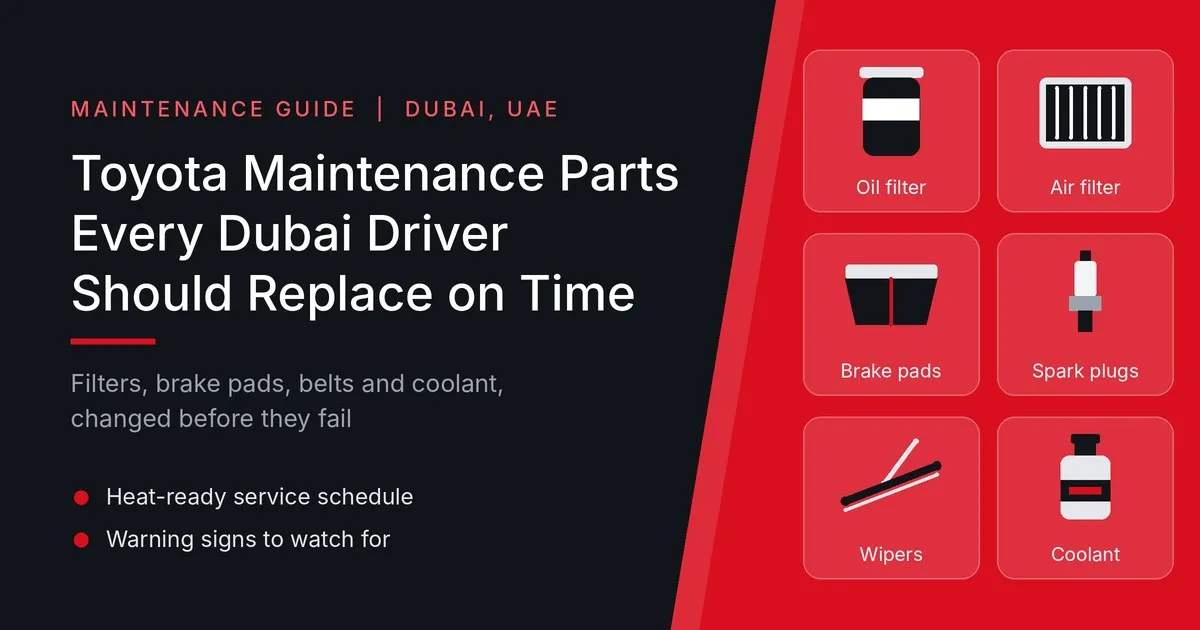
Keeping your car reliable in a hot climate comes down to replacing small, inexpensive items before they fail. Many owners search for Toyota spare parts only after something breaks, when a quick service has already turned into a tow and a larger repair bill. This guide covers the maintenance parts that deserve regular attention, why heat and city driving make them more important, and how to build a simple schedule you can actually follow.
The advice here applies to most popular models, including the Corolla, Camry, Yaris, RAV4, and Prado. Always check your owner's manual for the exact service intervals recommended for your own vehicle.
Why Maintenance Matters More in Hot Conditions
High temperatures, dust, and stop-and-go traffic put extra demand on a car. Engine oil works harder, rubber parts age faster, and filters collect fine dust more quickly. Heat does not cause problems overnight, but it speeds up wear. A part that might last comfortably in a mild climate may need earlier replacement here.
Regular maintenance is also the cheapest way to protect more expensive components. A clean filter protects the engine. Fresh coolant protects the cooling system. Healthy brake pads protect the discs. Replacing the small part on time is almost always cheaper than repairing what it was protecting.
The Parts That Need Regular Replacement
Engine Oil and Oil Filter
Oil lubricates moving parts, carries away heat, and holds tiny particles in suspension. Over time it thins, darkens, and loses protection. The oil filter traps those particles, and a clogged one cannot do its job. Changing both together at the interval in your manual is the single most useful habit for engine health. Use the grade of oil recommended for your engine rather than whatever is cheapest.
Air Filter
The air filter stops dust from entering the engine. In dusty conditions it can clog faster than expected, which restricts airflow and may increase fuel use or reduce performance. A quick visual check is easy: hold the filter up to a light, and if little light passes through, it is probably time to replace it.
Cabin Filter
The cabin filter cleans the air that enters the car through the vents. When it is blocked, airflow from the air conditioning can feel weaker and the cabin may smell musty. Because air conditioning is used heavily in summer, this inexpensive part is worth replacing regularly.
Fuel Filter
The fuel filter catches contaminants before they reach the injectors. A restricted filter can cause hesitation, hard starting, or rough running. Replacement intervals differ between models, so follow the guidance for your vehicle.
Spark Plugs
Spark plugs ignite the fuel mixture. Worn plugs can cause misfires, rough idling, weaker acceleration, and higher fuel consumption. They wear slowly, so owners often forget them until the car begins to run poorly. Replacing them at the recommended interval keeps combustion efficient.
Brake Pads
Brake pads wear every time you slow down, and city traffic means frequent braking. Signs of worn pads include a squealing sound, a longer stopping distance, or a vibrating pedal. Replace pads before they wear down to the metal, because damaged discs cost much more to fix.
Wiper Blades
Wiper blades are easy to ignore in a dry climate, but sun exposure makes the rubber brittle and cracked. When rain does arrive, worn blades smear the windscreen and reduce visibility. Replacing them once a year is a sensible habit.
Belts
Drive belts power components such as the alternator and air conditioning compressor. Look for cracks, fraying, or a glazed surface. A squealing noise when starting the engine can also signal a loose or worn belt. A broken belt can leave you stranded, so early replacement is worth it.
Coolant
Coolant keeps the engine at a safe temperature and protects the cooling system from corrosion. Old coolant loses its protective qualities. Check the level regularly, and replace it according to your manual. Never open a hot radiator cap.
A Simple Maintenance Schedule
The exact intervals depend on the model and how the car is driven, but this general pattern is easy to follow. Treat it as a reminder, and confirm the details in your manual.
Every month: Check tire pressure, coolant level, oil level, and lights.
Every few months: Inspect the air filter, wiper blades, and brake performance.
At each oil service: Replace the engine oil and oil filter, and ask for a general inspection.
Once a year: Replace the cabin filter and wiper blades, and inspect the belts and brake pads.
At longer intervals: Replace spark plugs, the fuel filter, and coolant as your manual recommends.
Warning Signs You Should Not Ignore
Parts often give notice before they fail. Pay attention to the following signals.
A squealing or grinding noise when braking.
A rough or shaky engine at idle.
Weak airflow from the air conditioning.
A burning smell or visible smoke.
A temperature gauge reading higher than usual.
Dashboard warning lights that stay on.
If any of these appear, have the car inspected soon. Driving for weeks with a known problem usually makes it more expensive.
Choosing Quality Maintenance Parts
Maintenance parts are bought often, so it is tempting to pick the lowest price. Instead, look for the correct specification for your model and engine, a recognizable brand, and clear information about fitment. A reputable supplier can explain whether a filter or pad is an original item or an aftermarket alternative, and what warranty applies. You can browse the maintenance, engine, suspension, and body categories for Toyota spare parts to see how the parts are grouped, which also helps you describe what you need.
Do It Yourself or Visit a Workshop?
Some jobs are suitable for owners with basic tools, such as replacing wiper blades, a cabin filter, or an air filter. Others, such as brake work, belt replacement, and spark plug changes, are better handled by a trained mechanic. Incorrect installation can create safety problems, so be honest about your skill level. If you do work on your own car, use the correct tools, follow the manual, and never work under a car supported only by a jack.
Keep a Simple Service Record
A short log in your phone or glovebox makes maintenance much easier. Note the date, mileage, and what was replaced each time. This helps you avoid replacing parts too early or too late, makes it easier to diagnose problems, and can support a better resale value when you sell the car.