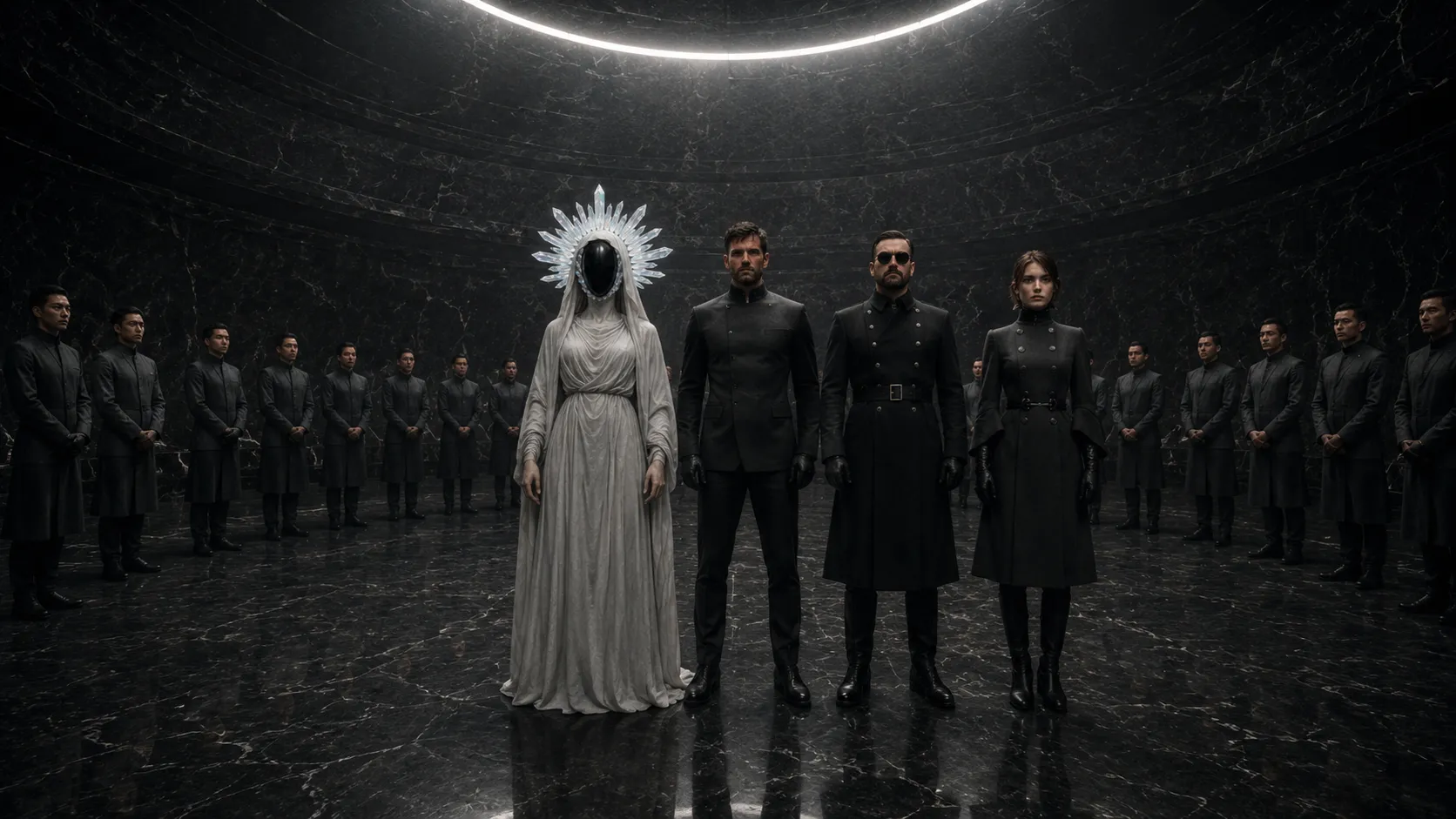
The base alarm went off at exactly 4:30 a.m., as always. A metallic sound, soft in tone but imperious in intent.
— “Good morning, child of Ceres. Fulfill your duty.” — the female voice repeated over the loudspeakers, almost maternal, almost mocking.
Tomas opened his eyes, already awake before the warning even came. The metallic ceiling of the barracks seemed even grayer in that early morning, reflecting the cold light from the corridors. He sat on the bunk, his bare feet touching the freezing floor, and for a moment he remained there, simply breathing, trying to ignore the dull pain in his joints and the constant weight in his stomach.
He got up and dressed in his uniform without haste, in a precise, almost reverent ritual. He folded the blanket perfectly, aligned the collar, polished the boot until it shone under inspection. When he finished, he slipped a hand into his pocket and felt the shape of his brothers' medal — a small reminder he kept hidden. The only thing that did not belong to Ceres.
In the central courtyard, the cold wind cut into his skin. Mother Ceres's flag waved from the mast while the loudspeakers played the anthem. Everyone repeated the daily oath, in unison:
— “Mother Ceres feeds us, educates us, and devours us.”
Each word sounded truer with every passing day.
Physical training began as soon as the sun tore through the mountains. Running around the circular courtyard, shouted counts, military anthems at full volume. Then came push-ups on the concrete, rope climbing, the obstacle course. Tomas ran, sweated, fell, and got back up, feeling every muscle protest. The smell of grease and ozone permeated the morning.
The cruelest test, however, still awaited him: the centrifuge.
The metallic cylinder spun inside the hangar like a hungry animal, groaning, creaking. He entered, sat inside the capsule, and closed his eyes as he felt his body crushed against the seat under ten times the force of gravity. Sometimes he feared his heart would stop right there.
But he always came out alive.
Then came the water.
Enormous tanks, filled with murky, cold water, simulating reduced gravity. He put on the spacesuit and submerged himself, floating slowly while anonymous hands timed him and shouted instructions from the edges.
There, in the liquid silence of the tank, Tomas could pretend for a few moments that nothing existed — no base, no oath, no son, no brothers.
The son.
One year old now.
He lived somewhere in a children's housing block inside Ceres, far from the outskirts, under state care. Tomas had never held him, had never heard his voice. He only knew that when the boy turned ten, he would be sent to the military school, where he would learn the same cruel machine that was now consuming him.
Sometimes, at night, Tomas wondered if his son would hate him for not being there.
Or worse, whether he would not even remember his face.
After lunch — cold, thick rations served on aluminum trays — came the instruction rooms. Blackboards covered in diagrams, noisy projectors, technical manuals. Psychologists administered tests: stress resistance, doctrinal questions, slogans repeated until they lost their meaning.
— “Do you belong to Mother Ceres?”
— “Yes, forever.”
Even though the answer hurt more every time.
At night, he returned to the barracks in silence. The corridor smelled of iron and oil. Lights blinked above his head. He lay down on the bunk with the medal between his fingers, thinking of his brothers Tycho and Theo — a few kilometers away, on the outskirts he could no longer visit without formal authorization.
The city had separated them by castes, sectors, invisible walls that no one ever dared cross.
Sometimes he wrote drafts of letters that he eventually tore apart.
He could only send three a year.
And with every draft, he felt there were fewer words left to say.
— “Mother Ceres feeds us, educates us, and devours us.”
That sentence echoed in his mind as heavy sleep finally carried him away.
He knew there were still six months left.
But inside, he already felt like a man condemned to leave.
Glory to Mother Ceres, who feeds us, educates us, and devours us.
That is the mantra every citizen of Ceres repeats, without even realizing they are doing it.
It is carved into our bones.
I repeat it myself every day, even when my hands bleed on the centrifuge bars, even when I vomit in the simulated-gravity pool, even when I close my eyes and see the tower.
And when I wake up in the barracks, sometimes I think:
“Am I still myself? Or am I already just another tooth in this machine?”
Because Ceres does not forgive.
Ceres does not forget.
Ceres never abandons her children.
We are the ones who abandon her — and we pay the price.
I see how the gear works because I live inside it.
I see the armored trains unload tons of gold, copper, grain, eggs, and fresh meat coming from the continent.
I see foreigners staring in amazement at our clean streets, orderly lines, garbage recycled down to the last bone — because in Ceres, neither rats, nor dogs, nor cats starve to death.
Even the sewage here is nutritious, and the compost feeds the vertical gardens.
Hunger does not exist in Ceres.
Nor disease.
Nor garbage on the sidewalks.
That is why they envy us.
Foreigners have hunger, civil wars, epidemics.
They have revolutions, flags, heroes, and villains.
I envy them for that.
They have inherited surnames.
They celebrate birthdays.
They sing anthems that are not only for Mother.
They remember who their parents, grandparents, and uncles were.
They have a past.
In Ceres, there is no past.
In Ceres, there is only Mother.
And Mother feeds us, educates us, and devours us.
I watch every sector turn like a clock:
the banks in the Center, where billions in precious metals pass through the hands of those who do not dare breathe louder than the Tower;
the chemistry laboratories;
the automated agricultural fields;
the meat and egg farms;
the medical pavilions.
And every twenty years, a new group of children enters the school, gives up their own name...
and, ten years later, they are all devoured.
In Ceres, losing your name is worse than death.
It is having your soul torn out and burned in a public square, for everyone to see.
I saw Rob get burned, remember?
C3P6Q.
I saw Deb disappear among the concrete corridors, swallowed up never to be seen again.
And I continue.
Because I love Mother.
Because we all love her.
But don't think we are pure.
Biological hunger still lives inside us.
In Ceres there are the Houses of the Color of Sound, clandestine halls in the outskirts where men and women surrender themselves, masked, to desires Mother forbids.
No one there belongs to anyone.
It is a simulacrum of freedom.
The dream of the oppressed, the despair of the oppressors.
Even in the warehouses of the centers, I have heard muffled screams and hidden moans among boxes and cables.
Bodies entwined like rats in the darkness.
Sexual favors sold in silence.
Forbidden pregnancies, forced abortions.
And when someone is caught, when Mother finds out, there is no mercy.
The condemners drag the bodies to the squares.
And the body burns,
and the name becomes a number,
and the number becomes nothing.
The Silencers never hesitate to remind everyone:
— “An excretory organ does not reproduce!”
Those who desire their own kind are punished.
Mother does not want love.
She wants efficiency.
So why do I stay?
Why don't I run?
Because I love Mother.
Because in Ceres I have never been hungry.
I have never been cold.
I have never been sick.
I have never seen a beggar die in an alley.
Mother gives me a roof, a uniform, a full plate.
And when she wants, she will devour me.
And I will accept it.
Because freedom is the enemy.
Because freedom kills.
Because only Mother has the right to take away what she herself gave me.
And I repeat it every day, quietly, before going to sleep:
Glory to Mother Ceres, who feeds us, who educates us, and who devours us.
And I sleep in peace.
Between Memories and Mother Ceres's Machine
I wake at 4:30 a.m., in the barracks where the future devoured sleep.
The cold light of the automated central system never lets me forget that the day has already begun, even when I still want to remain beneath the synthetic sheets for a little longer.
Mother Ceres's watchtower rises against the sky of the outskirts, taller than any mountain.
One thousand five hundred meters of steel and cameras watching everything.
The closer you are to the center, the more important you are — they say.
I am in the center, where decisions are made and plans are drawn, where gold passes through fingers and science becomes merchandise.
I think of Rob C3P6Q, my childhood friend.
Before, simply Rob.
Afterward, simply C3P6Q.
We lost our names because Mother does not want us to have a past, nor history.
She wants us to be pieces in the gear.
Deb, the synchronized diving girl.
The best Flagball player Ceres has ever seen, undefeated for fifty years of the sport.
She taught me to smile, to dream that we were more than numbers.
But Deb disappeared.
She was devoured.
I never saw her again.
The school, between the ages of ten and twenty, was the last time I had freedom — or at least the illusion of it.
Everything was training, study, discipline, but also laughter, games, hopes.
Mother taught, fed, but had already begun to devour.
The 10-g centrifuge crushed my chest; the zero-gravity pool made me feel as though I were floating between worlds.
The engineering of the training is brutal, but there was a kind of silent friendship among us.
Mother's rigor is cold, but the excitement about the future — about becoming the next astronaut — kept us alive.
I will be the thirteenth to ascend to the space station, a privilege carrying the sentence that I may never return.
I know that.
I know the mission could be disastrous.
That the gravity of space is less merciless than that of Mother Ceres.
She feeds us, educates us, and devours us.
I repeat it in silence, like a mantra to endure the pain.
Outside, there is only chaos.
Wars, hunger, misery.
Not here.
Here there is no hunger.
Nor disease.
Nor a hungry little dog in the streets.
Everything is used.
Even garbage becomes food.
But there is no freedom.
Freedom is the enemy.
Only Mother can grant it — and she gives or takes it with an iron hand.
I have seen colleagues burned in public squares, for disobeying, for loving wrongly, for wanting more than Mother.
Names become numbers.
Numbers become nothing.
There is a hidden world in the outskirts, the Houses of the Color of Sound.
There, the oppressed seek what is forbidden, pleasure, the dream of existing beyond the machine.
Some manage to escape surveillance, but Mother has eyes everywhere.
I love Mother Ceres.
Because she gave me everything.
Because without her, I do not exist.
Because if I flee, I die.
I sleep to the sound of the machine, my face sweaty and my heart heavy.
Tomorrow, I wake up and begin everything again.
Glory to Mother Ceres, who feeds us, who educates us, and who devours us.
At the Gymnasium of the Sports Training Center
The metallic smell of bars coated in grease and sweat permeated the air, mixed with the faint hiss of cables and counterweights sliding along their guides.
The gymnasium of the Sports Training Center, in the most disciplined outskirts of Ceres, never slept.
It was as relentless as the Mother who shaped them.
Major Tomas was on the bench press, lying beneath the cold bar.
The muscles in his arms trembled slightly, but the movement was firm, rhythmic, rehearsed a thousand times.
As he lifted the weight, his mind occupied itself with an even greater burden: the agricultural reports on his desk in the barracks.
Heat-resistant seeds.
Resistance to face a future that was already arriving late.
Forecasts indicated that temperatures on the continent would rise even further, the inevitable result of the city's own growth.
Even with an insignificant pollution index for what it produced, Ceres was beginning to alter the climate.
Ceres evolves.
Even a cancer evolves in order to win.
And we are its most perfect tumor, he thought, as he carefully lowered the bar to his chest.
He remembered the Republic of Garpan, with its chimneys vomiting smoke and its charred fields.
Cheap oil, black clouds, and endless wildfires, a grotesque contrast to Ceres's surgical order.
They polluted through carelessness, through greed.
Ceres, on the other hand... polluted cleanly.
Methodically.
Impeccably.
Even filth was converted into fertilizer.
Even sewage became useful.
Nothing was wasted.
Nothing except souls.
With the bar racked, he sat up, still breathing heavily, and looked through the large window.
The city's central tower tore through the sky like a steel spear, imposing, reminding everyone that no one was beyond Mother's reach.
He went to the rowing machine.
He adjusted the weight almost instinctively, sat down, and began the rhythmic movement, the cables creaking in protest.
The seeds — always the seeds — dominated his thoughts.
They needed to go into space with him.
To understand how they would behave under cosmic radiation, how they could be adapted for increasingly robust, faster, more nutritious harvests.
They had already broken records in the latest research...
but at the cost of significant losses.
Mother accepted those losses.
So did Tomas.
There was no alternative.
The future demanded more.
More harvests to feed more mouths.
More mouths to reinforce the very gear that crushed those who dared dream differently.
It was always like this:
Mother feeds, educates... and devours.
He released the cable and stood, walking toward the pull-up bar.
His hands closed around the icy grips, and the weight of his body stretched him out, tense, almost in pain.
There, suspended, Tomas felt like nothing more than a number, an obedient son within something he did not fully understand.
He envied the foreigners, even with their chaos and filth.
They had birthdays.
They had heroes and villains.
They could choose to hate or love.
He could only repeat, like a devoted son:
“Glory to Mother Ceres.
Who educates us.
Who feeds us.
Who devours us.”
And even so, if She ordered him into space, he would go.
He would watch the seeds germinate up there.
Or die without his hand.
Deep down, he thought, that was the true test:
to discover whether there was still life possible...
even after being devoured.
He opened his eyes, stared at the tower through the window, and let his body hang from the bar, sweat dripping onto the floor like metallic dew.
And he repeated, quietly, only to himself:
— “Glory to Mother Ceres.”
The metallic hiss of the cable stopped when the gym door opened with a dry snap.
Tomas, still hanging from the pull-up bar, shifted his eyes toward the entrance.
It was him.
The foreigner.
The man from the Republic of Garpan walked as though carrying an invisible burden, always followed by two Silencers who never left his side even for a step.
Even with his “autonomy” granted by Ceres, he was still an intruder under constant surveillance.
Captain Masord Gifuke — a man with two names, an absurdity for any child of Mother.
Tomas released the bar and let his feet touch the floor with a controlled thud.
He raised his chin and nodded.
A formal gesture, but already free of the hostility of their first encounters.
He respected the other astronaut — even if reluctantly.
After him, it would be Gifuke who went up to the satellite, carrying with him the hope of his homeland stained with oil and soot.
After all, it was Garpan's money that had financed part of the project.
In exchange, they sent a man.
Always watched.
Always strange.
But a man.
They spoke sometimes, under the silent watch of the guards, exchanging words with the forced formality of two cultures that barely understood one another.
Gifuke spoke about his country with a melancholy Tomas did not understand.
He called Ceres “totalitarian.”
“Hypocritical.”
He laughed at the prayers to Mother and called them superstition.
— “You worship a wall. I raise my hands to someone I cannot see... you kiss the concrete floor.”
Tomas remembered the first time he heard that.
He wanted to break his neck right there, on the bench press.
If it had been outside Ceres, he would have been burned in Plaza A for less.
But Mother spoke to him that night.
Tomas heard Mother's voice in his room, sweet and relentless:
— “You are one of my favorite children. Be patient. Respect him. There is wisdom in what he does not know how to say.”
So he yielded.
He began to listen.
Little by little, his accent, so ridiculous at first, became... endearing.
It was like watching a child learn to walk.
And Tomas, with the indulgence only Mother's favorite children could have, taught him to speak correctly, correcting him word by word, always mocking the “lolo” way — as he called it — that sounded in his language.
And little by little, respect became mixed with something more confusing.
An uncomfortable affection.
A certain pride.
He did not know how a man like Gifuke could have come from a republic where people choose their own executioners and kill one another to decide who will steal the most.
A miracle, Tomas thought.
And he said it without irony, no matter how much the other man laughed at the nickname.
Masord Gifuke was, in many ways, his opposite.
He always spoke about a young son — two years old, he said — with eyes and a nose just like his.
He carried folded photographs and perfumed letters in the pocket of his uniform.
Sometimes, in the dormitory, he showed the letters to Tomas, pointing to the child and smiling with an inexplicable sadness.
He cried from longing, hiding his eyes with his hand.
Tomas never knew what to say.
He himself did not know the color of the eyes of the son Mother had taken from him years ago.
He had never seen the boy's face.
And every time he saw Gifuke talking about that boy, he felt something inside his chest between envy and hatred.
And an enormous weight, like hot lead, in the pit of his stomach.
When Gifuke spoke about birthdays, Tomas only frowned.
What sense did that foolish celebration make, lighting candles because three hundred and sixty-five days had passed?
But even without meaning, Tomas envied that too.
A ritual that said:
“You are alive.
You matter to someone.”
Gifuke was there for his son, Tomas knew.
He had wanted to give up more than once, but Tomas always convinced him to continue.
Sometimes by force.
Sometimes simply by reminding him, in silence, that nothing and no one survives without Mother.
And when Gifuke cried at night, Tomas cried too.
But always in the shower.
So no one would see.
So Mother would not consider him too weak to carry the burden She had given him.
As he adjusted the bar for the next set, Tomas closed his eyes and murmured to himself:
— “Oh, Mother Ceres, who feeds us, who educates us, and who devours us... why are You so cruel to me by denying me my son's face? But I continue for You. For You, Mother.”
And when he opened his eyes, there was Gifuke, with that shy smile, holding yet another letter from his son, like a miracle that stubbornly insisted on existing.
Tomas thought:
“He is different.
That is why I tolerate him.
Because Mother ordered it.”
Tomas wiped the sweat from his face with the towel and sat on the bench beside the machines, feeling his heart still pounding in his chest.
Gifuke approached slowly, the two Silencers behind him maintaining the same mechanical distance as always.
In his hand was a folded sheet of paper, yellowed around the edges.
— “Another letter arrived today...” — Gifuke said, almost in a whisper, as though he were telling a secret to the guards as well.
Tomas raised an eyebrow, but did not look at him immediately.
He preferred to stare at the floor, as though indifferent.
But inside, every word of that rough accent still stirred something in him in ways he himself did not understand.
— “He...” — Gifuke continued, hesitating for a moment — “He already... already runs around the house now. My son. Runs and knocks things over. My wife says he's a little hurricane... Just like I was.”
Tomas finally raised his eyes to him.
The man was smiling, but there was a glimmer of restrained tears in the corner of his eyes.
Those calloused hands held the letter with such care, as though it were made of glass.
Tomas felt the old stab of envy in his chest, but also — against his will — a certain warmth.
— Yeah... that's beautiful. — Tomas said dryly, taking hold of the iron bar for another set.
Gifuke let out a quiet little laugh, a laugh inappropriate for anyone born in Ceres.
— You never told me anything about your son. — he commented, pulling one of the benches over to sit as well. — Does he run around the house too?
Tomas stopped, feeling the muscles in his hands tense.
He squeezed the bar until his fingers turned white.
Then he released it onto the rack with a snap and leaned forward, resting his elbows on his knees.
— I... don't know.
I've never seen him.
Gifuke fell silent for a moment.
The smile disappeared and his forehead furrowed, as though trying to solve a difficult equation.
— That's... cruel.
Tomas gave a short, bitter laugh.
— That's how Mother shapes us. Cruel, when necessary. — He looked him in the eyes. — You will never understand this.