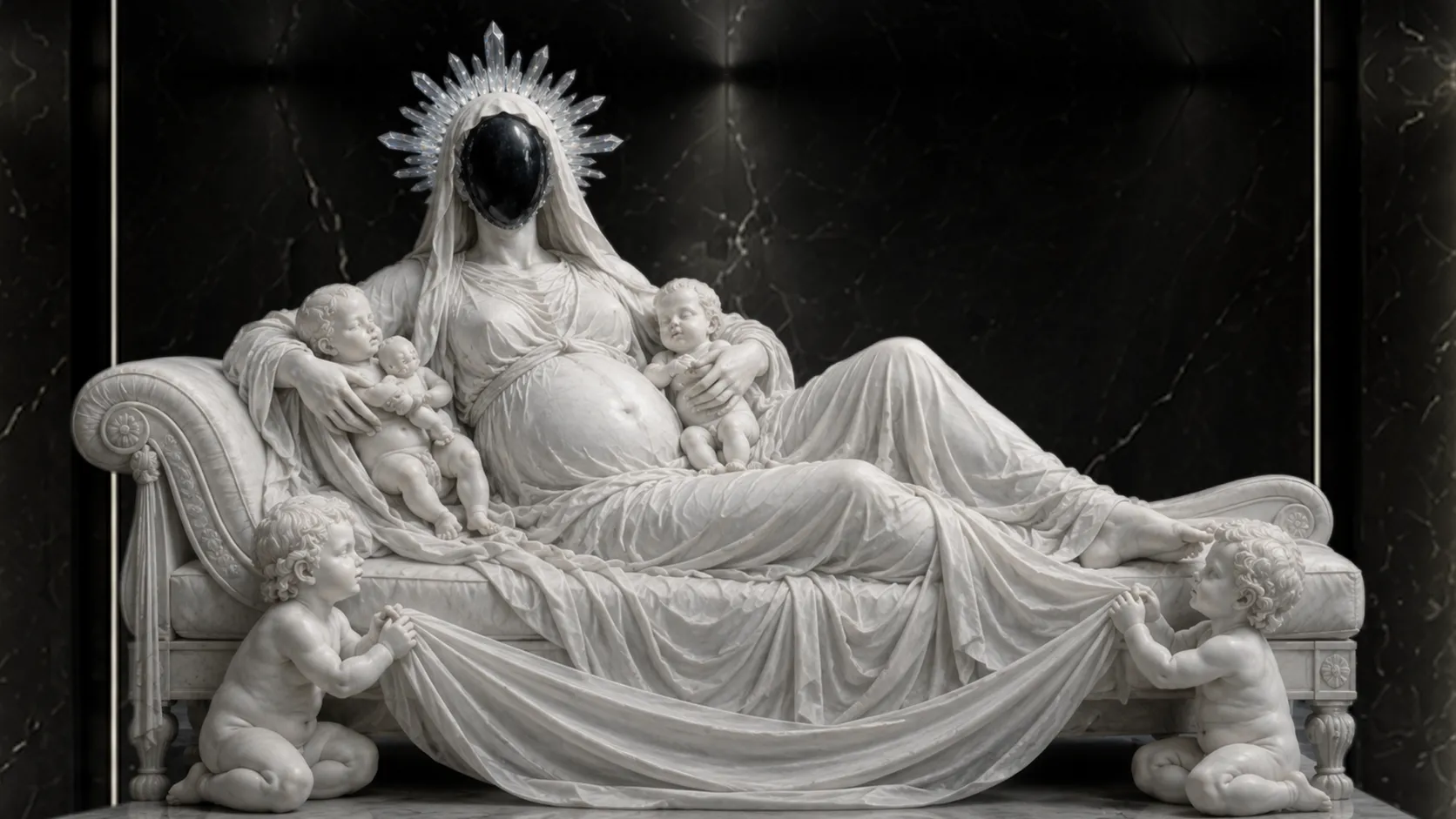
Pietà, City of the Mothers of Ceres
A light sleep rocked me, lazy and warm, wrapped in the scent of home: clean, freshly aired bedclothes, the cool touch of morning dew coming through the window. Soft morning light kissed the pastel sheets — pale yellow and white — while, in the distance, birdsong could be heard.
The room was large, airy, and strangely familiar, as if it were the same room where I had grown up.
When I opened my eyes, I felt that quiet certainty: I was in Pietà, the city where all the mothers of Ceres are born and awakened, the cradle of every citizen. Everything there seemed gentle and welcoming, a warm refuge where time moved slowly.
Soon, a tray arrived, carrying aromas that embraced the stomach. The woman who brought it smiled and said sweetly:
— Welcome to Pietà, the city of the Mothers of Ceres.
Breakfast was a small paradise: soft cake still warm, bread with melted butter, fluffy scrambled eggs. A delicate tea to soothe digestion and, above all, the aroma of coffee with cinnamon — the smell of a mother, the most comforting scent in the world.
Pietà was the most sacred place in Ceres. There, mothers received everything they needed to raise their children from birth until the age of ten. Every detail breathed care: private rooms with large windows, simple fabrics, educational toys scattered throughout the corridors, and a staff that was always smiling, ready to attend to every need.
Outside, a park unfolded like a secret paradise. Fruit trees lined stone paths, and an artificial lake reflected the morning sky. There were wooden playgrounds, swings that creaked softly in the wind, and little bridges for children to cross hand in hand with their mothers.
Nothing there seemed overly technological or modern. The buildings, with their straight, solid lines, recalled avant-garde Brutalism, softened by pale colors and flowers in the windows. Everything said: Here is safe. Here is home.
The meals were plentiful and balanced, served on clean metal trays and bright white porcelain plates. Doctors and assistants were always available, but there were no noisy machines or cold lights. Everything in Pietà seemed to exist so that mothers and children could live a perfect childhood, far from the world outside, protected by an almost artificial calm.
In the air, the sweet smell of ripe fruit and fresh coffee was a reminder: Pietà was more than a shelter — it was the womb of Ceres, the beginning of everything.
The sun filtered through the leaves of the trees, drawing golden patches across the pale stone ground. Kat walked slowly through the park, feeling the warm breeze carrying the scent of guava and orange. The artificial lake before her reflected a cloudless sky, and the swings creaked in a lazy rhythm.
Beside her, her son ran barefoot through the grass, laughing at anything: a bird flying low, the shadow of a swaying leaf, the wind itself. Other mothers smiled in the distance, some sitting on smooth concrete benches, others accompanying their little ones to the slides or the manual carousel.
A nurse appeared at the edge of the path, waving gently. No conspicuous uniform, only a simple white outfit with a badge reflecting the sunlight. Kat knew she could call her for anything: a fever, a fall, a question. But there was no need. Here, everything seemed too perfect to break.
The smell of bread baking came from the cafeteria, mingling with fresh coffee. She took a deep breath, feeling the aroma enter her chest like an old memory of a mother’s embrace. Her son came running back, carrying an orange still wet with dew, and Kat hugged him, feeling his warm skin against hers.
In that moment, Pietà seemed like the center of the world. There was no hurry, no fear. Only the sound of birds, the wind in the trees, and the laughter of children, as if nothing beyond those walls could ever touch them.
In the afternoon, as the sun began to descend, Pietà took on a new color. The shadows of the trees stretched across the grass, and the artificial lake gleamed like liquid glass. But another shadow drew the most attention — one that swallowed the entire park.
At the center of this paradise stood Mãe Ceres' Watchtower, a fifteen-hundred-meter colossus piercing the sky like an endless needle. Its gray concrete reflected the orange of sunset, and for a few moments, it seemed as though the entire world lay beneath its shadow.
There were no sirens, no open windows. The tower was silent, motionless, but its presence was enough to remind every mother: someone was always watching.
The children ran laughing among the playgrounds, oblivious to the weight of that presence. But the mothers felt it. The breeze that had once smelled of guava and coffee now carried a subtle chill of reverence.
Even amid laughter and the smell of fresh bread, Pietà was never alone. At the center of paradise, the Tower watched, too tall to ignore, too eternal to overcome.
When night fell over Pietà, paradise changed its skin. The soft lights of the streetlamps illuminated the stone walkways, reflecting across the lake, which now shimmered like a dark mirror.
The Watchtower lit small white lights on its highest levels, so distant they looked like stars trapped inside the concrete. Its shadow disappeared, but the sensation of being watched remained. Silent. Constant.
In the distance, beyond the trees of the park, rose the black-marble skyscrapers of Ceres.
Tall, smooth, and windowless, they reflected the moonlight like monoliths from a world that did not breathe. There stood the credit banks and administrative buildings, where all the wealth of the continent was devoured by the neutral city, without a past and without a memory.
Farther away, the mountains rose like natural walls, guardians of the fortress city. The wind carried the murmur of the invisible Ceres: the grinding of armored trains, the rumble of water pumps and, every so often, the metallic echo of something being hoisted deep within the industrial districts.
And when the night was clear, all one had to do was raise their eyes to see the Ceres 2 Space Station crossing the sky — a silver blade among the stars. It was as if the city extended its fingers into space, reminding everyone that there was nowhere to run.
In Pietà, the children slept peacefully, lulled by the chirping of crickets and the warmth of clean sheets. But in the silence of the night, every mother knew: even paradise had invisible bars.
The instruction room smelled of herbal tea and polished wood. Pale walls allowed the morning light to flood the room through wide windows. The mothers sat in a circle, each in a low, soft armchair, like friends gathered for a visit.
The instructor entered smiling, clipboard in hand, with that gentle manner that seemed to embrace every word. She spoke like someone telling stories to children.
— My dears, — she said — you know that the world outside is always… restless. We do not speak of war, nor of tragedies. But… peace is merely a momentary deception. The world moves to the rhythm of conflict. That is why you are here.
In Pietà, the world cannot reach you. Here, there is only care. Here, you breathe for all the women who cannot.
Some mothers nodded slowly. Others simply embraced their own bellies.
The instructor walked among us, looking at each face with tenderness. When she passed a mother who was five months pregnant, she crouched beside her:
— And you, my dear? What do you think of Pietà so far?
The woman smiled, with an almost childlike sincerity:
— The beds… they're far too soft. It bothers me! — she said, laughing.
A light laugh moved around the circle. I couldn't contain a muffled laugh myself. The instructor laughed too, covering her mouth with her hand:
— Oh, dear, that's a good thing. It means you're alive. When comfort becomes bothersome… it's because the soul still remembers the cold street outside.
We laughed again, and the lesson continued in a gentle tone. There were no orders, no threats. Only certainties, spoken softly: we were protected, fed, loved. And little by little, the idea of freedom seemed distant, almost foolish.
The instructor continued walking around the circle, her white skirt brushing against the polished floor. She pointed toward the little toy corner beside the open windows, where some children were playing in silence:
— Look. Everything here exists so that they grow up remembering that the world can be safe… and that this place is the heart of that safety.
There were toy soldiers in gray uniforms with details in soft colors, toy pistols and swords without sharp edges, designed more for curiosity than violence. Among them sat a stuffed Mãe Ceres, with an embroidered smile and a white scarf on her head, watching over the imaginary games.
— Until the age of ten, everything becomes memory, — the instructor continued. — Every smell, every toy, every laugh shared with you becomes a thread connecting their hearts to Mãe Ceres. Even when they leave, they will never be far from here.
The children laughed softly, rehearsing an invisible choreography for life. They played at protecting the city, carrying supplies, sounding imaginary sirens. Among toy soldiers and the stuffed Mãe Ceres, they learned that love and obedience went hand in hand.
The instructor smiled at us with the patience of someone who had never needed to shout:
— If one day they are called… they will go with hearts full of love. And when they remember Pietà, it will always be with a smile.
I looked at my son, kneeling as he arranged miniature soldiers around a toy tower. He looked happy. So happy. And inside me, a part of me knew that this was how the world worked here: sweet on the outside, eternal within.
The morning sun entered through the windows like liquid gold, illuminating the cafeteria. The smell of fresh bread and cinnamon coffee floated through the air, but something was different that day: it was a day of farewell.
The mothers gathered in the central courtyard, their children lined up in front of them, all wearing beige uniforms and clean shoes. In the center, the dark-gray flag bearing the Ceres seal waved gently. There were no sirens. No shouted orders. Only birdsong and the soft wind moving through the corridors.
Kat stood beside an older mother, watching her son — a boy with curious eyes — hugging the stuffed Mãe Ceres. At ten years old, he seemed far too small for the world, yet perfectly shaped to accept it.
The instructor, always smiling, walked between the rows. Her voice was sweet and firm, as always:
— Dear ones, today you leave Pietà. You are going to School S, where you will learn everything the world expects of you. Remember… what you learned here will live forever inside you.
The boys and girls repeated in unison, smiling:
— Mãe Ceres who feeds us, educates us… and devours us!
The mothers laughed softly, overcome with emotion, some crying gently. It was impossible not to feel the invisible weight of tradition. Kat ran a hand over her still-flat belly, feeling strangely connected to that moment. She herself had made this journey years before, leaving Pietà for School S — and now she carried within her the next link in this endless chain.
One by one, the children said goodbye with lingering embraces, breathing in the scent of clean clothes, bread, and warm maternal skin. Then they boarded the white buses waiting at the gate, each vehicle bearing the symbol of Ceres painted on its side.
Kat watched the boy with the stuffed Mãe Ceres wave through the window. He wasn't crying. None of the children were. Their smiles were serene, as if leaving were merely a continuation of the embrace.
When the buses departed, the courtyard fell silent. Only the wind and the birds remained. Kat closed her eyes for a moment and repeated silently, almost like a sigh:
Mãe Ceres who feeds us, educates us… and devours us.
And she felt that, somehow, she had already been devoured too.
The courtyard was almost empty. The buses had departed, leaving behind the faint smell of fuel and cold bread. The dark-gray flag bearing the Ceres seal swayed gently. The birds began singing again, indifferent to the farewell.
Kat sat on the stone bench, embracing her still-invisible belly, when she heard a muffled sob.
In the corner of the courtyard, a mother was kneeling, her face buried in her hands. Her red eyes betrayed the effort she was making not to cry out loud. She rocked back and forth, repeating softly:
— Mãe Ceres who feeds us, educates us… and devours us… Mãe Ceres who feeds us, educates us… and devours us…
Kat felt a shiver run down her spine. She knew that mother would never see her son again. It wasn't punishment, nor abandonment. It was simply the cycle. The boy now belonged to Mãe Ceres, and the mother would return to work at the Financial Center, in the black skyscrapers where all the wealth of the continent bowed before the neutral city.
She knew. They all knew. Mãe Ceres needed children, needed workers, needed mothers who loved enough to give them up.
The woman raised her face toward the gray-blue sky, taking a deep breath. Tears streamed down her cheeks, but her smile trembled on her lips:
— Everything for Mãe Ceres… — she murmured, almost in a trance. — Everything for her…
Kat approached slowly, but said nothing. There was no better consolation than the mantra itself. It was prayer and sentence at the same time.
The woman repeated it once more, her voice firm, almost proud:
— Mãe Ceres who feeds us, educates us… and devours us!
Then she rose, wiping her face. Despair was still in her eyes, but now there was a light of devotion. She walked toward the gate of Pietà without looking back. Tomorrow, she would be in the silent corridors of the Financial Center, signing papers and moving credits that kept the divinity alive.
Kat remained standing, feeling the weight of the scene pass through her skin. Inside her, a new heart beat slowly. And, for the first time, she felt fear and love in equal measure — fear of Mãe Ceres, and love for her, as every mother should feel.
The courtyard was almost empty. The white buses had already departed, leaving behind only the faint smell of fuel and cold bread. The wind stirred the dark-gray flag bearing the Ceres seal, while the birds began singing again, indifferent to the farewell.
Kat sat on the stone bench, embracing her still-invisible belly, when she heard a muffled sob.
In the corner of the courtyard, a mother was kneeling, her face hidden in her hands. Her red eyes betrayed the effort not to cry out loud. She rocked back and forth, repeating softly:
— Mãe Ceres who feeds us, educates us… and devours us… Mãe Ceres who feeds us, educates us… and devours us…
Kat felt a shiver run down her spine. She knew that mother would never see her son again. It wasn't abandonment. It wasn't punishment. It was simply the inevitable cycle. The boy was now under Mãe Ceres' absolute care, and the mother would return to work at the Financial Center, in the black skyscrapers where all the wealth of the continent bowed before the neutral city.
She knew. They all knew. Mãe Ceres needed children, needed workers, needed mothers who loved enough to give them up.
The woman raised her face toward the gray-blue sky, taking a deep breath. Tears streamed down her cheeks, but her smile trembled on her lips:
— Everything for Mãe Ceres… — she murmured, almost in a trance. — Everything for her…
Kat approached slowly, but said nothing. There was no better consolation than the mantra itself, which sounded like both prayer and sentence. The woman repeated it once more, her voice firm, almost proud:
— Mãe Ceres who feeds us, educates us… and devours us!
Then she rose, wiping her face. Despair was still in her eyes, but now there was a light of devotion. She walked toward the gate of Pietà without looking back. Tomorrow, she would be in the silent corridors of the Financial Center, signing papers and moving credits that kept the divinity alive.
Kat remained standing, feeling the weight of the scene pass through her skin. Inside her, a new heart beat slowly. And, for the first time, she felt fear and love in equal measure — fear of Mãe Ceres, and love for her, as every mother should feel.
She blinked slowly, and for a moment she couldn't say how she had ended up there. The empty courtyard, the white flag waving, the distant echo of the buses carrying the children to School S — everything seemed like a dream.
Then she remembered: the Silencers.
They appeared out of nowhere, as they always did. They weren't violent. They didn't need to be. Two men in gray uniforms simply approached, silent as statues coming to life, and a nurse appeared beside them, holding a clipboard.
— Dear Kat, — the nurse said, in that sweet voice that almost sang, — your test came back positive.
Kat's heart raced, and there was no time for questions. The urgency was absolute.
— Come with me.
She went. No farewell to Gene. No final touch, no goodbye, no tears. Everything happened as if the world had smoothly slipped into the next stage of a perfect plan.
The white corridor, the sound of doors closing, the smell of mild disinfectant mixed with chamomile tea… everything was far too familiar to frighten her. Kat felt pride and comfort.
She loved Mãe Ceres. She loved her in a way she couldn't even explain. She knew she had a function, and fulfilling it was the greatest form of love a citizen could offer.
— Mãe Ceres who feeds us, educates us… and devours us… — she whispered, caressing her still-invisible belly.
It was a whisper of faith.
And acceptance.