Abrasive blasting performance depends on much more than simply directing abrasive particles toward a surface at high speed. The type, size, shape, hardness, density, and condition of the abrasive can significantly influence how quickly contamination is removed, what kind of surface finish is produced, how much surface profile is created, and how effectively a later coating bonds to the prepared substrate. In industrial operations, Abrasive Blasting Media becomes a critical process variable because the same blasting equipment can produce very different results when the abrasive is changed. A hard angular abrasive may cut through corrosion and old coatings rapidly and create a pronounced anchor profile, while a softer or rounded abrasive may provide gentler cleaning with a smoother appearance. Therefore, understanding the relationship between abrasive characteristics, blasting parameters, surface condition, and coating requirements is essential for achieving consistent results. When the media is properly matched to the application, blasting can become faster, more predictable, and more economical while also producing a surface that is better prepared for the next manufacturing or finishing stage.
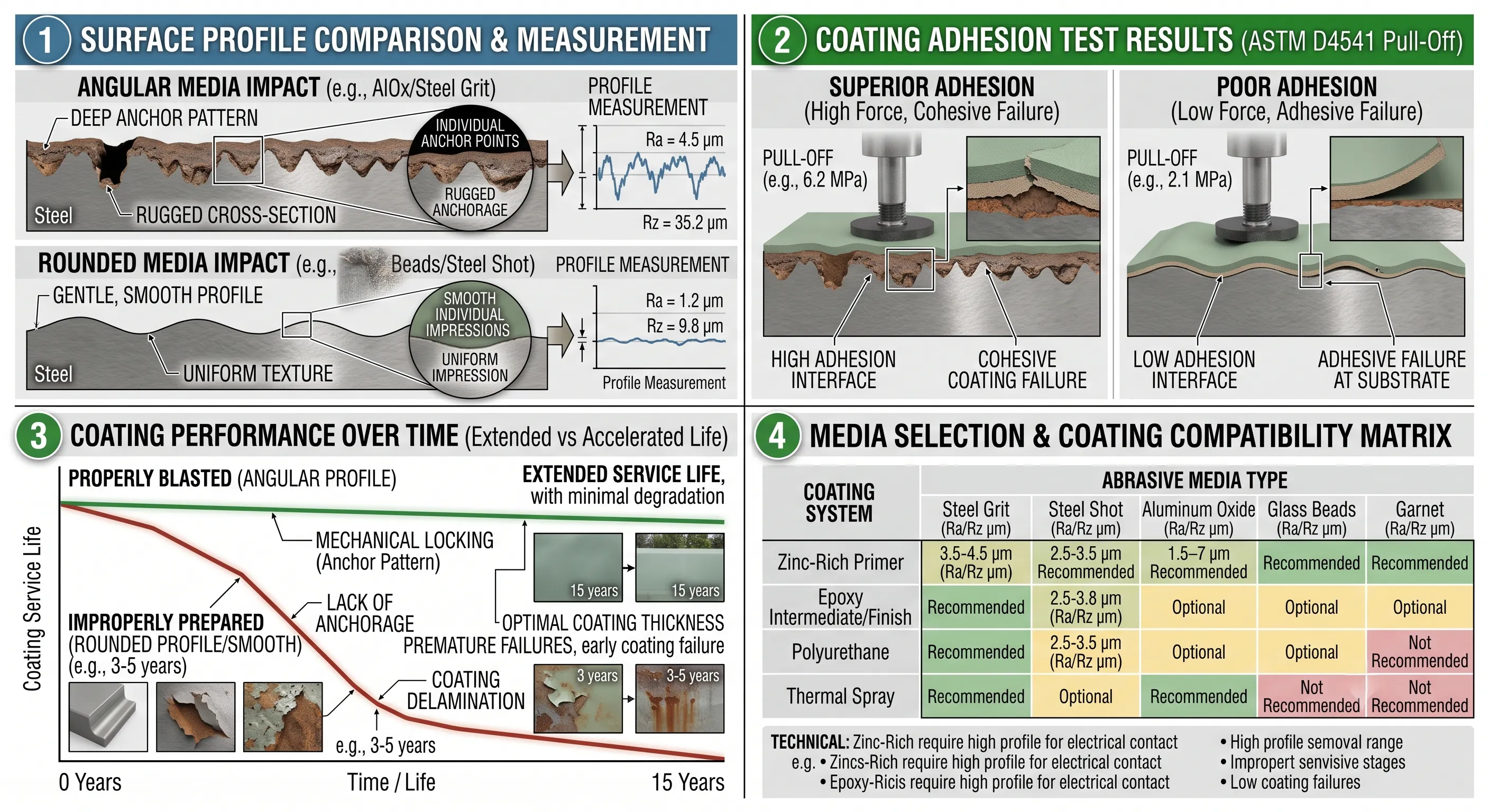
The first major influence of abrasive media is blasting efficiency. Efficiency refers to how effectively the blasting process removes unwanted material within a reasonable amount of time and abrasive consumption. When the abrasive has the appropriate hardness and cutting characteristics, each impact contributes effectively to removing rust, paint, mill scale, oxidation, deposits, or other contaminants. However, efficiency is not simply a matter of using the most aggressive abrasive available. Excessive aggression can cause unnecessary substrate removal, increased dust, higher equipment wear, greater abrasive consumption, and additional finishing work. The most efficient abrasive is the one that delivers the required cleaning result with controlled energy and minimal unnecessary processing.
Particle hardness has a direct effect on this balance. A sufficiently hard abrasive can resist excessive breakdown during impact and maintain useful cutting action against difficult contamination. This can be particularly valuable when heavy corrosion, thick coatings, or hard mill scale must be removed from durable substrates. However, when the substrate is relatively soft or sensitive, excessive hardness can create problems. The abrasive may remove more material than intended or create a surface profile that is deeper than necessary. Therefore, hardness should always be evaluated against both the contamination and the substrate rather than considered independently.
Particle shape is another factor that strongly affects blasting efficiency and final surface characteristics. Angular particles have sharp edges that can cut into coatings and contaminants. Their geometry allows them to break through stubborn layers and create a textured surface. This makes angular media useful when aggressive cleaning and surface profiling are required. Rounded particles behave differently because their impact tends to produce more peening and less cutting. They can therefore be useful when the objective is cleaning, smoothing, controlled finishing, or producing a uniform satin appearance. Choosing the correct shape allows the blasting action to be directed toward the desired result instead of relying entirely on increased pressure or longer blasting cycles.
Particle size also influences efficiency. Coarser particles can deliver substantial individual impacts and may be useful for heavy contamination and deeper surface profiles. Finer particles provide a greater number of impacts over the same area and can produce a more refined surface condition. The correct size depends on the material being removed and the required final surface. Using a particle that is too large may create excessive roughness and increase the risk of over-profiling. Using particles that are too small may require longer blasting time to remove thick contamination. The ideal size therefore represents a balance between removal rate, surface profile, coverage, and finish requirements.
Density influences impact energy as well. A denser abrasive can deliver substantial impact energy at a given velocity, which can improve the ability to remove tough contamination and generate a defined profile. However, high impact energy is not automatically beneficial for every application. Thin sheet metal, soft alloys, precision components, and sensitive surfaces may require more controlled blasting. If the media is too dense or the operating pressure is too high, the surface may develop unwanted deformation, excessive roughness, or dimensional changes. Therefore, media density must be considered together with pressure, nozzle size, blasting distance, and substrate properties.
The relationship between media and surface finish is especially important when the component will remain visible after blasting. A manufacturer may require a uniform matte, satin, textured, bright, or cleaned appearance depending on the product. Rounded media can produce a more uniform peened or satin effect in appropriate applications, while angular media can create a more pronounced texture. If the wrong abrasive is selected, the component may technically be clean but still fail the required appearance standard. This is why surface finish should be defined before selecting the abrasive rather than evaluated only after the blasting operation is complete.
Surface profile becomes even more important when blasting is performed as preparation for painting or protective coating. A coating needs an appropriately prepared substrate to achieve reliable adhesion and long-term performance. Blasting can create microscopic peaks and valleys that provide mechanical anchoring for the coating. However, the required profile depends on the coating system and its thickness. An insufficient profile may not provide the desired mechanical bond, while an excessively deep profile can create its own problems, particularly when a relatively thin coating must cover the surface evenly. The objective is therefore a controlled profile that matches the coating specification rather than simply creating the roughest possible surface.
Abrasive shape has a major role in profile development. Angular particles tend to cut and form sharper surface irregularities, which can be useful for coating preparation. Rounded particles generally create a less aggressive profile and may be more appropriate when a coating profile is not the primary objective. This distinction is important because two abrasives may clean the same surface but leave very different textures behind. Cleaning effectiveness alone should therefore never be the only criterion used to evaluate blasting performance.
The cleanliness achieved before coating also affects coating performance. Paint, rust, oil, dust, scale, old coatings, and other contaminants can interfere with proper coating contact. Blasting removes many of these unwanted materials, but the blasting process itself must also be controlled so that the newly prepared surface remains suitable for coating. Abrasive breakdown, contamination in recycled media, improper equipment cleaning, and poor dust control can all affect the final condition. Consequently, abrasive quality and process cleanliness should be considered together.
Media contamination can become particularly important in closed-loop blasting systems. Abrasive is repeatedly collected, separated, and returned to the blasting process. Over time, particles can break down into smaller fractions, while removed coating material, rust, dust, and other contaminants may enter the abrasive stream. If the separation system does not remove these unwanted materials effectively, blasting consistency can decline. The abrasive may produce a different surface profile, create more dust, or require longer processing time. Proper media management therefore plays a major role in maintaining predictable blasting performance.
Recyclability also influences efficiency. Durable abrasives that can be recovered and reused may provide strong economic advantages in suitable industrial systems. However, the number of useful cycles depends on media durability, machine design, separator performance, contamination levels, and operating conditions. An abrasive that lasts through multiple useful cycles can reduce the frequency of media replacement and help maintain stable production. At the same time, recycled media must be monitored because excessive breakdown can gradually change the particle-size distribution. A recovery system should therefore be designed to remove unusable fines while returning suitable abrasive to the blasting circuit.
The blasting machine itself has a strong influence on how media performs. Pressure blasting systems, suction systems, blast cabinets, blast rooms, and centrifugal wheel machines accelerate and deliver abrasive in different ways. The same abrasive may therefore behave differently when used in different equipment. Air pressure, wheel speed, nozzle condition, abrasive flow, blast pattern, recovery system, and separation efficiency all contribute to the final result. If the equipment parameters are poorly matched to the abrasive, the operator may compensate by extending the blasting cycle or increasing pressure, which can raise operating costs without necessarily improving quality.
Nozzle condition is another factor that can affect efficiency. A worn nozzle can change the velocity and distribution of the abrasive stream, potentially increasing abrasive consumption and reducing consistency. When the blasting pattern becomes less controlled, some areas may receive insufficient treatment while others receive excessive exposure. This can create variations in surface profile and finish. Regular inspection of blasting equipment therefore supports the effective use of the selected abrasive and helps maintain consistent production.
Blasting pressure must also be controlled carefully. Increasing pressure can increase abrasive velocity and impact energy, but higher pressure is not always the most efficient solution. If the media is already suitable for the application, excessive pressure may increase dust, equipment wear, and substrate damage without providing proportional improvement in cleaning. A controlled combination of abrasive type, particle size, pressure, nozzle configuration, and blasting distance is generally more effective than relying on pressure alone.
Blasting angle can influence the way particles interact with the surface. A more direct impact can produce strong cutting action, while other angles may provide different cleaning behavior depending on the geometry and contamination. Complex components may require changes in operator technique or automated movement to ensure that recessed areas, corners, edges, and other difficult locations receive sufficient treatment. The abrasive must therefore be selected with the geometry of the component in mind. A media that works efficiently on flat steel plates may require a different process strategy when used on intricate castings or fabricated assemblies.
Component geometry can also affect coating preparation. Deep recesses, internal corners, holes, welds, sharp edges, and irregular surfaces can be difficult to blast uniformly. Media selection should account for whether the abrasive can reach these areas and whether the selected particle size is appropriate for the geometry. In automated systems, the movement of the workpiece and blast pattern should be designed to provide consistent coverage. The goal is not simply to achieve a clean appearance on accessible surfaces but to produce a uniform preparation across the complete component.
Coating thickness is another important consideration when evaluating surface profile. Different coating systems have different requirements, and the profile should be compatible with the final coating thickness. If the profile is too deep relative to the coating, the peaks may remain inadequately protected. If the profile is too shallow, the desired mechanical anchoring may not be achieved. Therefore, abrasive selection should be connected to the coating specification before blasting begins. This is especially important in demanding environments where coating performance and corrosion protection are critical.
The condition of the abrasive also affects consistency. Fresh media may behave differently from heavily recycled media because particle size, shape, and hardness distribution can change during repeated use. Fine particles created through breakdown can influence dust generation and surface texture. If the abrasive mixture becomes unbalanced, the blasting process may gradually become less predictable. Regular media inspection and proper separation help maintain a more stable operating condition.
Abrasive consumption is closely connected to all of these factors. Excessive consumption can result from selecting media that breaks down too quickly, using an unsuitable particle size, operating at unnecessarily high pressure, allowing leaks in the abrasive delivery system, or using a blasting technique that produces excessive waste. Efficient blasting aims to achieve the required surface condition with the minimum practical abrasive consumption. This does not necessarily mean choosing the cheapest abrasive. A more durable media with better recovery characteristics may have a higher purchase price but lower total cost per component.
Equipment wear should also be included when evaluating abrasive performance. Highly aggressive or sharp media can increase wear on nozzles, hoses, liners, blast wheels, cabinets, recovery components, and other machine parts. If the abrasive causes frequent replacement of critical components, the apparent productivity advantage may be offset by maintenance downtime and spare-part costs. A balanced abrasive selection should therefore consider not only how quickly the media cleans the surface but also how it affects the complete blasting system.
The quality of the finished coating can provide one of the clearest indications of whether the blasting process is properly controlled. When the surface is uniformly clean and has the appropriate profile, coating application can become more predictable. When surface preparation varies significantly from one area to another, coating thickness, adhesion, appearance, and long-term durability may also vary. Therefore, consistent blasting is an important foundation for consistent coating quality. Media selection, equipment settings, operator technique, inspection, and coating requirements should all work together.
Inspection should be performed after blasting and before coating whenever the process requires controlled surface preparation. Visual inspection can identify remaining rust, paint, scale, dust, or other contamination. Surface-profile measurement can help determine whether the blasted texture meets the required specification. Additional checks may be appropriate depending on the substrate and coating system. These inspections help identify whether the selected media and process settings are achieving the intended result. If the profile is too high, the media or blasting parameters may need adjustment. If cleaning is incomplete, the process may require a different abrasive or operating condition.
A trial blasting process is often one of the most practical methods for optimizing media selection. A representative component or test panel can be blasted using the proposed abrasive and operating parameters. The result can then be evaluated for cleaning level, surface finish, profile, abrasive consumption, and coating readiness. If the result is satisfactory, the process can be standardized. If improvements are needed, changes can be made before full-scale production. This approach can prevent costly mistakes and reduce the risk of discovering problems only after an entire production batch has been processed.
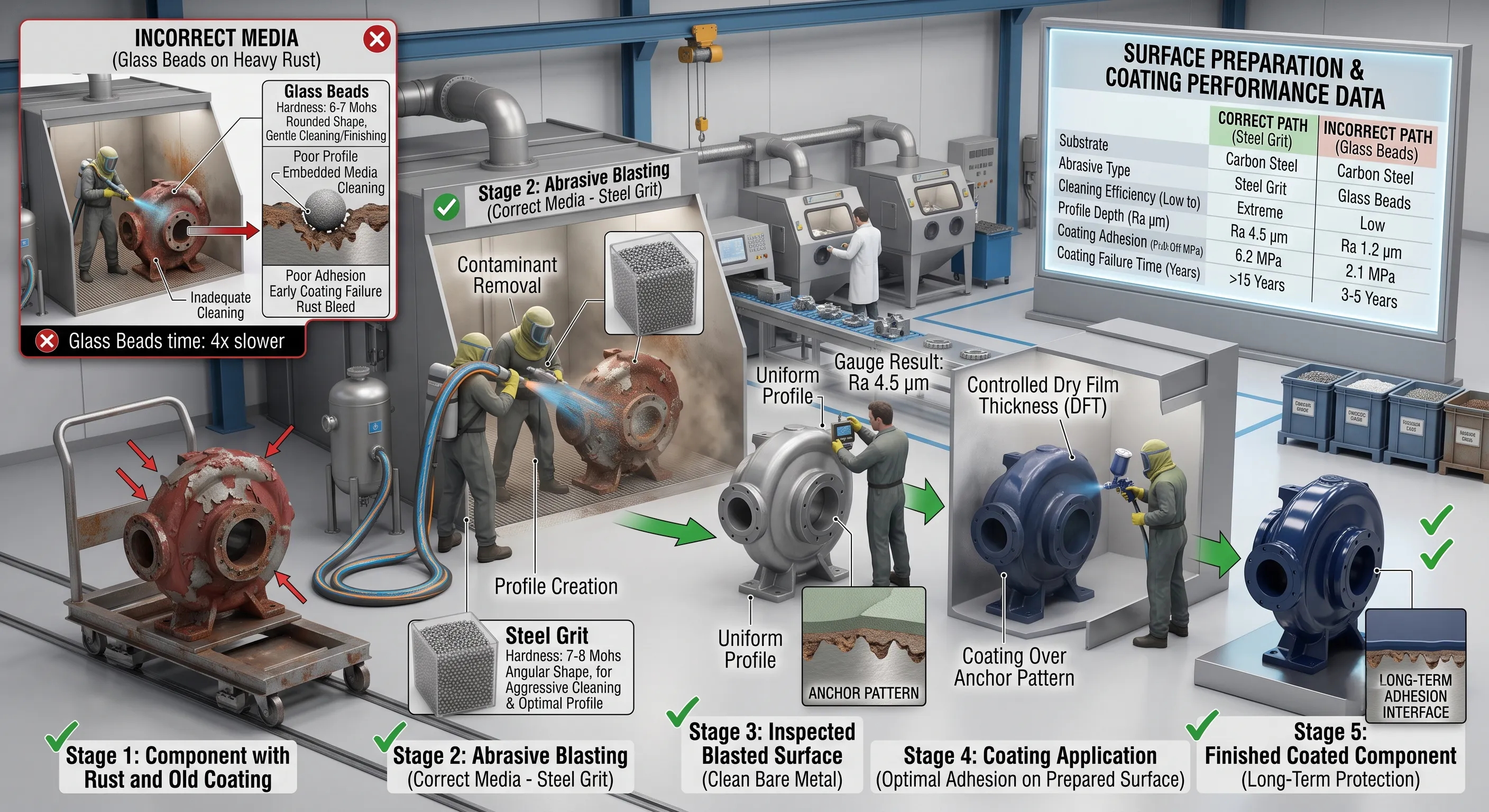
The best abrasive choice therefore comes from evaluating the complete process rather than judging one property in isolation. Hardness affects cutting ability and durability. Shape affects the way particles interact with the surface. Size influences impact frequency and profile. Density affects impact energy. Recyclability affects operating economics. Equipment compatibility affects delivery and recovery. The substrate determines how much aggression can safely be applied. The contamination determines how much cleaning power is required. The coating system determines the required surface profile and cleanliness. When all of these factors are balanced, Abrasive Blasting Media can improve blasting efficiency, help create a consistent surface finish, and provide the controlled surface condition required for reliable coating adhesion. The result is a more predictable process with lower risk of over-blasting, under-blasting, excessive media consumption, equipment wear, and coating-related rework.
Conclusion
Abrasive media has a direct influence on the complete surface preparation process. It affects how quickly contamination is removed, how much surface texture is created, how the finished component looks, how much abrasive is consumed, and how effectively a coating can bond to the prepared surface. The best results come from selecting media according to the substrate, contamination, required finish, surface profile, equipment, production requirements, and coating system. Proper process control is equally important because even a high-quality abrasive can produce inconsistent results when pressure, nozzle condition, blasting distance, abrasive flow, or recovery conditions are poorly controlled. By treating abrasive selection as an important part of the complete manufacturing process, industries can achieve more consistent cleaning, better surface preparation, improved coating performance, and greater operational efficiency. Ultimately, the right media is not simply the one that removes material fastest. It is the one that delivers the required surface condition reliably, safely, and economically.