Choosing the correct rotary valve for an industrial process requires more than matching the valve connection size with an existing hopper or dust collector. The equipment must be capable of handling the material consistently while operating under the required pressure, temperature, capacity, and environmental conditions. A Rotary Airlock Valve should therefore be selected after evaluating the complete material-handling system rather than considering the valve as an isolated component. The characteristics of the material, required throughput, pressure difference, temperature, abrasiveness, moisture, corrosion potential, sealing requirements, rotor configuration, construction material, drive arrangement, installation space, maintenance access, and downstream equipment can all influence the final specification. A valve that performs well with a dry, free-flowing powder may not provide the same results with a hot, abrasive, sticky, or corrosive material. Similarly, a valve suitable for gravity discharge may not be appropriate for feeding a pressurized pneumatic conveying line. Careful selection at the design stage helps reduce premature wear, excessive air leakage, inconsistent discharge, unnecessary maintenance, and avoidable operating costs while allowing the rotary valve to work effectively with the rest of the process equipment.
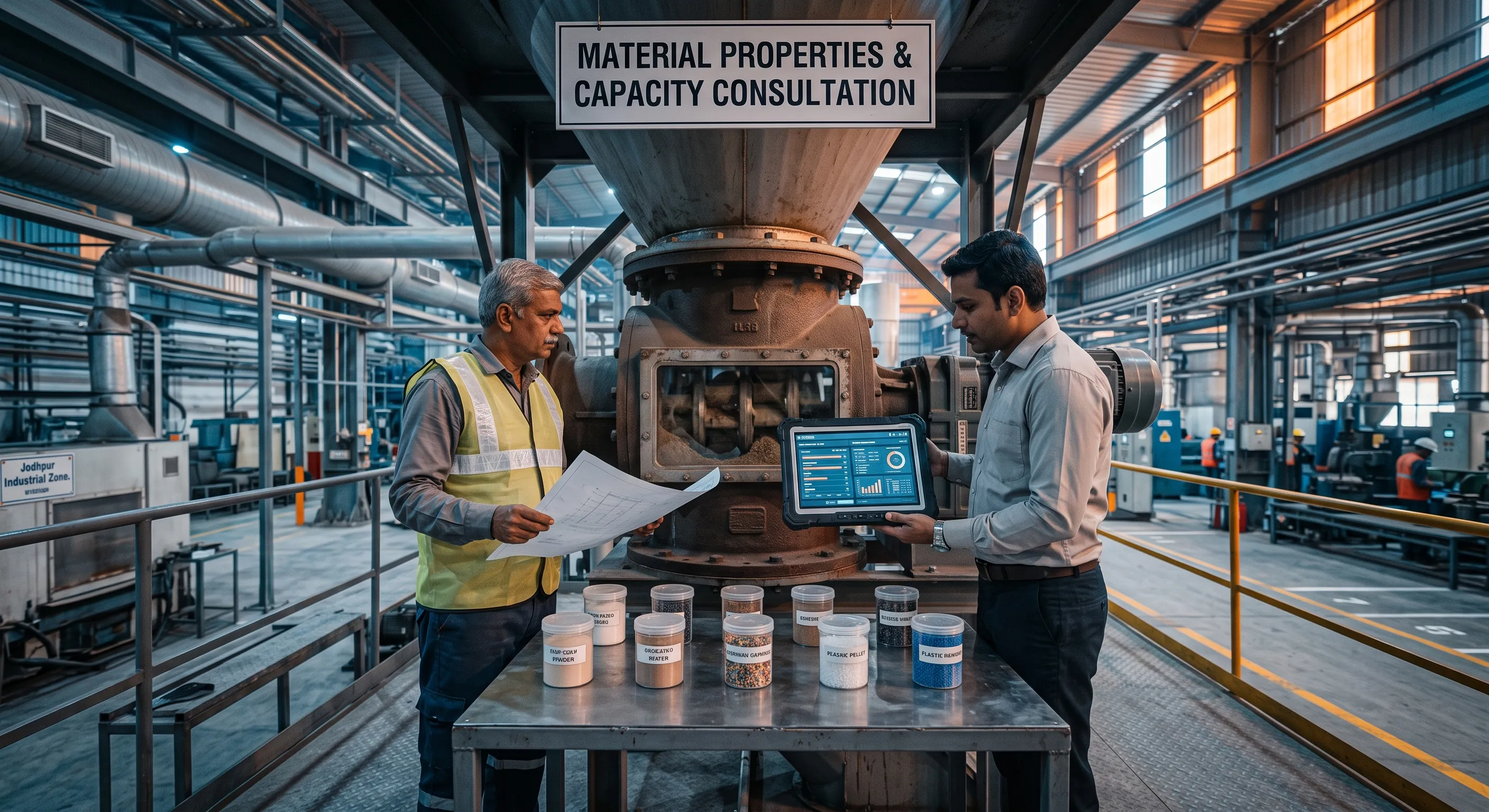
The first factor to evaluate is the material that the valve will handle. The material should be identified clearly rather than described only as dust or powder. Different materials behave differently during storage and discharge. Cement dust, wood particles, metal residues, plastic powder, grain products, mineral fines, chemical powders, ash, and other bulk solids can have very different flow characteristics. The material description should include its physical properties and any hazards associated with handling it. This information provides the foundation for choosing the appropriate rotor, housing, seals, clearances, and construction materials.
Bulk density is an important consideration because it affects the amount of material carried by each rotor pocket and the mechanical load placed on the drive system. A lightweight powder may occupy a relatively large volume while producing a lower mass flow, whereas a dense material can create a much higher mass flow at the same volumetric displacement. The required capacity should therefore be expressed in practical operating units and related to the material's bulk density. This allows the valve size and rotor volume to be evaluated more accurately.
Particle size distribution also affects valve selection. Fine powders can behave differently from larger granules or coarse particles. Very fine material may require closer attention to internal leakage and sealing, while larger particles can influence pocket filling and mechanical clearance. If the material contains a mixture of fine and coarse particles, the complete particle-size distribution should be considered rather than selecting the valve based only on the average particle size.
Flowability is another major factor. Some powders flow freely under gravity, while others can bridge, compact, cling to surfaces, or form stable deposits. Poorly flowing material may not fill rotor pockets consistently. This can reduce the actual throughput compared with the theoretical displacement of the valve. Hopper design, material conditioning, vibration, and inlet geometry may therefore need to be considered along with the rotary valve itself.
Moisture content can have a significant effect on flow behavior. A dry powder may discharge easily, while the same material at a higher moisture level may become sticky or form lumps. Moisture can also increase corrosion risk and create deposits inside the housing. If the material's moisture content changes during production, the valve should be selected for the expected operating range rather than for ideal dry conditions.
Material temperature must also be established. Some applications handle material close to ambient temperature, while others involve solids that remain hot after thermal processing. Temperature affects seals, bearings, lubricants, rotor materials, housing expansion, and other components. The normal operating temperature and maximum possible temperature should both be identified before selecting the valve.
Temperature cycling is also important. A valve exposed to repeated heating and cooling may experience expansion and contraction that influence internal clearances. A design that works under constant temperature conditions may require different considerations when the equipment starts cold and reaches a high operating temperature during production. Startup and shutdown conditions should therefore be included in the specification.
Abrasiveness should be evaluated carefully. Materials containing hard particles can wear rotor surfaces, housing walls, end plates, and other components. If the valve will handle abrasive material continuously, standard construction may not provide the required service life. Wear-resistant rotor surfaces, protective liners, replaceable wear components, or stronger construction may be appropriate depending on the application.
The expected wear rate should also be considered when estimating maintenance intervals. A valve operating with mildly abrasive material may require occasional inspection, while highly abrasive material can cause significant wear over a shorter period. Selecting suitable wear protection can reduce maintenance frequency and help maintain consistent clearances.
Corrosiveness is another important material property. Certain chemical powders, salts, fertilizers, acidic residues, alkaline materials, and process vapors can attack metal surfaces. The valve housing, rotor, shaft, fasteners, seals, and other exposed components should be selected according to the actual chemical environment. Stainless steel or other corrosion-resistant construction may be appropriate for some applications, while protective coatings or specialized materials may be suitable for others.
The required throughput should be established before choosing the valve size. The system should define the normal material flow rate and the maximum expected rate. Designing only for the average production rate can create problems if the process frequently reaches higher output. On the other hand, excessive oversizing can increase equipment cost and may reduce the efficiency of material filling and transfer under certain conditions.
Rotor pocket volume directly influences volumetric capacity. Larger rotors generally provide greater displacement per revolution, while smaller rotors are suitable for lower material flow requirements. The actual capacity depends on rotor geometry, number of pockets, speed, material fill percentage, and flowability. Therefore, theoretical displacement should not be treated as identical to actual production capacity.
Rotor speed is another selection factor. Increasing speed can increase volumetric transfer, but it can also influence wear, noise, power consumption, and pocket-filling behavior. The appropriate speed range depends on the material and valve design. Variable-speed drives may be useful where production demand changes, while fixed-speed drives can be practical for stable processes.
The duty cycle should also be established. A valve used for occasional discharge experiences different operating conditions from one running continuously for several shifts every day. Continuous operation places greater demands on bearings, seals, gearbox components, rotor surfaces, and housing construction. The equipment should therefore be selected according to the actual operating hours and expected service life.
Pressure difference across the valve is one of the most important technical parameters. A rotary valve installed below a dust collector may operate under relatively low pressure conditions, while one feeding a pneumatic conveying line may experience a much greater pressure differential. Higher pressure differences can increase air leakage through rotor clearances and place greater demands on sealing and mechanical construction.
The pressure should be specified for both normal and maximum operating conditions. Short-duration pressure changes may also occur during process transitions, equipment startup, or shutdown. The valve should be capable of handling the expected pressure range without excessive leakage or mechanical stress.
Air leakage requirements should be considered separately from material capacity. In a dust collection system, unwanted air entering through the rotary valve can affect the pressure balance and extraction performance. In pneumatic conveying, air leakage can influence conveying efficiency and system stability. Internal rotor clearance, end clearance, shaft sealing, housing geometry, and pressure conditions all contribute to the overall leakage behavior.
Internal clearance must therefore be selected carefully. Very large clearance can increase leakage, while extremely tight clearance can create operational problems if the material contains larger particles or if thermal expansion occurs. The correct clearance depends on temperature, material characteristics, rotor size, manufacturing accuracy, and pressure conditions.
Shaft sealing is another important consideration. Material can potentially escape through the shaft area if the sealing arrangement is unsuitable or poorly maintained. The correct seal type depends on temperature, dust characteristics, shaft speed, pressure, and maintenance requirements. Seal access should also be considered because regular inspection or replacement may be necessary during the equipment's service life.
Bearing selection is closely connected to the operating conditions. Bearings must support the rotor while handling the expected loads and operating temperature. In demanding applications, bearing arrangement and protection from dust contamination become especially important. Proper bearing placement can also simplify maintenance and help protect critical components.
The drive system should be selected according to the rotor size, material load, operating speed, starting conditions, and duty cycle. A motor and gearbox that are adequate for a light powder may not be suitable for a dense or heavy material. Starting torque can be particularly important when material remains inside the valve during startup.
Gearbox selection should also consider the required output speed and torque. The drive should operate within its rated conditions rather than being continuously pushed beyond its intended capacity. Proper drive sizing helps prevent overheating, excessive wear, and unexpected shutdowns.
The inlet arrangement should be evaluated with the upstream hopper or collector outlet. The material should enter the rotor pockets consistently. Poor alignment or restricted inlet geometry can reduce filling efficiency and cause uneven material flow. Hopper angle, outlet dimensions, bridging behavior, and material flow characteristics should therefore be considered together.
The downstream connection is equally important. The valve may discharge into a collection bin, screw conveyor, pneumatic conveying line, bucket elevator, conveyor, or another process stage. The outlet configuration should suit the receiving equipment and provide enough space for the discharged material to leave the rotor without creating unnecessary restriction.
If the valve feeds a pneumatic conveying system, the conveying pressure and transport capacity must be considered together with the rotary valve. The valve must supply the required material quantity without creating unacceptable air leakage. The conveying line diameter, air velocity, material loading, and pressure conditions can influence the required valve capacity.
Installation orientation can also affect performance. Vertical drop-through arrangements are common in dust collection applications, but other orientations may be required because of equipment layout or conveying requirements. The valve should be installed in the orientation for which its internal design and material flow path are intended.
Available space should be measured before selecting the final valve. The physical dimensions include more than the housing itself. Space may be needed for the motor, gearbox, guards, inspection covers, shaft access, electrical connections, and maintenance work. A valve that fits physically may still be difficult to service if adequate clearance is not provided.
Maintenance access should therefore be part of the original design. Operators and technicians may need to inspect seals, bearings, rotor surfaces, fasteners, and internal clearances. If access is difficult, routine inspection can be delayed. Practical maintenance access supports more consistent long-term operation.
The expected maintenance environment also matters. If the valve is installed in a dusty area, external components should be protected appropriately. If the system is outdoors, weather exposure should be considered. Rain, humidity, temperature changes, and dust can affect motors, bearings, seals, and electrical components.
Cleaning requirements should be established where the material must be changed frequently. Processes handling different products may require regular internal cleaning to prevent cross-contamination. In food, pharmaceutical, or sensitive chemical applications, cleanability can become a major selection factor. The valve design should provide suitable access and construction for the required cleaning method.
Safety requirements should also influence the selection. Certain materials may be combustible, toxic, reactive, or otherwise hazardous. The rotary valve may form part of a larger dust-handling or material-isolation system, but its role should be evaluated within the complete process risk assessment. Application-specific protective measures, equipment ratings, isolation arrangements, and operating procedures may be required depending on the material and process.
For combustible dust applications, the dust characteristics and potential fire or explosion hazards should be assessed before equipment selection. A rotary valve should not automatically be treated as an explosion-protection device simply because it separates material between two process sections. The required safety function must be defined and engineered according to the complete installation and applicable requirements.
Controls and monitoring can also be valuable. A valve may be integrated with the plant control system so that rotor speed, motor status, overload conditions, or other operating parameters can be monitored. In variable-speed applications, the control system can adjust material discharge according to production demand. Suitable monitoring can also help operators identify abnormal conditions before they become major equipment problems.
Future capacity should be considered when selecting the valve. Production requirements can increase over time, and a system operating near its maximum capacity today may become restrictive later. Reasonable future expansion can be included in the design, but excessive oversizing should be avoided because it can increase capital cost without providing practical benefits.
Spare parts availability should also be evaluated. Rotor components, seals, bearings, drive parts, fasteners, and other wear items may eventually require replacement. A valve supported by readily available service components can reduce downtime. The supplier should be able to provide suitable replacement parts and technical information for maintenance.
Supplier engineering capability is another important consideration. A rotary valve is most effective when its design is matched to the actual process. The supplier should understand material characteristics, capacity requirements, pressure conditions, temperature, installation configuration, and maintenance expectations. Providing accurate process information allows the equipment to be specified more reliably.
Technical documentation can also support long-term operation. Installation drawings, operating information, maintenance instructions, recommended spare parts, and technical specifications can help plant personnel operate and service the equipment correctly. These details become particularly useful when the valve is integrated into a larger dust collection or material-handling system.
Total cost of ownership should be considered rather than focusing only on the purchase price. A low-cost valve may require frequent replacement if it is not suitable for the material. High leakage can increase system energy requirements. Excessive wear can create repeated maintenance costs. A properly selected valve may therefore provide better long-term operating value even when its initial cost is higher.
The complete process should be reviewed before the final specification is approved. Material properties, capacity, pressure, temperature, wear, corrosion, sealing, drive requirements, installation conditions, safety considerations, maintenance, controls, spare parts, and future production should all be considered together. This prevents one specification from being optimized while another important requirement is overlooked.
A Rotary Airlock Valve should ultimately be chosen according to the complete operating conditions of the material-handling system. Material properties determine the required construction and rotor design, while throughput determines the appropriate pocket volume and operating speed. Pressure difference affects clearances and sealing, while temperature influences materials, bearings, seals, and thermal expansion. Abrasiveness and corrosion can determine the need for specialized construction, while the upstream hopper and downstream equipment influence the inlet and outlet arrangement. Installation space, maintenance access, drive capacity, controls, safety requirements, spare-parts availability, and future production should also be included in the evaluation. When these factors are reviewed together, the selected valve is more likely to provide consistent material transfer, controlled air leakage, reliable service, and practical integration with the complete industrial system.
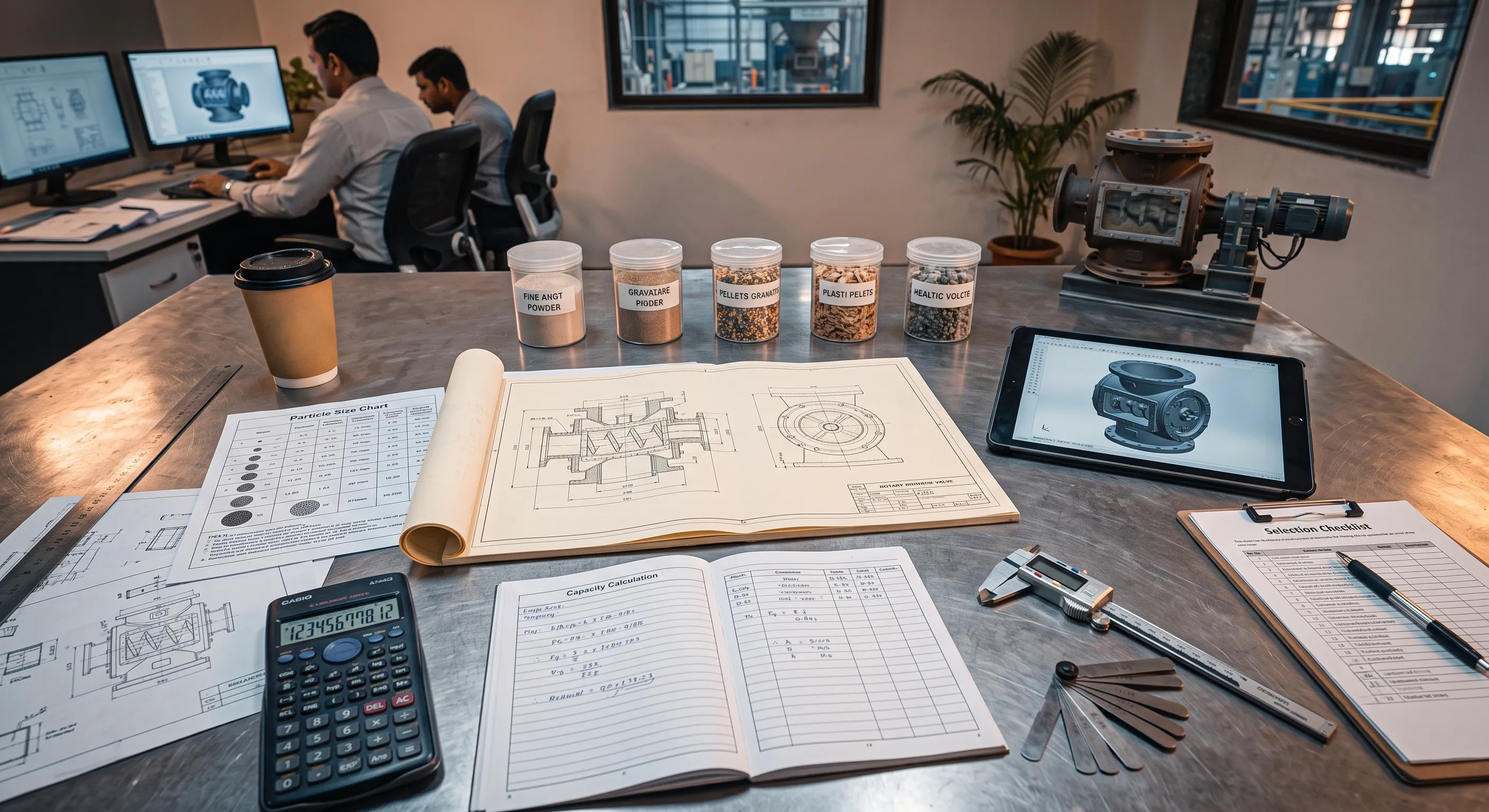
Conclusion
Choosing a rotary airlock valve should begin with a clear understanding of the material and the process in which the equipment will operate. The valve needs to match the physical properties of the material as well as the mechanical and environmental conditions of the installation.
Material type, bulk density, particle size, flowability, moisture, temperature, abrasiveness, and corrosion potential influence the construction and internal design. These properties help determine the appropriate rotor configuration, housing material, clearances, sealing arrangement, and wear protection.
Capacity is another major consideration. The required normal and maximum material flow should be established before selecting the valve size. Rotor pocket volume and speed should then be matched to the required throughput without creating unnecessary mechanical loading or excessive operating speed.
Pressure difference must also be evaluated carefully. Dust collection systems and pneumatic conveying systems can impose different pressure conditions. The valve should therefore be selected according to the actual pressure range and the required level of air leakage control.
The drive system must match the rotor size, material load, operating speed, and duty cycle. Motor and gearbox selection should account for starting conditions as well as continuous operation.
Installation and maintenance requirements should not be overlooked. The valve needs sufficient space for inspection, cleaning, seal replacement, bearing service, and drive maintenance. Connections with the upstream and downstream equipment should also support smooth material movement.
Safety requirements depend on the material and process. Combustible, toxic, reactive, or corrosive materials may require additional engineering measures. The rotary valve should be evaluated as part of the complete system rather than treated as an independent safety solution.
Controls and monitoring can provide additional operational information, particularly where variable-speed operation or continuous production is involved. Monitoring motor status, operating conditions, and other relevant parameters can help identify developing problems.
Future production should also be considered. A valve selected close to its maximum operating capacity may become restrictive if production increases. At the same time, excessive oversizing can add unnecessary cost. The design should therefore provide a practical balance between present requirements and realistic future needs.
Finally, supplier support and total cost of ownership should be included in the decision. Spare-parts availability, technical documentation, maintenance requirements, energy consumption, wear rate, and expected service life can all influence the long-term performance of the equipment.
The right selection is therefore based on the complete application rather than one specification alone. When material characteristics, capacity, pressure, temperature, construction, sealing, drive requirements, installation conditions, safety, maintenance, and future production are evaluated together, the rotary valve can operate more reliably and integrate effectively with the overall industrial process.