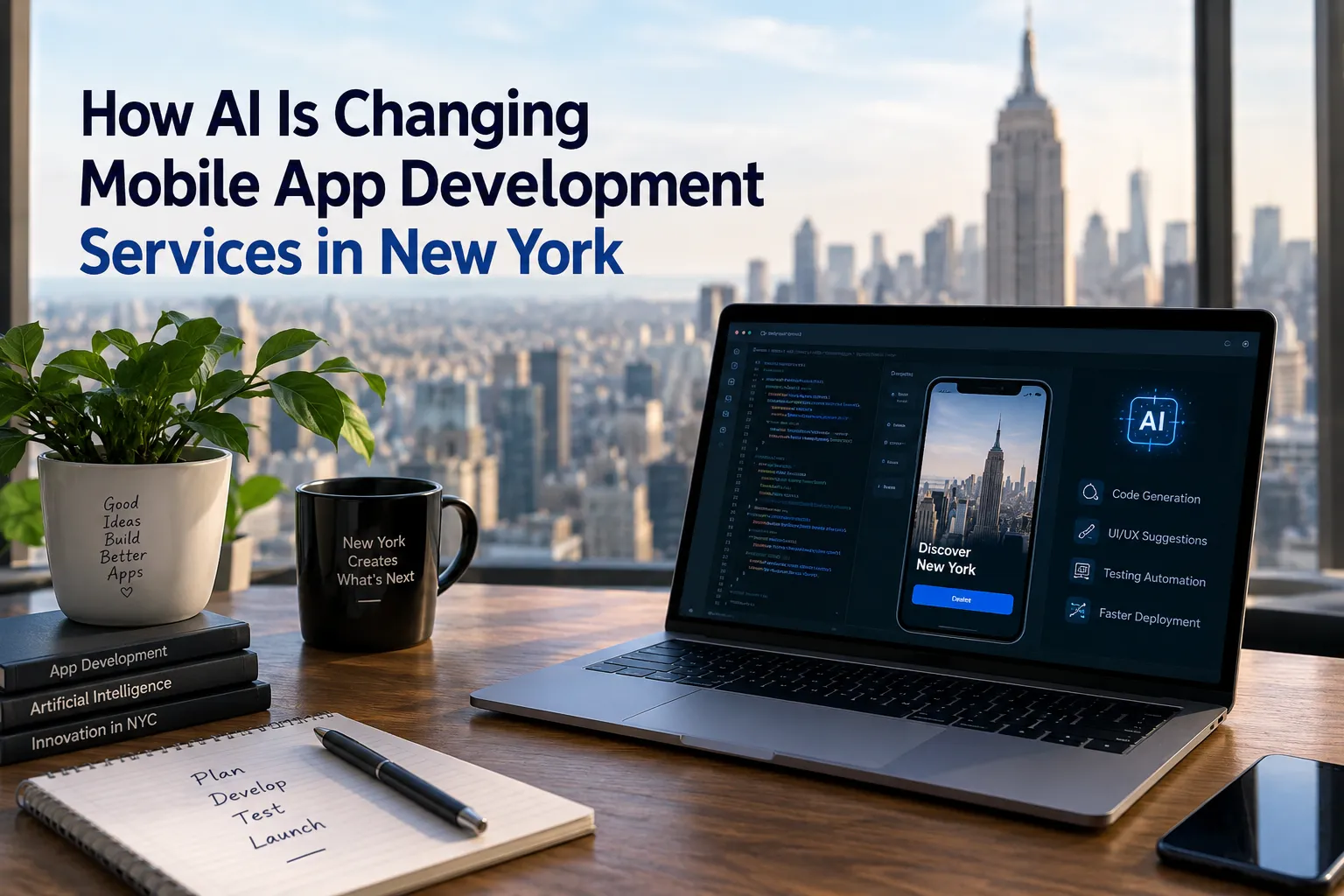
Sit in on a product meeting in Manhattan these days and AI comes up before you've even finished your coffee. It's stopped being a buzzword — it's just how teams now think about features, budgets, and timelines.
New York's tech world has never moved slowly, but something feels different about 2026. Machine learning isn't an add-on anymore; it's woven into how apps get designed, tested, and pushed out from the very first sprint.
That's a big part of why so many founders and product leads are re-evaluating what they actually want from Mobile App Development Services in New York. The expectations have shifted, and teams still working the old way are starting to notice it — slower releases, apps that feel a step behind.
This article digs into what's genuinely changing, why it matters regardless of company size, and how to make good decisions here without getting swept up in the hype.
Key Takeaways
-
AI is touching nearly every stage of app development now, from the earliest design sketches to what happens months after launch.
-
Personalization, predictive features, and automated QA have gone from optional extras to baseline expectations.
-
Picking the right development partner matters more than it used to, since a rushed AI implementation tends to cause more headaches than it solves.
-
New York businesses have a real edge here — deep technical talent and a market that rewards moving fast.
-
Long-term wins come from getting the strategy right first. The technology part is almost secondary.
Why This Is Happening Right Now
Not long ago, slapping "AI-powered" onto a pitch deck was mostly a marketing move. These days, users actually expect the app to learn from how they behave and adjust on its own.
Compare how people interact with apps now versus five years back. Recommendation feeds, voice search, chat-based support — none of that reads as novel anymore. It's just what's expected.
For businesses leaning on mobile app development services in New York, this has quietly redefined what "good" even means. It's no longer just clean design and a stable build — it's whether the app actually adapts to the person using it.
That's a genuinely harder problem than most people assume going in, and it's exactly where a lot of teams get stuck.
The Challenges Nobody Mentions Upfront
AI integration sounds simple right up until you're the one implementing it. The real friction tends to show up in spots founders don't see coming.
Data quality trips people up first. A model is only as good as what it's trained on, and most businesses don't have clean, well-structured data just sitting around ready to use.
Cost and timeline overruns come next. Adding predictive features or natural language processing isn't a drop-in plugin — it usually means reworking parts of the architecture, and that eats more time and budget than teams expect going in.
Talent shortage rounds out the list. Developers who can genuinely work across both mobile engineering and applied machine learning are still hard to find, even in a market as deep as New York's.
None of this is an argument against using AI. It's an argument for planning it out properly instead of tacking it on at the last minute.
Where AI Is Genuinely Moving the Needle
Worth getting specific here, since "AI in apps" can mean a dozen different things depending on who you ask.
Sharper personalization. Apps are getting better at adjusting content, suggestions, and even layout based on how one specific user behaves, not some generic average profile.
Predictive monitoring. Instead of waiting on a crash report, AI-driven monitoring can catch performance issues before users even notice something's off.
Automated testing. AI tools can now blitz through thousands of test scenarios faster than any manual QA team ever could, catching edge cases that used to slip past everyone.
Conversational interfaces. Chatbots and voice assistants have gotten noticeably sharper at reading context, which cuts down on the frustrating back-and-forth users used to put up with.
Faster build cycles. AI-assisted coding tools are shrinking the time between an idea and a working prototype, which counts for a lot in a competitive market like New York's.
Teams reaching out for mobile app development services in New York are increasingly asking for these features from day one, rather than treating them as a later-phase upgrade.
Actually Picking the Right Approach
This is where plenty of businesses get overwhelmed. Not every app needs every AI capability, and trying to grab all of them at once usually backfires badly.
Start with the actual problem you're solving. A retail app trying to cut down cart abandonment needs a different AI setup than a healthcare app trying to catch anomalies in patient records.
From there, a handful of practical habits tend to separate the projects that make it from the ones that stall out halfway.
-
Audit your existing data before you commit to anything. If it's messy or incomplete, fix that first — no algorithm makes up for bad inputs.
-
Focus on one or two AI features, not five. Depth wins over breadth, especially for a first release.
-
Ask potential partners for actual examples, not just claims. A team that's genuinely shipped AI features should have specifics ready to show you.
-
Plan for ongoing tuning, not a one-and-done build. AI features need monitoring and adjustment well past launch day.
-
Keep the front end simple even when the backend gets complicated. The best AI work is often invisible — users just notice things working better.
Organizations that stick to this kind of disciplined process tend to avoid the trap of shipping flashy features nobody actually uses.
What This Means Specifically for New York Businesses
New York carries a real advantage here worth pointing out. The city's mix of finance, media, healthcare, and retail means developers are constantly solving AI problems across wildly different industries, which builds a kind of hands-on expertise that's tough to replicate elsewhere.
That concentration also means quicker feedback loops. A fintech startup in Manhattan can get a working prototype in front of real users within weeks rather than months, mostly because the talent and infrastructure are already sitting right there.
For any business exploring an App Development Company in New York, weighing what a Mobile Application Development Company New York team can offer, or evaluating a Custom Mobile App Development New York partner, this local concentration of expertise is a real advantage, not just a nice-to-have.
It's also worth noting AI adoption isn't just an enterprise thing anymore. Small and mid-sized businesses are increasingly baking AI-driven features into their very first release instead of bolting them on years down the road.
Habits Worth Adopting Right Now
A handful of habits separate teams getting real value from AI from teams just adding complexity for no real payoff.
Keep a human in the loop for anything touching sensitive decisions — AI should back up judgment, not replace it outright, especially in healthcare or financial settings.
Test with real users early, and often. AI features can act unpredictably around edge cases that only surface once actual people start poking at the app.
Write down what the AI is actually doing. Partly for your own team's sanity, partly for regulatory reasons if you're in a regulated space.
Budget for ongoing iteration, not just the launch. AI models drift as user behavior shifts, and the apps that stay useful are the ones built with that in mind.
Ready to Build Something Smarter?
If your app still feels stuck in 2022 while competitors are rolling out AI-driven features every quarter, that gap won't close on its own.
The businesses pulling ahead aren't necessarily the ones with the deepest pockets. They're the ones working with teams that genuinely understand both mobile engineering and applied AI, not just one half of that equation.
Esferasoft Solutions has built its reputation on exactly that combination — solid engineering fundamentals paired with real AI expertise, and a track record of apps that keep getting better well after launch instead of stalling out. If you want to see what that looks like for your own project, contact us and let's figure out what actually makes sense for where your business stands today.
Frequently Asked Questions
1. How is AI genuinely different from the automation already built into older apps?
Older automation ran on fixed rules — if X happens, do Y. AI-driven features adjust based on patterns in real user behavior, so the app keeps getting better instead of staying frozen after launch.
2. Do small businesses actually need AI features, or is this really just for big enterprises?
Small businesses often gain more from it, since AI-driven personalization can help a smaller app go toe-to-toe with bigger competitors on user experience without needing a huge marketing budget behind it.
3. How long does adding AI features to an existing app usually take?
It varies a lot, but most meaningful integrations run anywhere from six weeks to several months, depending on how ready the data is and how many features get added at once.
4. What's the most common mistake businesses make when adding AI to their apps?
Trying to cram in too many AI features at once, often before the underlying data is even clean enough to support them. Starting narrow and expanding gradually tends to work far better.
5. Does AI integration cost noticeably more than a standard app build?
It usually adds cost upfront, mostly from data prep and testing, but well-built AI features tend to pay for themselves over time through better retention and lower support overhead.
6. How do I know if my business needs a custom AI solution instead of an off-the-shelf tool?
If your workflows or user patterns are fairly unusual, custom development tends to outperform generic tools, which are typically built around average use cases rather than your specific one.
7. Which industries in New York are adopting AI-driven apps fastest?
Fintech, healthcare, retail, and logistics are leading the pack right now, mostly because these industries have clear, measurable problems — fraud detection, patient monitoring, inventory forecasting — where AI produces quick, visible results.
8. Can an older app be upgraded with AI features, or does it need a full rebuild?
Most of the time it can be upgraded incrementally, especially if the existing architecture is reasonably current. A full rebuild is really only necessary when the underlying codebase is outdated or poorly structured to begin with.