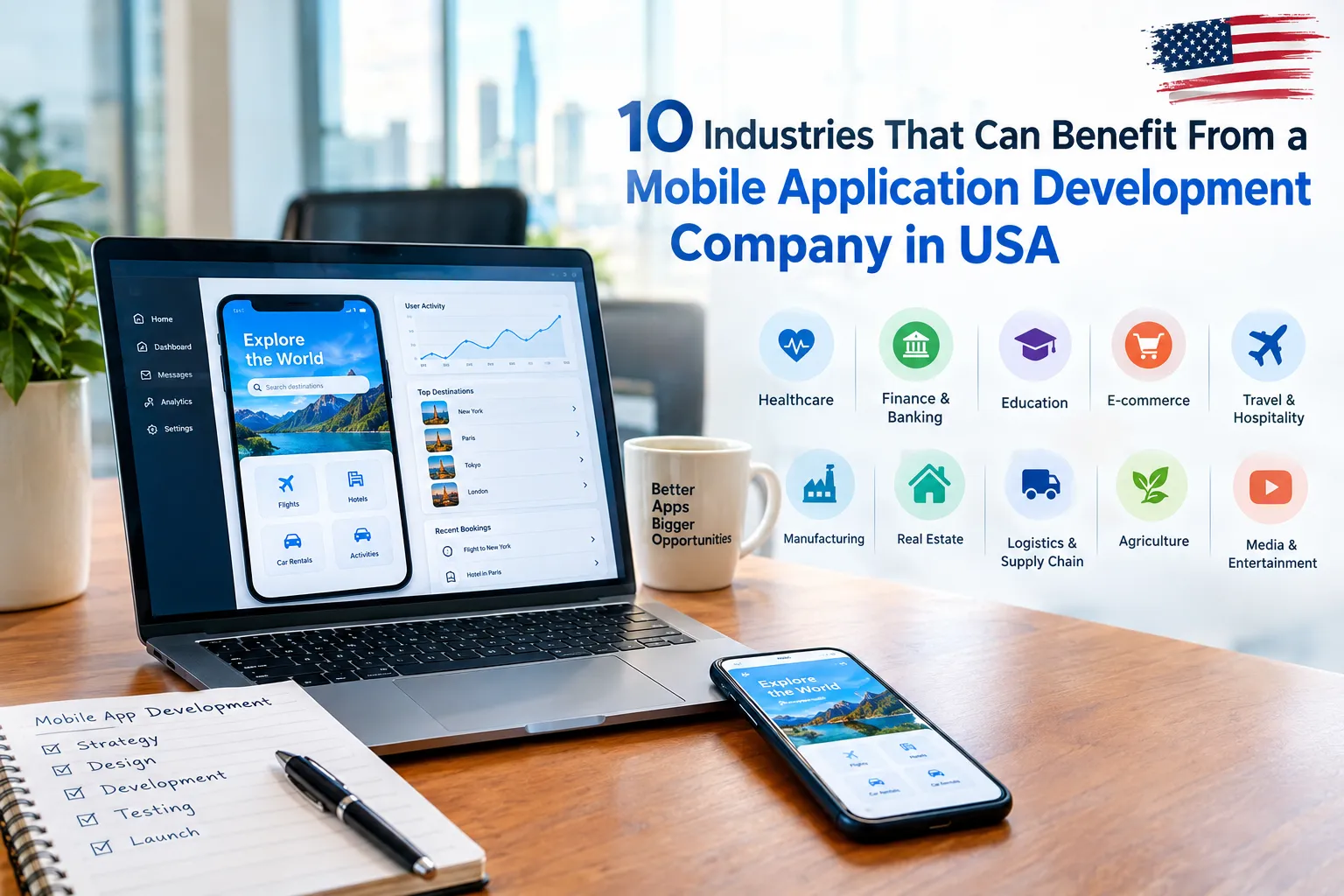
Nobody thinks twice about opening an app anymore. Order food, check a bank balance, book a doctor's visit — it all happens through a screen in your pocket, and businesses that haven't caught up are starting to feel it.
2026 has pushed this even further. AI personalization, voice-first search, super-apps that do five things at once — users expect all of it now, no matter what industry they're dealing with. That's part of why so many companies are teaming up with a mobile application development company in USA rather than trying to figure it out solo.
This post walks through ten industries where a solid mobile strategy is making a real difference right now, plus what to actually look for before you commit to building anything.
Key Takeaways
-
Mobile apps have shifted from "nice extra" to core business infrastructure across most industries.
-
Working with an experienced partner cuts down on expensive mistakes and guesswork.
-
Security, scalability, and genuine usability matter more than flashy feature lists.
-
In-house vs. outsourced comes down to budget, timeline, and who's maintaining it later.
-
Apps built around clear goals outperform apps built just to "have an app."
The Bar Has Moved — And It's Not Moving Back
A basic app used to be enough. Now people compare everything to Amazon or Uber, whether they're booking a hotel room or scheduling a dental cleaning.
That comparison isn't fair, exactly, but it's reality. Speed, design, and how smooth the whole experience feels — that's the new baseline everywhere.
It's a big reason companies are turning to a mobile application development company in USA instead of building blind. Teams that specialize in this know the compliance rules, the integrations, and the quirks of user behavior in each sector — things you'd otherwise learn the hard way.
Here's where the returns are showing up most.
1. Healthcare
Telehealth and remote monitoring aren't "innovative" anymore — patients just expect them. What's harder is getting it right: HIPAA compliance, secure records, EHR integration. This is not a space for cutting corners.
2. Retail and E-commerce
Most online shopping now happens on phones. AR try-ons, one-tap checkout, recommendations that actually feel relevant — these aren't bonus features anymore, they're table stakes. Retailers dragging their feet are watching carts get abandoned to competitors with smoother checkouts.
3. Logistics and Supply Chain
Real-time tracking and route optimization used to be enterprise-only tools. Now even mid-sized logistics operations run on custom dashboards and GPS-integrated apps, cutting delays that used to just be accepted as normal.
4. Education
Hybrid learning stuck around, and so did the tools that support it — gamified assessments, parent-teacher messaging, attendance tracking. Schools going mobile-first are seeing better engagement, and honestly, it makes sense — students already live on their phones.
5. Finance and Fintech
Banking apps, budgeting tools, peer-to-peer payments — this is probably the least forgiving space out there. Security has to be airtight, and the UX still has to feel effortless. Getting both right at once is genuinely hard, which is exactly why it matters who builds it.
6. Real Estate
Virtual tours and instant agent chat have changed how people house-hunt. Buyers scroll listings the same way they scroll Instagram — fast, visual, and gone if it's clunky.
7. Hospitality and Travel
Contactless check-in, personalized itineraries, real-time updates — travel apps have basically turned into concierge services. Guests expect the app to think ahead for them.
8. Food and Beverage
Ordering apps and loyalty programs directly affect whether someone comes back. Even small independent restaurants are investing in their own apps now, mostly to stop losing margin to third-party delivery platforms.
9. Manufacturing
IoT-connected apps that flag equipment issues before they become expensive problems — this is one of the quieter wins in mobile development, but it adds up fast in reduced downtime.
10. Professional Services and B2B
Law firms and consultancies are using apps for secure document sharing and client portals. It's not flashy, but it builds trust — and clients notice when things run smoothly.
Where Businesses Get Stuck
A few things come up again and again when companies hesitate:
-
Not knowing what a project should actually cost or take
-
Native vs. hybrid vs. cross-platform — and which one fits their situation
-
Compliance and data security concerns
-
Who handles updates and maintenance once it's live
This is usually where a custom mobile app development company in usa earns its value — building around your actual workflow instead of forcing you into a template that mostly fits.
What Actually Matters When Choosing a Partner
Before signing anything, it's worth checking a few things:
Have they built in your industry before? Relevant experience saves time — they've already made the early mistakes elsewhere.
What happens after launch? Apps need patches, updates, OS compatibility checks. A team that disappears post-launch is a problem waiting to happen.
Can it grow with you? Rebuilding from scratch six months in is expensive and avoidable with the right planning upfront.
Is the pricing actually clear? Vague estimates turn into budget surprises almost every time.
A Few Things Worth Doing Right
If you're about to start (or restart) a mobile project, a few habits go a long way:
-
Define the actual problem before listing features you want.
-
Test the experience early — don't wait until the end to find out something's clunky.
-
Build in analytics from day one so you're not guessing later.
-
Plan for ongoing updates, not one big "final" launch.
-
Pick a partner that communicates clearly and doesn't go quiet mid-project.
None of this is industry-specific, really. It applies whether you're running a hospital system or a five-location restaurant chain.
Thinking About Building Something? Here's Where to Start
If your business fits into any of the industries above, there's a good chance your competitors already have an app — or are building one. That gap gets harder to close the longer it's ignored.
What usually makes the difference isn't the technology itself, but the team behind it — people who actually understand your industry's problems, not just app development in general.
That's where Esferasoft Solutions has built a reputation, pairing technical skill with real industry knowledge so the apps they build actually solve problems instead of just looking good in a pitch deck. It's the kind of steady, innovation-driven approach people look for when comparing options for the best mobile application development company in USA. If you're ready to talk specifics, contact us and let's map out what your project actually needs.
Frequently Asked Questions
1. How do I know if my business really needs a custom app?
If customers are regularly interacting with you online — scheduling, tracking orders, managing accounts — a custom app usually beats trying to force all of that through a website.
2. Freelancer or full development company — what's the real difference?
Freelancers can be fine for something small and simple. But once you need QA testing, project management, and support that doesn't vanish after launch, a full team is usually the safer bet.
3. How long does building an app typically take these days?
For something mid-complexity, plan on roughly 3 to 6 months once you factor in design, development, testing, and the inevitable round of revisions.
4. Native or cross-platform — which should I pick?
Native tends to perform better for complex, feature-heavy apps. Cross-platform saves time and money for simpler builds. It really comes down to what you're trying to do and what you're working with budget-wise.
5. What's a realistic budget for mobile app development in the US?
It swings a lot depending on complexity — simple apps might run in the tens of thousands, while enterprise-level builds with heavy integrations cost considerably more.
6. Which industries are seeing the biggest returns from mobile apps right now?
Healthcare, retail, logistics, education, and finance are leading the pack, mostly driven by customers expecting faster, more convenient access to everything.
7. Does post-launch support actually matter that much?
Yes — more than people expect. Security patches, OS updates, performance tweaks — skip these and user retention drops fast.
8. What should I actually look for in a mobile application development company in USA?
Real industry experience, pricing that's upfront rather than vague, solid post-launch support, and a portfolio of apps that are actually live and working — not just polished mockups.