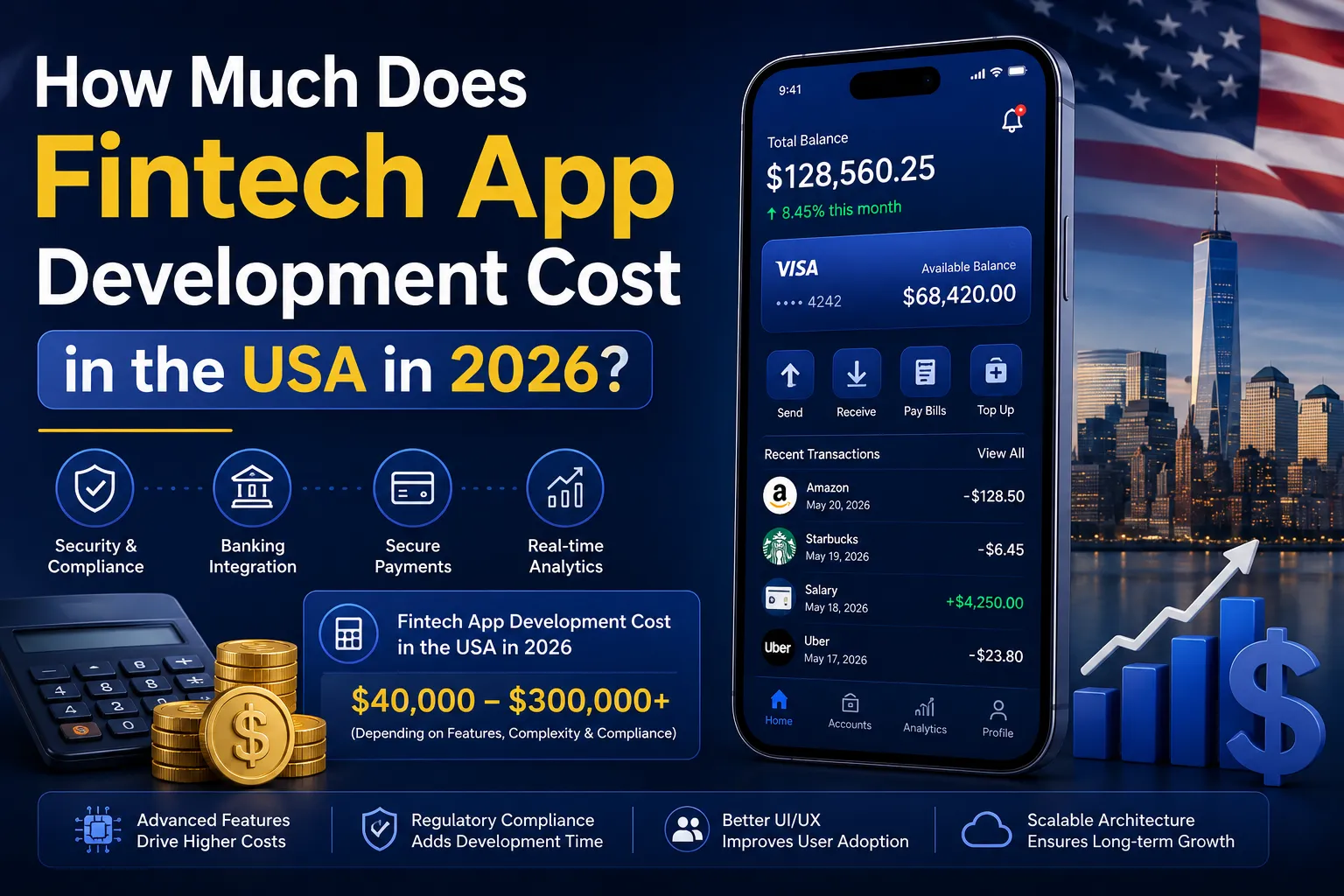
The US remains the largest fintech market in the world, and the appetite for digital-first banking, payments, and lending products hasn't slowed down. But before founders, banks, or SMEs commit to a build, they run into the same question: what does a fintech app actually cost in the USA in 2026? The honest answer depends heavily on compliance scope, feature complexity, and where your development team sits — and this guide breaks down exactly how.
Direct Answer: What Does a Fintech App Cost in the USA?
In 2026, fintech app development cost USA businesses pay typically ranges from $30,000–$70,000 for a lean MVP, $70,000–$200,000 for a mid-complexity app, and $250,000–$600,000+ for an enterprise-grade or heavily regulated platform, depending on compliance scope and integrations.
Did you know? According to Federal Reserve Financial Services, U.S. consumers made an average of 11 mobile-phone payments per month in 2024 — nearly three times the 4 monthly payments recorded in 2018 — a clear sign of how fast mobile-first financial habits are growing.
Why Fintech App Development Costs Vary So Much in the USA
A fintech app isn't priced like a typical consumer app. It carries legal, security, and infrastructure requirements that shape the budget from the ground up.
1. App Complexity and Feature Set
A single-purpose budgeting or savings app costs a fraction of what a full digital bank or lending platform costs. Every added workflow — transfers, credit scoring, investment tools — adds engineering time.
2. Regulatory and Compliance Requirements
US fintech apps typically need to account for state money transmitter licensing, KYC/AML checks (FinCEN), PCI-DSS for card data, SOC 2 audits, and, depending on the product, SEC or FINRA oversight for investment features. Compliance work commonly adds 20–40% to the total build.
3. Security Architecture
Encryption, tokenization, biometric authentication, fraud detection, and regular penetration testing are non-negotiable for apps handling money — and none of it is cheap to build correctly the first time.
4. Platform Choice
Native iOS and Android development (built separately) costs more than a shared cross-platform codebase, though native apps often perform better for latency-sensitive banking features.
5. Third-Party Integrations
Payment processors, banking-as-a-service providers, credit bureaus, identity verification vendors, and core banking rails all bring licensing fees and integration overhead.
6. Team Location
US-based teams in major tech hubs charge premium hourly rates, while nearshore or offshore teams cost less but require careful vetting for fintech compliance experience. This is one of the biggest cost levers in any budget.
7. Post-Launch Support
Security patching, compliance monitoring, and infrastructure scaling are recurring costs. A fintech app is never really "done" at launch.
Fintech App Development Cost USA: Breakdown by Project Type
|
Project Type |
Typical Cost Range (USD) |
Timeline |
Best Suited For |
|---|---|---|---|
|
MVP / Proof of Concept |
$30,000 – $70,000 |
3–5 months |
Startups validating a core idea before raising or scaling |
|
Mid-Complexity App (payments, budgeting, lending features) |
$70,000 – $200,000 |
5–9 months |
SMEs and growing fintechs adding core financial functionality |
|
Enterprise / Regulated Platform (digital banking, investing, insurtech) |
$250,000 – $600,000+ |
9–18 months |
Banks, licensed fintechs, and large-scale product launches |
Figures reflect 2026 US market benchmarks and exclude ongoing infrastructure and compliance costs. Actual pricing depends on scope, licensing needs, and chosen technology partner.
Cost by Core Feature
|
Feature |
Estimated Cost Impact |
|---|---|
|
User onboarding + KYC/AML verification |
Moderate–High |
|
Payment gateway / banking-as-a-service integration |
Moderate |
|
Biometric authentication & encryption |
Moderate |
|
AI-driven fraud detection |
High |
|
Real-time transaction tracking |
Moderate |
|
Multi-state licensing support |
High |
|
Admin dashboard & reporting |
Low–Moderate |
|
Investment/brokerage features (SEC/FINRA scope) |
High |
Not every feature needs to ship on day one. A tightly scoped, compliant MVP validates demand far more efficiently than building the full feature set upfront.
Security, Compliance, and the "Hidden" Costs
The line items that don't show up in an initial development quote are often the ones that matter most:
-
State money transmitter licensing — can vary significantly depending on how many states you operate in
-
Security audits and penetration testing — usually required before launch and on a recurring basis
-
Cloud infrastructure and hosting — ongoing, usage-based costs (AWS, Azure, or GCP)
-
Legal and regulatory advisory fees — separate from the development contract
-
Post-launch maintenance — typically 15–20% of the original build cost annually
Budgeting for these from the start is what separates a realistic fintech plan from one that runs out of money mid-build.
Fintech App Development Timeline in the USA
|
Stage |
Duration |
|---|---|
|
Discovery & compliance planning |
3–5 weeks |
|
UI/UX design |
4–6 weeks |
|
MVP development |
10–18 weeks |
|
Testing, security audit & QA |
3–6 weeks |
|
Launch & post-launch support |
Ongoing |
Skipping or rushing the discovery and compliance phase is the single biggest reason fintech timelines and budgets slip in the US market, where regulatory scope can shift by state.
Common Mistakes to Avoid
-
Treating compliance as an afterthought instead of designing the architecture around it from day one.
-
Choosing a vendor purely on the lowest quote, without checking fintech-specific delivery experience.
-
Building every feature before validating the core product, instead of starting with a focused MVP.
-
Underestimating multi-state licensing complexity if the app operates nationally.
-
Skipping a post-launch support plan, leaving security and compliance updates unmanaged after launch.
Choosing the Right Fintech App Development Company in the USA
A low quote rarely holds up once compliance and security requirements are fully scoped. When evaluating a fintech app development company USA, look for:
-
Direct experience with US financial regulations (FinCEN, PCI-DSS, SOC 2, and state licensing where relevant)
-
Transparent, itemized quotes that separate design, development, compliance, and support
-
In-house security expertise rather than compliance work outsourced at the last stage
-
Clear post-launch SLAs instead of a one-time handoff
At Esferasoft Solutions, fintech projects start with compliance and security architecture before any screen is designed, so the estimate given upfront reflects what the product actually needs to launch and operate in the US market — whether that's a lean MVP or a fully regulated platform.
Key Takeaways
-
Fintech app development cost USA ranges from roughly $30,000 for a lean MVP to $600,000+ for an enterprise-grade platform.
-
Compliance and security (FinCEN, PCI-DSS, SOC 2, state licensing) typically add 20–40% to total build cost.
-
US mobile payment usage nearly tripled between 2018 and 2024, according to Federal Reserve data, underscoring steady demand for mobile-first financial products.
-
Budget for post-launch maintenance (roughly 15–20% of build cost annually) from the outset, not as an afterthought.
-
Vendor selection should weigh regulatory experience and transparency as heavily as price.
FAQs
1. What is the average cost of fintech app development in the USA?
Most fintech apps in the USA cost between $30,000 and $600,000+, depending on complexity, compliance scope, and whether it's an MVP or a full regulated platform.
2. How much does a fintech MVP cost in the USA?
Fintech MVP development USA projects typically cost $30,000–$70,000 and take 3–5 months, enough to validate the core product before scaling.
3. Why are fintech apps more expensive to build than regular apps in the USA?
Fintech apps require regulatory compliance (FinCEN, PCI-DSS, SOC 2, and often state licensing), advanced security architecture, and integrations with banking or payment infrastructure — requirements standard apps don't carry.
4. How long does it take to build a fintech app in the USA?
A focused MVP typically takes 3–5 months, while a fully regulated, enterprise-grade platform can take 9–18 months depending on licensing scope and feature complexity.
5. Do fintech apps need ongoing costs after launch in the USA?
Yes. Plan for roughly 15–20% of the original development cost per year for maintenance, security updates, compliance monitoring, and infrastructure scaling.