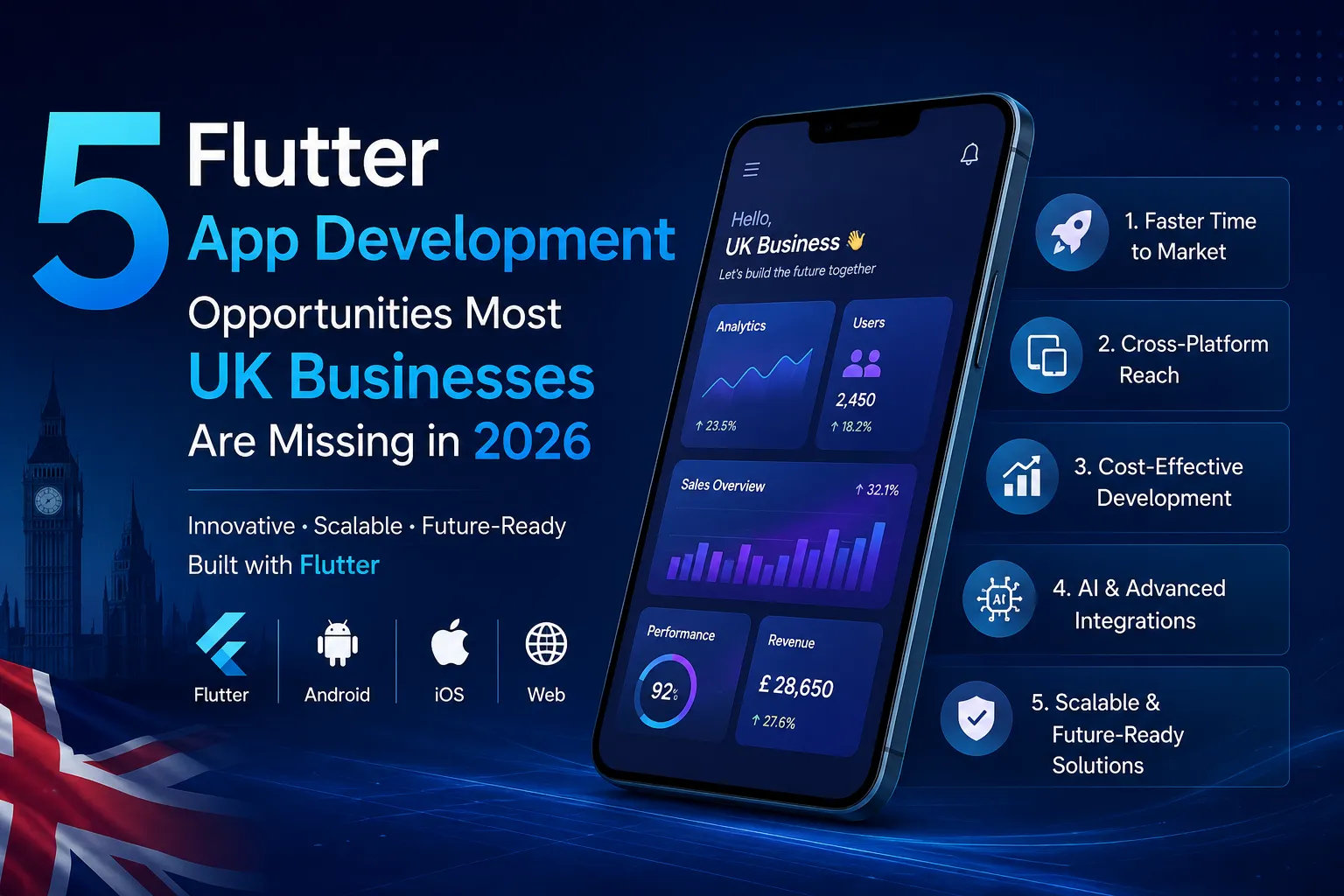
Most UK business owners still treat app development as a choice between "expensive native" and "cheap but limited" cross-platform tools. That thinking is outdated. Flutter, Google's open-source UI toolkit, has quietly become one of the most capable ways for small businesses, startups, and enterprises alike to build fast, good-looking, multi-platform apps from a single codebase — and a lot of UK companies haven't caught up to what it can now do.
In short: Flutter lets UK businesses build one codebase that runs natively on iOS, Android, web, and desktop, cutting development time and cost while enabling AI features, offline-first performance, and enterprise-grade security — making it a strong fit for SMEs, startups, and regulated industries alike.
Did You Know?
According to Stack Overflow's developer survey data reported by Statista, Flutter is used by roughly 46% of cross-platform mobile developers worldwide — more than any other framework, including React Native. That popularity isn't just a developer trend; it directly affects UK businesses, because a larger talent pool means faster hiring, lower day-rate inflation, and a healthier long-term maintenance outlook for any app built on it.
Key Takeaways
-
Flutter now supports six platforms (iOS, Android, web, Windows, macOS, Linux) from one codebase, which is a genuine opportunity for UK businesses planning omnichannel digital transformation.
-
SMEs and startups can typically cut app development costs by using Flutter app development services in the UK compared with maintaining two separate native codebases.
-
Regulated sectors — healthcare, fintech, and logistics — increasingly choose Flutter because of its consistent UI, strong security libraries, and faster compliance testing cycles.
-
AI integration (on-device ML, Gemini SDK support) is one of the biggest under-used opportunities for UK businesses in 2026.
-
The most common mistake isn't picking Flutter — it's picking the wrong Flutter app development company in the UK without checking their production track record.
Why Flutter Deserves a Second Look in 2026
A few years ago, cross-platform frameworks had a reputation for feeling "almost native" rather than actually native. Flutter has mostly closed that gap. Its Impeller rendering engine, now stable, renders UI directly rather than relying on native OS widgets, which is why Flutter apps tend to look and behave identically across an iPhone, a Samsung device, or a browser tab. For a UK business trying to launch quickly without sacrificing polish, that consistency is worth real money.
The opportunities below aren't theoretical. They reflect where cross-platform frameworks currently give UK businesses a genuine competitive edge — and where most companies still aren't paying attention.
5 Flutter App Opportunities Most UK Businesses Are Missing
1. One Codebase, Every Platform — Including Web and Desktop
Most UK businesses still think of Flutter purely as a mobile tool. In reality, a single Flutter codebase can now ship to iOS, Android, web, and desktop simultaneously. For a retail or logistics business that needs a customer-facing app, an internal staff tool, and a browser-based dashboard, this removes the need to brief and maintain three separate development teams. Companies exploring cross-platform app development in the UK alongside iOS app development often don't realise both can come from the same Flutter codebase, with platform-specific polish added where it matters.
2. Industry-Specific Compliance and Workflow Apps
Healthcare, fintech, and logistics businesses in the UK have specific regulatory and workflow demands — GDPR compliance, NHS data standards, PCI DSS, or real-time fleet tracking. Flutter's plugin ecosystem now covers most of these needs out of the box, from biometric authentication to encrypted local storage. Businesses building healthcare apps, fintech platforms, or logistics tools no longer need to accept slower native development purely for compliance reasons — Flutter can meet most of those bars while still shipping on one codebase.
3. AI and On-Device Machine Learning, Built In
This is the opportunity most UK SMEs are missing entirely. Flutter's Dart ecosystem now has first-class support for Google's Gemini SDK and mature TensorFlow Lite plugins, meaning features like on-device image recognition, text embedding, and conversational assistants can be built directly into a Flutter app rather than bolted on afterward. Retailers can add visual search; healthcare apps can add symptom triage chat; logistics apps can add predictive delivery ETAs. Businesses already exploring AI chatbot development or AI agent development can fold those capabilities straight into a Flutter app instead of running them as a separate integration.
4. Enterprise-Grade UI/UX Without Enterprise Timelines
Flutter's widget-based architecture makes it unusually well-suited to design systems — the kind of consistent branding, accessibility standards, and micro-interactions that used to take native teams months to align across iOS and Android separately. Businesses working with a UI/UX design team in the UK can prototype in Figma and hand off directly into Flutter widgets with far less translation loss than traditional native handoffs, shortening the gap between design sign-off and a shippable build.
5. Faster, Cheaper Market Entry for Startups and SMEs
For a startup or SME, the biggest missed opportunity is simply not knowing how much cheaper validation has become. A Flutter MVP can typically reach both app stores and a web preview from one build, letting founders test demand before committing native-level budgets. Sectors like ecommerce, grocery delivery, food delivery, and real estate have all seen Flutter-built products go from concept to public beta faster than comparable native builds, simply because there's one codebase to test, fix, and iterate on.
Flutter vs Native vs React Native: A Quick Comparison
|
Factor |
Flutter |
Native (Swift/Kotlin) |
React Native |
|---|---|---|---|
|
Codebase |
Single codebase for iOS, Android, web, desktop |
Separate codebase per platform |
Single codebase, some native modules needed |
|
UI consistency |
Pixel-perfect across platforms (own rendering engine) |
Fully native look per platform |
Relies on native components; can vary by platform |
|
Development speed |
Fast — one team, one build pipeline |
Slowest — two parallel teams |
Fast, but native bridging can slow complex features |
|
Best for |
SMEs, startups, multi-platform products, MVPs |
Apps needing deep OS-level integration (AR, heavy graphics) |
Teams with existing React/JavaScript expertise |
|
UK developer availability |
Large and growing talent pool |
Smaller, higher day-rate specialists |
Large JavaScript talent pool |
|
Typical cost impact |
Lower — one build, less QA duplication |
Higher — duplicate builds and testing |
Moderate — some native work still required |
Which UK Business Types Benefit Most From Flutter?
|
Business Type |
Primary Use Case |
Why Flutter Fits |
|---|---|---|
|
Healthcare & clinics |
Patient portals, telemedicine, appointment booking |
Consistent UI, GDPR-friendly local storage, faster compliance testing |
|
Fintech & lending |
Banking apps, payment tools, wealth dashboards |
Strong biometric and encryption plugin support |
|
Retail & eCommerce |
Shopping apps, loyalty programs, marketplaces |
Web + mobile from one codebase, fast catalogue updates |
|
Logistics & field services |
Delivery tracking, fleet management, dispatch tools |
Offline-first support, real-time GPS plugins |
|
Startups & SMEs |
MVPs, market validation, early-stage products |
Lower build cost, faster time-to-market |
|
Education |
LMS platforms, virtual classrooms, exam systems |
Reliable video and real-time sync plugins |
How to Evaluate If Flutter Is Right for Your Business
Before choosing a Flutter app development company in the UK, it helps to run through a short evaluation rather than assuming any framework is a universal fit.
-
Budget: Flutter usually reduces build cost versus separate native apps, but confirm the quote covers both platforms, QA, and post-launch support — not just development hours.
-
Scalability: Ask how the proposed architecture (state management, backend, API design) will hold up once your user base grows past the pilot stage.
-
Security: For fintech or healthcare apps, confirm the team has direct experience with UK/EU data handling requirements, not just general app security.
-
Integration: Check that the team has integrated Flutter apps with the specific systems you already run — CRM, ERP, payment gateways, or existing APIs.
-
Industry experience: A developer who has shipped apps in your sector will already know the workflow quirks that generic teams discover the hard way.
-
Post-launch support: Ask what ongoing maintenance, OS-update compatibility, and bug-fix turnaround looks like once the app is live.
Common Mistakes UK Businesses Make With Flutter Projects
-
Choosing a developer on price alone, without reviewing published apps or client references.
-
Skipping a discovery phase, which leads to scope changes mid-build and blown timelines.
-
Treating the MVP as the finished product, rather than budgeting for iteration after real user feedback.
-
Ignoring platform-specific polish, assuming "cross-platform" means zero platform-specific testing is needed.
-
Underestimating backend and API work, which is often a bigger cost driver than the Flutter front end itself.
Best Practices for a Smooth Flutter Implementation
-
Start with a clear discovery and scoping phase before any code is written.
-
Choose a state management approach (Provider, Riverpod, Bloc) early and stick with it consistently.
-
Build accessibility and localisation into the design system from day one, not as a later retrofit.
-
Set up CI/CD pipelines early so app store and web deployments aren't manual, error-prone steps.
-
Plan a maintenance and update cycle before launch, not after the first support ticket arrives.
FAQs
Is Flutter a good choice for a small UK business with a limited budget?
Yes, in most cases. Because Flutter builds from a single codebase, small businesses typically spend less on development and QA than they would maintaining separate iOS and Android native apps, while still reaching both platforms at launch.
Can Flutter apps meet UK data protection and industry compliance requirements?
Flutter itself doesn't guarantee compliance, but its plugin ecosystem supports the encryption, biometric authentication, and secure storage features needed to help healthcare, fintech, and other regulated apps meet GDPR and industry-specific standards when implemented correctly.
How long does it typically take to build a Flutter app?
Timelines vary by complexity, but a well-scoped MVP often takes a few months, while a full-featured, multi-platform product with backend integrations can take longer. The single-codebase approach usually shortens the timeline compared with parallel native development.
Does Flutter support AI features like chatbots or recommendation engines?
Yes. Flutter's Dart ecosystem has mature support for Google's Gemini SDK and TensorFlow Lite, making it possible to add conversational assistants, image recognition, and predictive features directly inside the app.
What's the difference between hiring Flutter developers directly and working with a development company?
Individual developers can suit very small, narrowly scoped projects, but a development company typically brings design, QA, backend, and project management together — which reduces the coordination burden on a business that doesn't have in-house technical leadership.